

Unravelling the Canon: Textile Exhibitions and the Limits of Institutional Imagination
Textile art has long told stories that slip between the threads of official histories — stories of care, survival, kinship, defiance, and memory. Across the exhibitions that display them, one truth is clear: textile artists are making extraordinary work. Their pieces carry stories, prayers, protests, and dreams. But our museums are not yet doing them justice. As a Mestizo curator, born and raised in Kuskatan (present-day El Salvador), I do not approach textiles as mere objects to be hung on sterile white walls or displayed inside glass cases. I approach them as living beings, often with names, obligations, and responsibilities. They are not flat. They are dimensional, relational, and full of force.
What follows is not simply a review of repeated curatorial practice regarding textile exhibitions in so-called Canada. It is a curatorial reckoning. An invitation to shift how we think about textiles and what they hold. I bring to this work the lens of IndigiQueer Mesoamerican museology: an embodied, relational, and land-based methodology rooted in diasporic return, community accountability, refusal of the centre, and ceremonial praxis.
Curation is not neutral. Display choices are not incidental. Community engagement is not a line item. These are the core ethics of the work. We must go beyond celebration to transformation. We must challenge our institutions to be braver, more responsive, more responsible. It is time to move from representation to relation, from tokenism to trust, from display to dialogue. It is time to honour the textiles not just as objects, but as living archives, ancestral technologies, and vessels of collective memory.
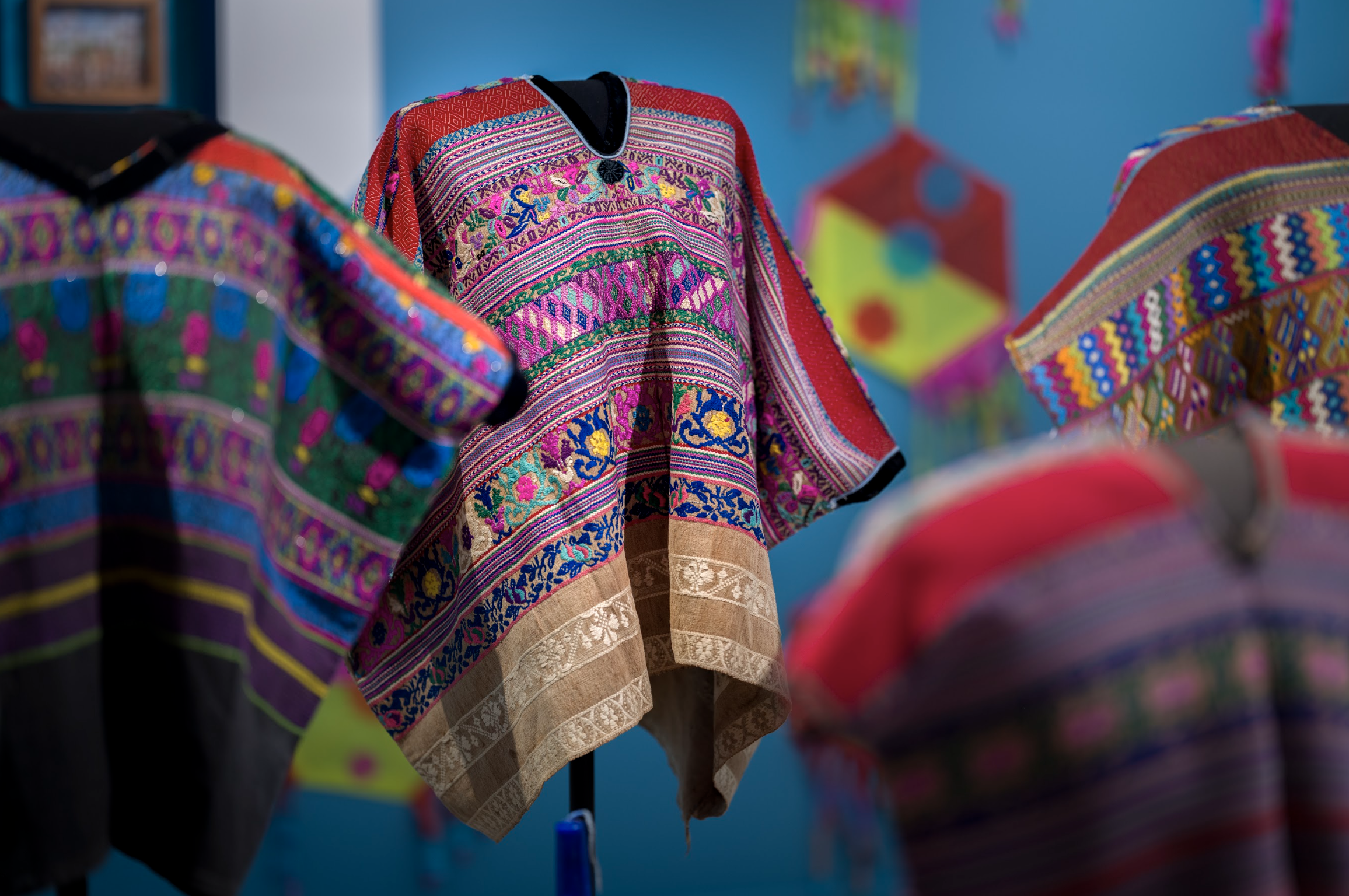
Installation view of 4 off the wall Kaqchikel huipiles from Comalapa (1950-1980). Their assigned role was to serve as storytelling and mnemonic activations contextualizing Rosa Elena Curruchich's life and work in Beyond the Vanishing Maya: Voices of a Land in Resistance at the Textile Museum of Canada, 2024. Photo: Darren Rigo.
For this text, I will centre four curatorial principles, amongst several others, that I use to guide my work with textiles:
1. Off the Wall – the power of placement and curating space
Curating textiles is never just about aesthetics. It’s about how placement either affirms or erases the lives, lands, and labours that live inside the weave. As a curator, I know that every wall choice, every selected height, every fold and wrinkle in a textile tells a story — of memory, of displacement, of ceremony, of resistance. This principle considers the politics of spatial choreography, the ways in which we must refuse institutional norms of display that flatten Indigenous and diasporic textiles into design objects, and instead embrace placements that honour them as relations.
2. Dialogue – community engagement and political resistance
Textiles don’t speak unless someone listens. In my curatorial work, dialogue is not metaphor — it’s a method. It’s the whispered testimony sewn into a hemline, the political demand embroidered across centuries of survival. Textiles activate conversation — between artists, ancestors, and audiences— and make exhibitions become sites of resistance when they are rooted in community. For me, curating means to be responsible for uplifting the stories that institutions silence. From oral history to visual protest, this is where thread becomes testimony, and the gallery becomes a gathering.
3. Joy as refusal – textiles as celebration and cultural survival
Joy is a refusal. A refusal to let grief be our only register. In every exhibition I’ve curated, I’ve sought out not just beauty but brilliance — the laughter behind the loom, the sass in a silk fringe, the ceremony hidden in sequins. Joy lives in textiles not as decoration, but as resistance. Through dance, fashion, performance, and unapologetic flair, we celebrate the power of textiles to affirm life, kinship, and culture. This is joy not as escapism, but as strategy and a proclamation of sovereignty.
4. Rebellion – textiles as blueprints for action
In Nahua and other Mesoamerican worldviews, the petlatl — the woven mat — is not just a domestic item but a symbol of power and governance. To sit upon the mat is to assume responsibility, to lead with care and reciprocity. Weaving is world-making. In this tradition, to unweave becomes a metaphor for resistance. Not a historical saying, but a contemporary gesture: to pull apart the patterns that uphold coloniality, to rethread our futures. Rebellion is not destruction — it is redesign. In every textile lies a call to act: to move from critique to commitment, from exhibition to assembly, from representation to transformation. This is the fourth principle — an opening toward change.
Taking these exhibitions as case studies, we are shown not only the evocative power of textile as medium, but also the limits of institutional curation. These exhibitions attempt to spotlight radical practices and politically charged textiles, yet too often fall back into extractive logics, flat design, or disconnection from the very communities these works emerge from. As a queer Mestizo curator and museum critic grounded in community-rooted practices, I engage these shows with both admiration for the artists and critical concern for the frameworks they are placed within. This review is an invitation to rethink how museums display, interpret, and co-create textile exhibitions — with responsibility, imagination, and relation.
This is not an impartial assessment. It is a situated critique by someone who has lived through museum violence, curated in community, and carried textiles across borders, both literal and symbolic.
The Archive of Absence at the McCord
At the McCord Stewart Museum, Costume Balls: Dressing Up History, 1870-1927 which ran from November 14, 2024, to August 17, 2025, is a visual marvel, bringing together more than 40 garments and photographs from Montréal’s elite masquerade history. The exhibition unfolds across three dramatically distinct sections.
As you enter the show, you are immediately taken back to a world of fantasy and elaborate display. Glass cases filled with exquisitely preserved costumes and archival materials from the McCord and other museum collections greet visitors with an air of theatricality. This first section situates the viewer historically, offering context about the social codes, materials, and themes of the time period. Through photographs, invitations, and garments, the setting reanimates a past full of pomp and performance.
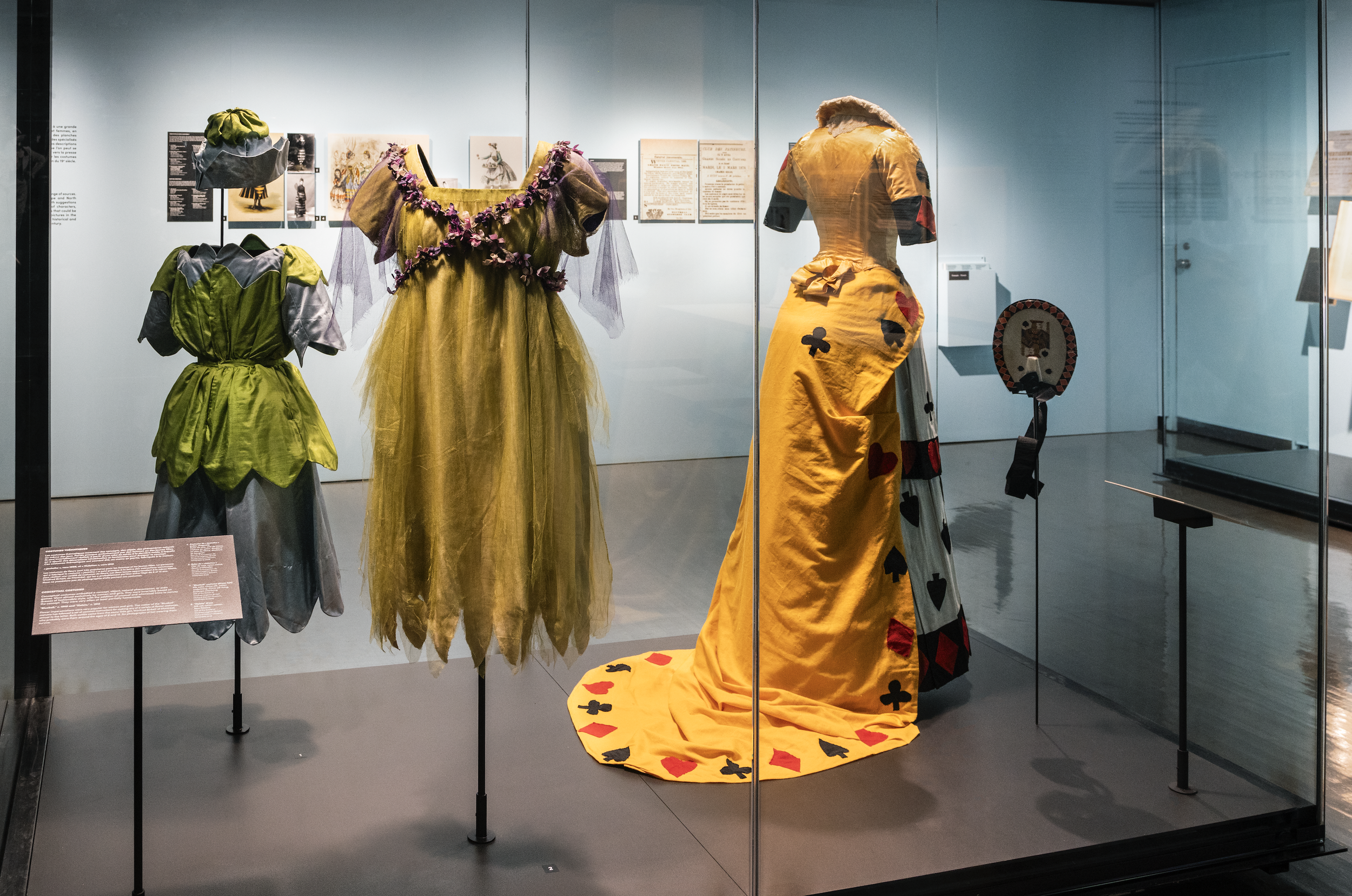
Dress worn by Alice Scott as "A deck of cards" in 1887 (right), and other costumes. Installation view of Costume Balls: Dressing Up History, 1870-1927 at the McCord Stewart Museum, 2024. Photo: Laura Dumitriu. © McCord Stewart Museum.
But as a curator, I know that exhibition design is not just aesthetic — it is a statement. Every choice — every wall, case, or spotlight — tells us who is centred and who is silenced. This first section, while immersive, orients us to a fantasy world that privileges elite white histories without interrogation. Here, Off the Wall becomes urgent: What stories are elevated, and whose garments get reverence?
The second part of the exhibition intensifies the mood. With black walls to add drama and dimly lit like a jewel box, the room glows with the elegance and colour of the ball costumes. Each piece seems to float in space, radiating luxury and historical presence. Here, the grandeur of the costume balls truly comes alive — you hear the music, imagine the dancing, and sense the immersive joy that these events offered the white elite of the time. It’s beautiful, immersive, and emotionally evocative.
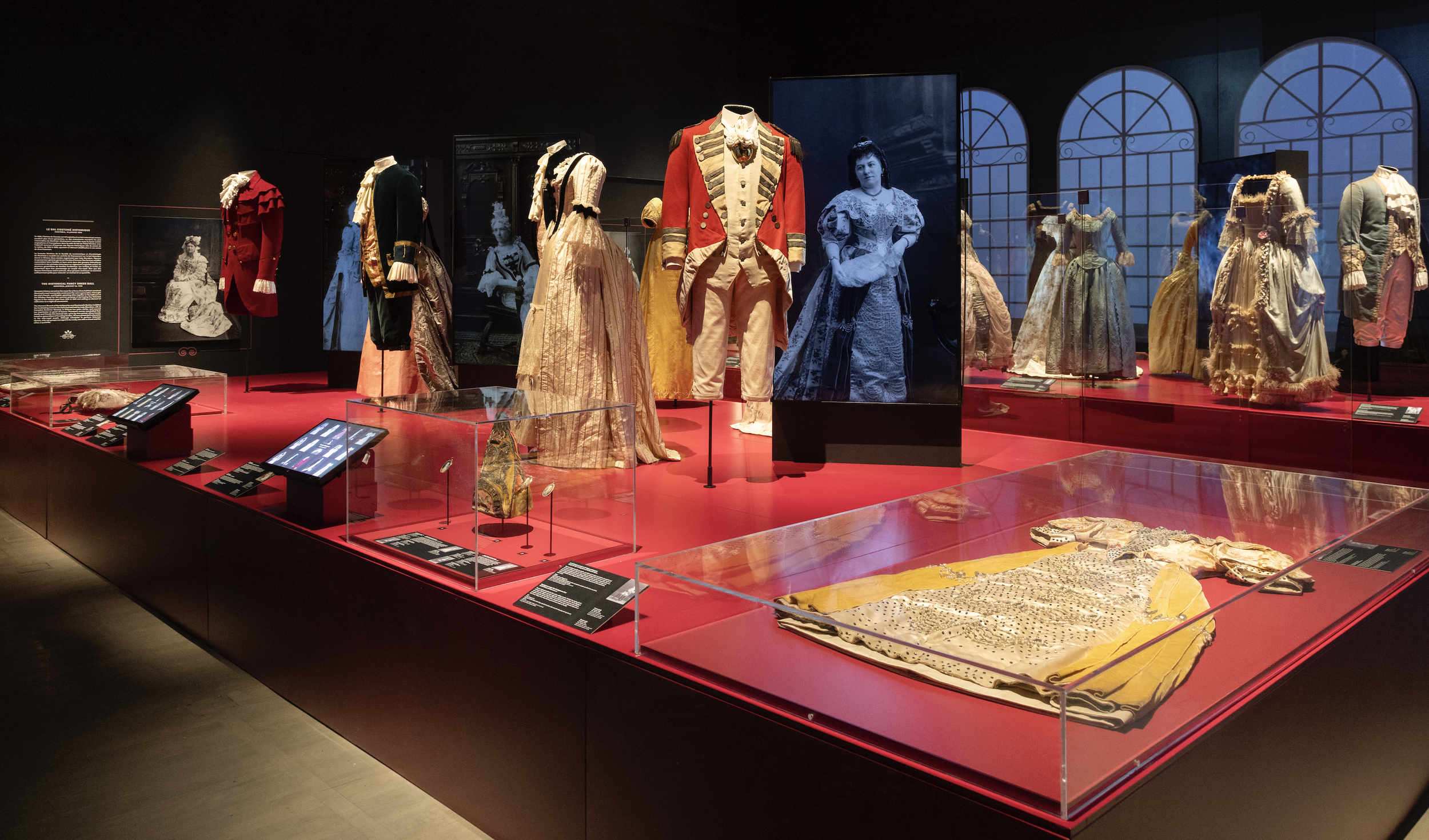
Mixed historically styled 18th century gowns and military dress as costumes. Installation view of Costume Balls: Dressing Up History, 1870-1927 at the McCord Stewart Museum, 2024. Photo: Laura Dumitriu. © McCord Stewart Museum.
This is where Joy appears — but in a limited register. The joy here is opulent, exclusive, and rooted in a colonial fantasy of beauty. And yet, joy is not the enemy. What’s missing is the multiplicity of joy — the kind that resists, the kind that refuses erasure. Where were the joy-filled gatherings of Indigenous, Black, and racialized communities during this period? Their absence in the curatorial framing is not a void — it’s an erasure of radical cultural survival.
The third and final section departs dramatically from this opulence. It moves into a space of solemn reflection — dedicated to the theft of Indigenous garments and the violence inflicted on communities when settlers wore them in mockery. Upon entering, visitors are confronted by floor-to-ceiling glass cases in the centre of the room, where the Cree garments are laid flat and dramatically lit. On the black walls surrounding the cases are larger-than-life photographs of the white individuals who wore these stolen belongings at costume balls to mock Indigenous peoples. The contrast between the reverent presentation of the objects and the looming images of this violent act is both jarring and powerful.
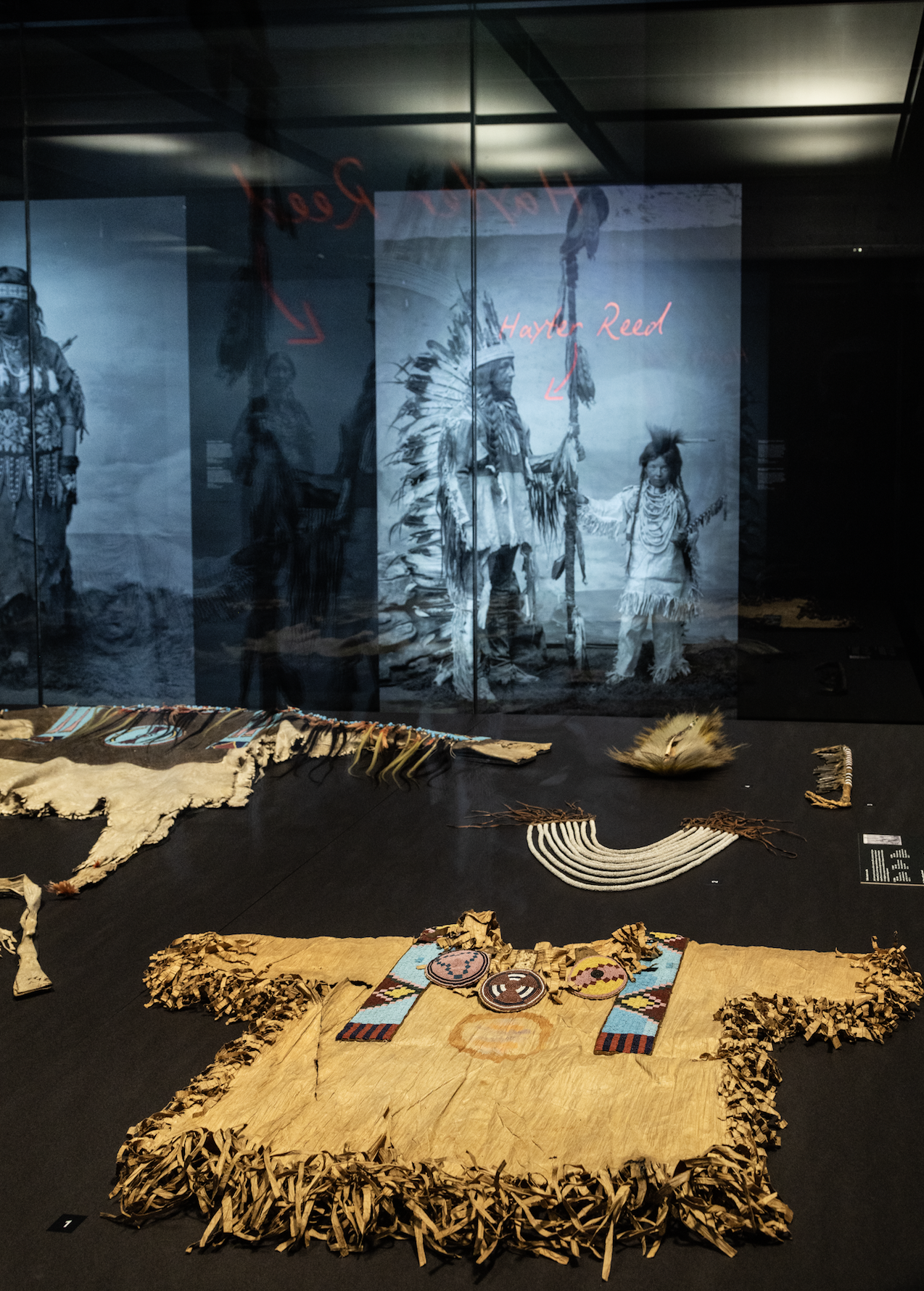
Historically themed racialized impersonation photographs, with clothing and accessories often being Indigenous made on display. Installation view of Costume Balls: Dressing Up History, 1870-1927 at the McCord Stewart Museum, 2024. Photo: Laura Dumitriu. © McCord Stewart Museum.
The design here is stripped down and dignified. The lighting is soft yet focused, creating an atmosphere of mourning and confrontation. The presence of Cree legal scholar Douglas Sanderson’s voice, narrating the story and offering lived context, adds gravity and clarity to this space. His account, rooted in community experience, does not merely illustrate the objects but restores their spiritual and familial weight. Sanderson’s narration provides an important corrective. His testimony grounds the narrative in lived knowledge and asserts Indigenous interpretive authority.
This is Dialogue in its most distilled form — a community voice breaking through the museum’s silence. And yet, it is isolated. Had the exhibition embedded Indigenous perspectives throughout — instead of reserving them for a single solemn section — the entire show could have told a fuller, more relational story. One that included both the violence of exclusion and the vibrancy of resistance. One that trusted Indigenous joy, critique, and brilliance from the start.
The exhibition’s spatial progression — fantasy, glamour, reckoning — is well-executed and emotionally affecting. However, it also reflects the limits of the curatorial framing. Despite the excellence in display and conservation, the narrative centres joy, creativity, and decadence exclusively within the realm of the white elite. The handful of stories about racialized communities are largely framed through the lens of how the white upper class used costumes to mock or violate them — flattening our presence into mere objects of ridicule or exploitation. The only Indigenous narrative included is that of the encased belongings in the third section. Though essential to acknowledge, this remains the sole story told about Indigenous people, and it is centred on theft, violence, and trauma.
There were valid conservation reasons for the display — the items needed to be laid flat. And I support the museum’s and its permanent Indigenous Advisory Committee’s decision not to display them on mannequins, which would have reproduced the very violence enacted at the historical ball. But where was the imagination? These garments could have been interpreted not only through the horror of their misuse, but through the brilliance of their creation — their makers’ stories, their techniques and science, their spiritual power. The layers of knowledge contained in the beading, the hide tanning, the fringe making, their intended use, the meaning of their designs, all absent. Where is the joy their makers experienced when making these garments and when they were worn and danced in by their rightful owners? Where was the acknowledgment of the Indigenous futurities these textiles point toward?
And where was the joy? We know Indigenous and racialized communities have long gathered in celebration and resistance. Where were the parallel dances, the drag balls, the joy-filled gatherings of Black and Brown life? Drag balls were thriving in Harlem during this very same period. Similar gatherings existed in Canada, too. Their absence here is not a gap in knowledge, but a failure of research and curatorial imagination.
Ultimately, Costume Balls is stunning in design and rich in archival insight. But its framing reinforces a familiar museological pattern: spectacle first, trauma second, relationship last. There is still much work to do. And this is where Rebellion comes into view. To unweave is to rebel. The textile, in its silenced brilliance, becomes a demand. A call for structural change in how institutions reckon with the histories they exhibit. What would it mean for this show to not only name harm but to catalyze repair? To go beyond representation and into transformation? Rebellion insists that we do more than critique. It asks us to act.
Woven Histories: Beauty Without Ethics?
At the National Gallery of Canada, Woven Histories: Textiles and Modern Abstraction, which ran from November 8, 2024, to March 2, 2025, should have been a landmark exhibition of textiles. And visually, it delivers. More than 130 works spanning continents and decades create a dense and diverse visual field. The physical space of the exhibition, spread across the Gallery’s contemporary wing, is spacious and open, allowing the artworks to breathe and assert themselves across wide, unencumbered sightlines. The architecture itself enhances this openness, giving a grandeur and clarity to the way one can experience the artworks. This spatial generosity works well in some cases — particularly in the display of baskets and sculptural pieces, where the layout is clean, effective, and respectful of form and texture.
But this same openness, anchored in white walls and crisp linearity, reveals a failure of imagination. Off the Wall means more than just visual breathing room. It is a commitment to disrupting the colonial choreography of white-cube exhibition design — a refusal to flatten Indigenous and diasporic textiles into mere painterly compositions. Textiles do not exist in isolation; they are inherently relational and meant to be activated, spoken to, in motion and in dialogue. This could have been supported through some of the programming — bringing the works into conversation with performers, storytellers, or community members who live with textile traditions. Textiles can — and often should — be taken off the wall, engaged with through movement, ritual, or voice. Here, the dominant whiteness of the walls heightens a sterile, detached atmosphere. Instead of feeling like a celebration of textile cultures, the show at times evokes the aesthetic of a medical gallery or an anthropology museum.
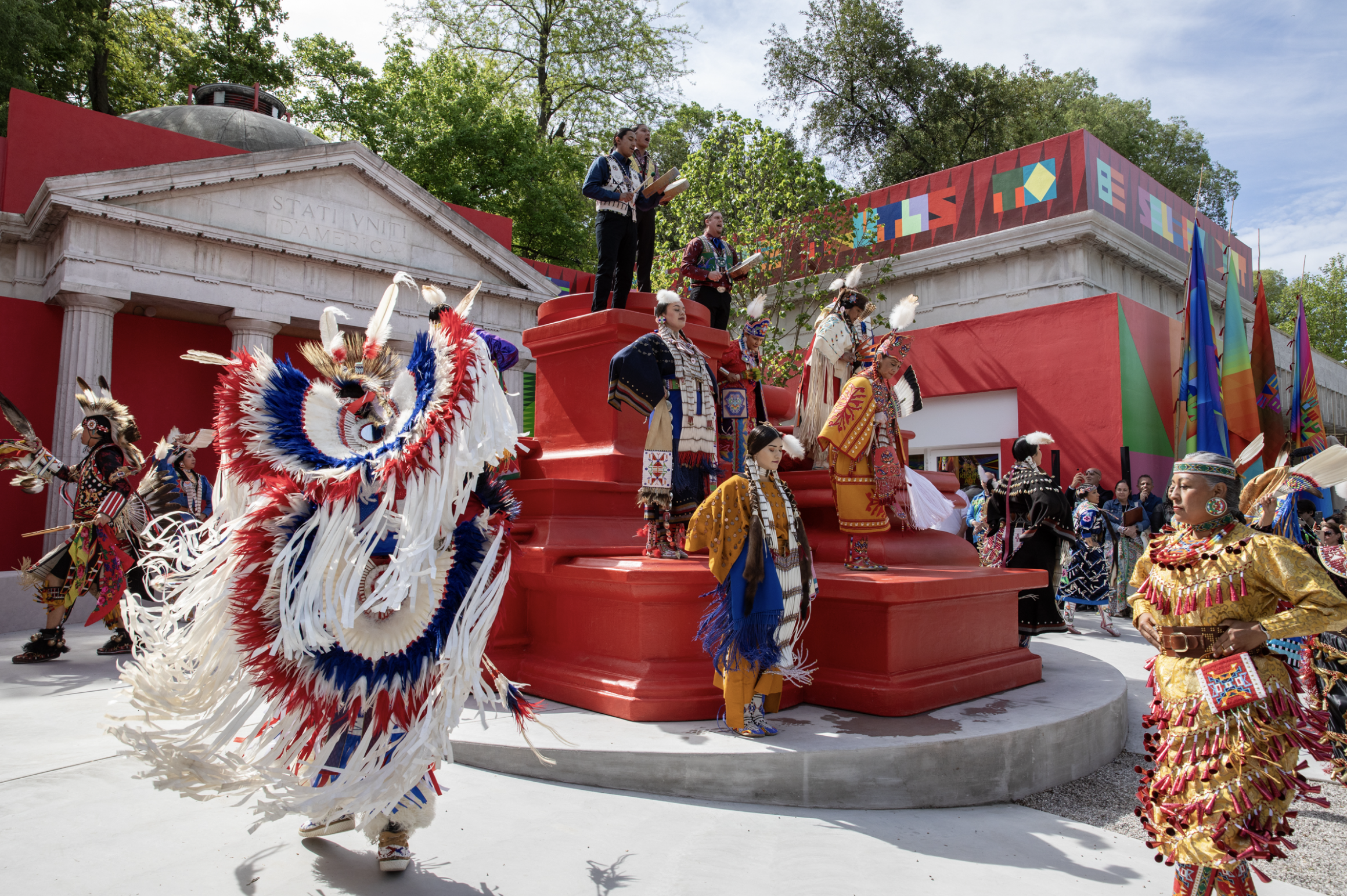
Members of the Oklahoma Fancy Dancers and Colorado Inter-Tribal Dancers activating the forecourt of the U.S. Pavilion for Jeffrey Gibson’s exhibition the space in which to place me. (Exhibition for the United States Pavilion, 60th International Art Exhibition – La Biennale di Venezia), 2024. Photo: Federica Carlet.
That feeling culminated in one particularly troubling moment: seeing Jeffrey Gibson’s masks — deeply charged with Indigenous cultural meaning — placed behind glass. The encasement immediately evoked the colonial legacy of museums as places that display looted Indigenous artifacts as trophies. In this moment, the exhibition slipped into the visual language of ethnographic display, despite being in an art museum. I couldn’t help but wonder if the use of display cases for Gibson’s work was a conservation or artist requirement. I recall seeing more of his masks at the Venice Biennale in 2024, and they were not enclosed in vitrines. A good approach to displaying Indigenous masks must centre respect, relationality, and community collaboration. It should emerge from the values, protocols, and worldviews of the Indigenous Nations to whom the masks belong. For instance, Maya artist-curator-ajq’ij Diego Ventura Puac-Coyoy performs a cleansing ceremony with candles before hanging masks on a gallery wall, as he did recently at the Textile Museum of Canada for the exhibition Beyond the Vanishing Maya — ceremonially preparing them for their presence in an exhibition space and removing any residual energy. That is curating as ceremony — not just presentation.
Installation view of Crucitas by Juan José Guillén, as part of a Maya ceremonial altar consecrated by Ajq'ij' and curator Diego Ventura Puac-Coyoy in the exhibition Beyond the Vanishing Maya, at the Textile Museum of Canada, 2024. Wood, paint, fabric, embossed tin, mixed media, 30.5 x 18 x 18 cm. Photo: Darren Rigo.
Upon entering Woven Histories, visitors are greeted with wall-mounted textiles presented as 2D visual works — flattened into the register of painting and abstraction. This immediately signals the exhibition’s intent: “to legitimize” textiles by fitting them into the historical canon of modern art. While this strategy is clear, it is also deeply problematic. Textile works are not inherently two-dimensional — they are tactile, time-based, and often ritualistic. Their reduction to wall-hung objects does not elevate them. It confines them.
The exhibition is divided into six thematic areas that feel overly indebted to the vocabulary of painting and sculpture. This thematic framework imposes a rigid order on a field that thrives in multiplicity and non-linearity.
The works on display, drawn from several international museums, public institutions, and private collections, are breathtaking. Many are stunning feats of materiality, vision, and technique. But the exhibition’s framing misses the mark. The curatorial choices further marginalize, often by showcasing pieces that themselves appropriate Indigenous forms without proper credit or context. While the show includes several Latin American artists, none are Indigenous. Andean quipu is represented — but by a white artist. Once again, Indigenous knowledge systems are aestheticized without the involvement of their stewards. This is not ethical curation. This is appropriation.
This approach directly contradicts the practices advocated by Elvira Espejo Ayca, the Aymara artist and former director of Bolivia’s National Museum of Ethnography and Folklore. At MUSEF, she helped lead efforts to build curatorial methodologies rooted in Indigenous weavers’ knowledge systems — where the process of weaving, the rhythms of life, and the ceremonial contexts are inseparable from the finished work. Textiles are often displayed showing their backs for the benefit of the weavers that visit the museum and visitors. That Canada’s national gallery — with all its resources and reach — ignored this methodology is not just a missed opportunity. It is a perpetuation of museological violence.
The racialized artists who are present appear in the final section, framed under the theme of “Community and the Politics of Identity.” This is a familiar gesture: racialized expression is permitted, even celebrated, so long as it stays in its box. So long as it does not challenge the universality of white abstraction and fine art hegemony. It’s the same curatorial segregation we’ve seen before, and it speaks volumes.
Dialogue requires community consultation not as an afterthought but as a foundation. It is about listening to the weavers, the makers, the knowledge holders. It is about staging exhibitions with communities, not about them. Woven Histories offered neither. What might have been? The National Gallery of Canada had the opportunity to commission a textile-based exhibition rooted in the communities who call these lands home. It could have partnered with Indigenous and racialized artists, with elders and weavers — communities that have long used textiles as acts of resistance, remembrance, and imagination.
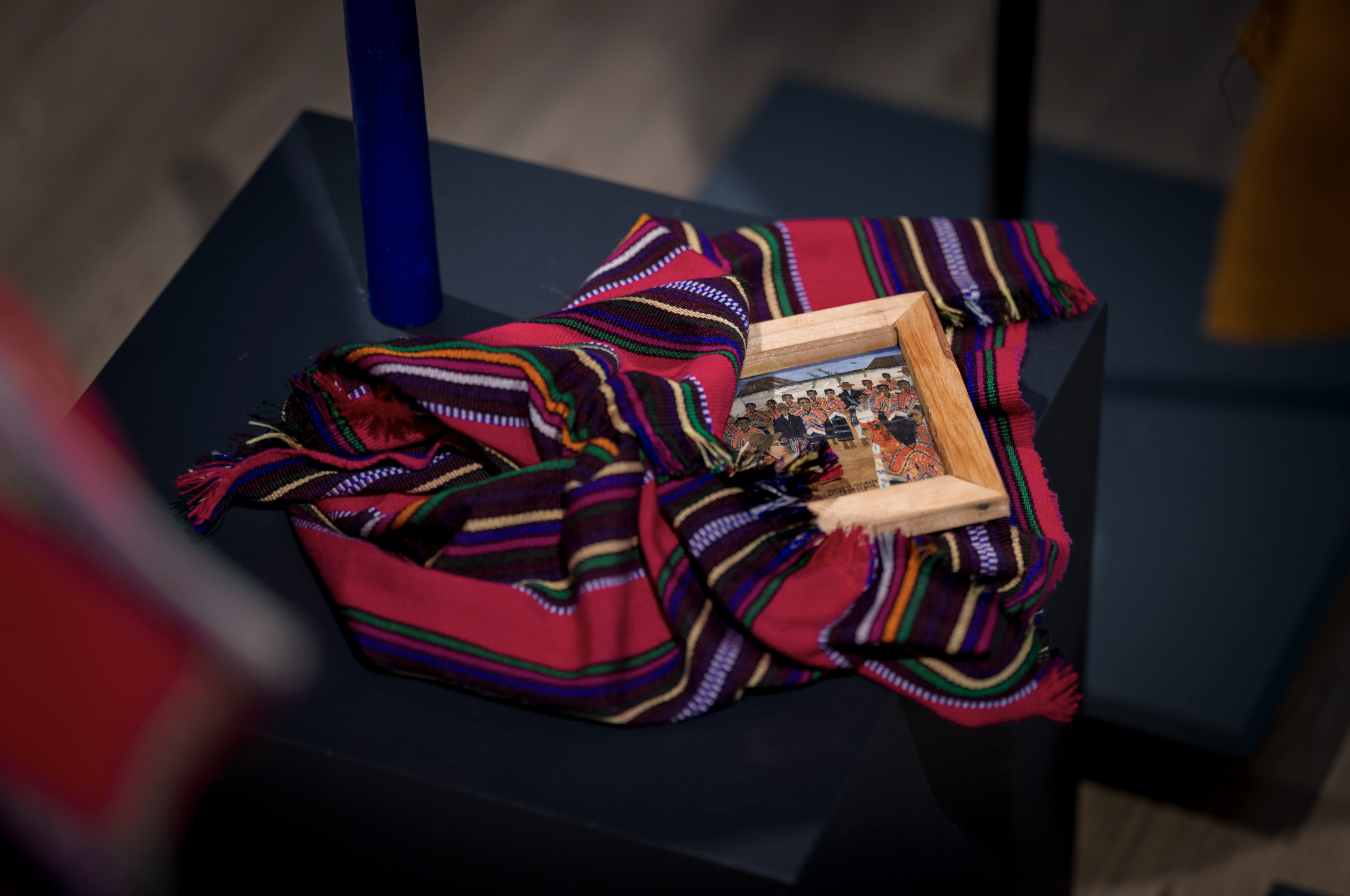
Installation view of Murió el alcalde la esposa se quedó en su lugar ahora deja al nuevo alcalde (reproduction) by Rosa Elena Curruchich, 20th century, wrapped in a textile provided by curator Diego Ventura Puac-Coyoy. This textile-wrapped painting was meant to serve as a storytelling and mnemonic activation contextualizing Rosa Elena Curruchich's life and work in Beyond the Vanishing Maya: Voices of a Land in Resistance at the Textile Museum of Canada, 2024. Photo: Darren Rigo.
It could have drawn inspiration from the Textile Museum of Canada’s Beyond the Vanishing Maya: Voices from a Land in Resistance, that ran from October 17, 2024, to March 28, 2025, an expansive exhibition curated by Ventura Puac-Coyoy and developed with over 200 works by Maya artists from Guatemala and the Maya diaspora in Toronto. This landmark show — the first in Canada to centre Maya art under the leadership of a Maya curator — foregrounded Indigenous cosmologies, collective knowledge, and reciprocal relationships. It was curated by Maya people, for Maya people — both in Guatemala and in diaspora. This exhibition has set a standard, as Andean curator and writer Maya Wilson-Sánchez illustrates in her review for C Magazine in April 2025. Woven Histories did not meet it. It felt like a show curated by the art sector for the art sector, not for the living communities whose traditions were on display. It claimed to celebrate textiles, but failed to embrace their radical relationality. There was no joy in this exhibition. There was abstraction. There was beauty. There was modernism. But there was no laughter behind the loom. No sass in a silk fringe. No sequined protest. No community mural in thread. There is no better example of joy than seeing spaces filled with community crafting together. Joy is not frivolous — it is ceremonial, it is insurgent, it is Indigenous. And this show offered none of it.
This isn’t just about aesthetics. It’s about rebellion. In Mesoamerican epistemology, to weave is to govern; to unweave is to disrupt. The show missed a powerful opportunity to model what Rebellion could look like in textile curation: a refusal to aestheticize violence, and instead a commitment to institutional change. This is the fourth curatorial principle — a map for action. What if Woven Histories had invited us to unweave colonial legacies, to rebuild exhibitions rooted in community praxis, in uprising, in refusal? To move from the archive to the uprising? This isn’t just about curation — it’s about accountability, and possibility.
Joyce Wieland and the Limits of Settler Solidarity
Joyce Wieland’s Heart On retrospective at the Montreal Museum of Fine Arts, that ran from February 8 to May 4, 2025, positions Wieland as a pioneering feminist and political artist. Her textiles are stunning — Reason Over Passion (1968) and The Maple Leaf Forever (1972) subvert patriotic iconography and domestic crafts with bold feminist critiques. These pieces shine.
The exhibition stretches across a series of interconnected galleries that feel both intimate and expansive. The artworks are presented chronologically, offering a foundational understanding of Wieland’s trajectory, allowing the viewer to focus on the evolution of her visual language.
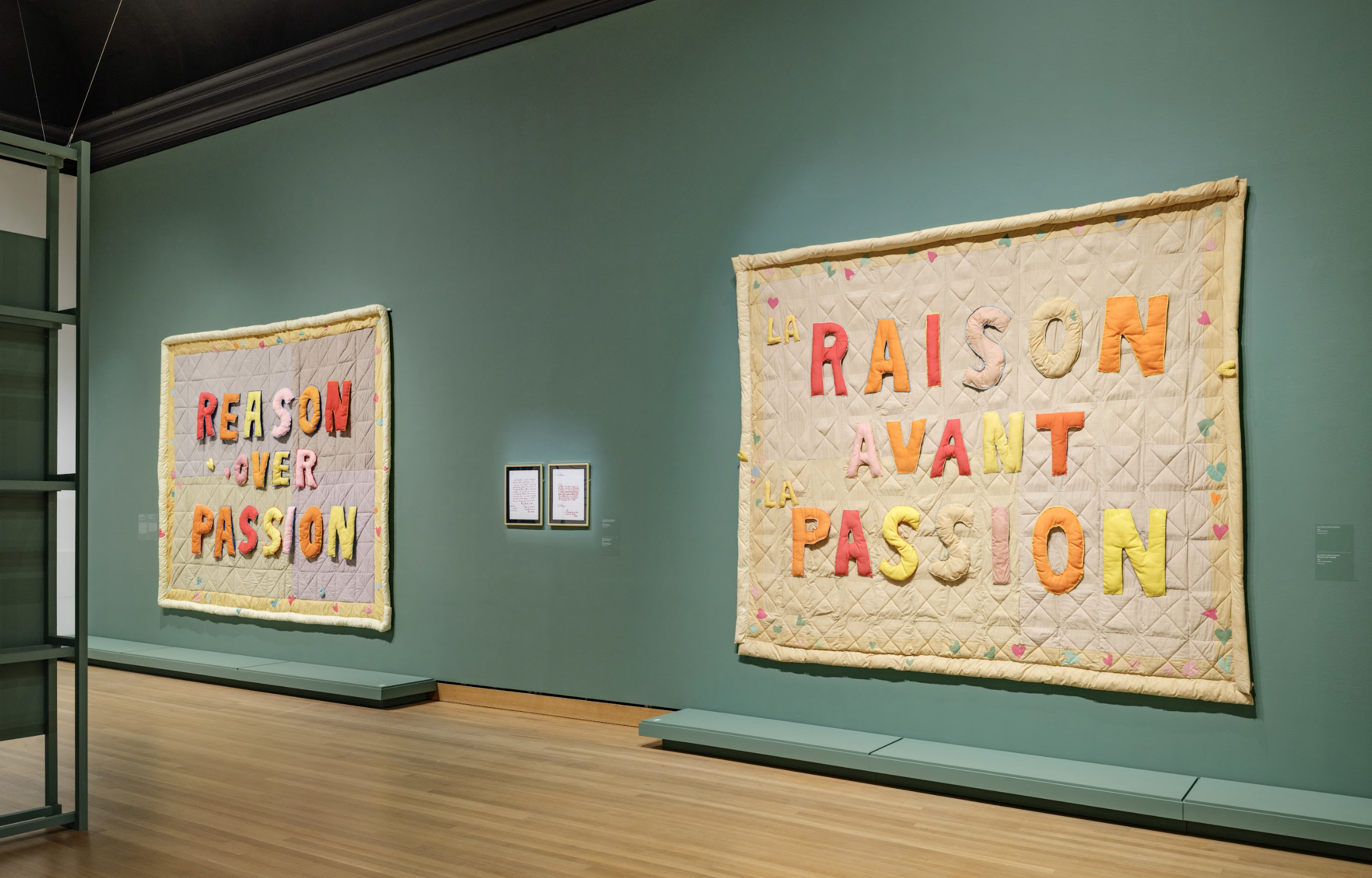
Joyce Wieland, Reason over Passion — Raison avant passion, 1968. Quilted cotton, 256.5 x 302.3 x 8 cm.
View of the exhibition Joyce Wieland: Heart On. © National Gallery of Canada, Ottawa. Photo: Denis Farley. COURTESY OF THE MONTREAL MUSEUM OF FINE ARTS.
As we move deeper into the show, we witness Wieland’s shift toward textiles and craft — a moment of transformation that electrifies the exhibition. The inclusion of quilts, mixed-media assemblages, and embroidered works breathe life into the galleries. The textile-based installations are a clear highlight: the colours are vibrant, thoughtful placement allows the works to speak for themselves. The physical space becomes animated and layered, reflecting the experimentation and mischief that defined Wieland’s practice. Navigating through the show feels like traversing a maze of discovery. Each room unfolds like a new chapter in her artistic journey. There is a rhythm to the space that mimics her restlessness as an artist — no medium too sacred, no boundary left unchallenged. This spatial vitality, while engaging, could have more fully embodied an Off the Wall curation — challenging conventional gallery aesthetics and using spatial design to amplify the radical textures and messages in her work.
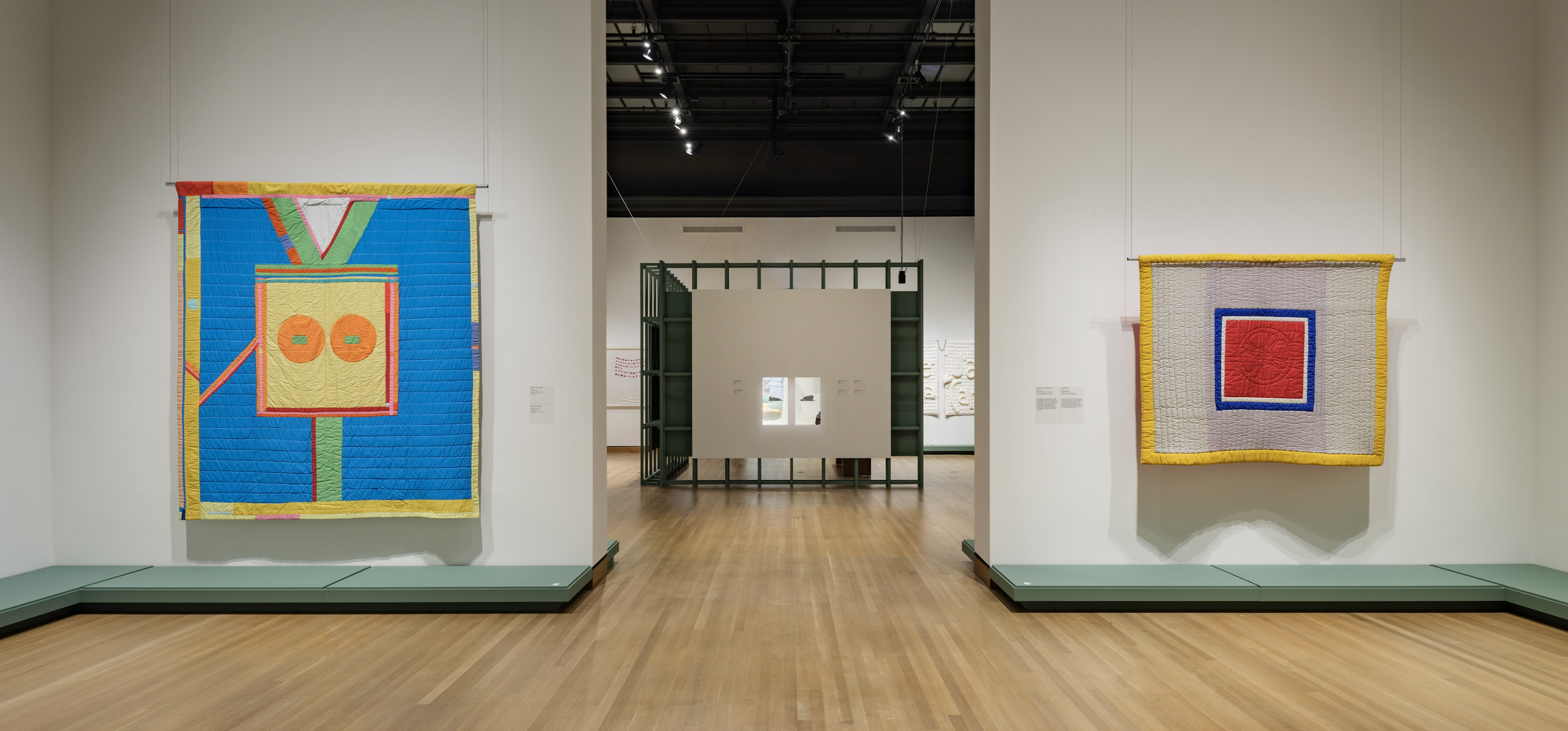
Left: Joyce Wieland, Works including Stuffed Movie and Larry’s Recent Behaviour, 1966. Mixed media. Varied dimensions.
Right: Joyce Wieland, The Camera’s Eyes, 1966. Textile and wood, 203 x 202 cm.
View of the exhibition Joyce Wieland: Heart On. © National Gallery of Canada, Ottawa. Photo: Denis Farley. COURTESY OF THE MONTREAL MUSEUM OF FINE ARTS.
Thus, the curatorial framework does not meet the same level of ambition. Despite the vitality of the artworks and design elements that mimicked Wieland’s passion for experimental artforms, the show lacks community engagement, participatory interpretation, or critical contextualization of Wieland’s settler positionality. Her apparent solidarity with Indigenous communities remains vague. References to Indigenous issues are present, but evidence of real relationships is not. In a moment when museums claim to be moving toward relational accountability, this absence reads as extractive. The show could also have benefited from deeper curatorial risks — foregrounding the contradictions in Wieland’s practice and the broader structures in which she worked. As a white woman artist who was politically engaged but still positioned within institutions that routinely marginalized Indigenous and racialized artists, Wieland’s impact is complex. A more radical, ethical exhibition might have placed her work in dialogue with contemporary Indigenous women and Two-Spirit artists, extending her legacy rather than freezing it in time. The absence of reciprocal engagement underscores a missed opportunity to activate a curatorial Dialogue, which calls for exhibitions to emerge from and be accountable to the communities they reference.
Moreover, while Joyce Wieland’s feminist embrace of quilting was celebrated as radical within 1960s and ’70s Canadian art, this solitary framing risks erasing the deeper, longer-standing histories of textile innovation by Black women. In African American and African Nova Scotian communities, quilting has long functioned as a vital form of cultural resistance — used to preserve stories, transmit ancestral knowledge, and even encode messages during the Underground Railroad. These quilts were born not out of artistic rebellion against high art, but out of survival, community, and inherited practice. Yet in Wieland’s exhibition, this lineage remains unacknowledged. When the much smaller Secret Codes: African Nova Scotian Quilts exhibition, organized by the Black Artists Network of Nova Scotia (BANNS), toured Canadian museums, it foregrounded the creative and political contributions of Black women to the history of textile work in this country.
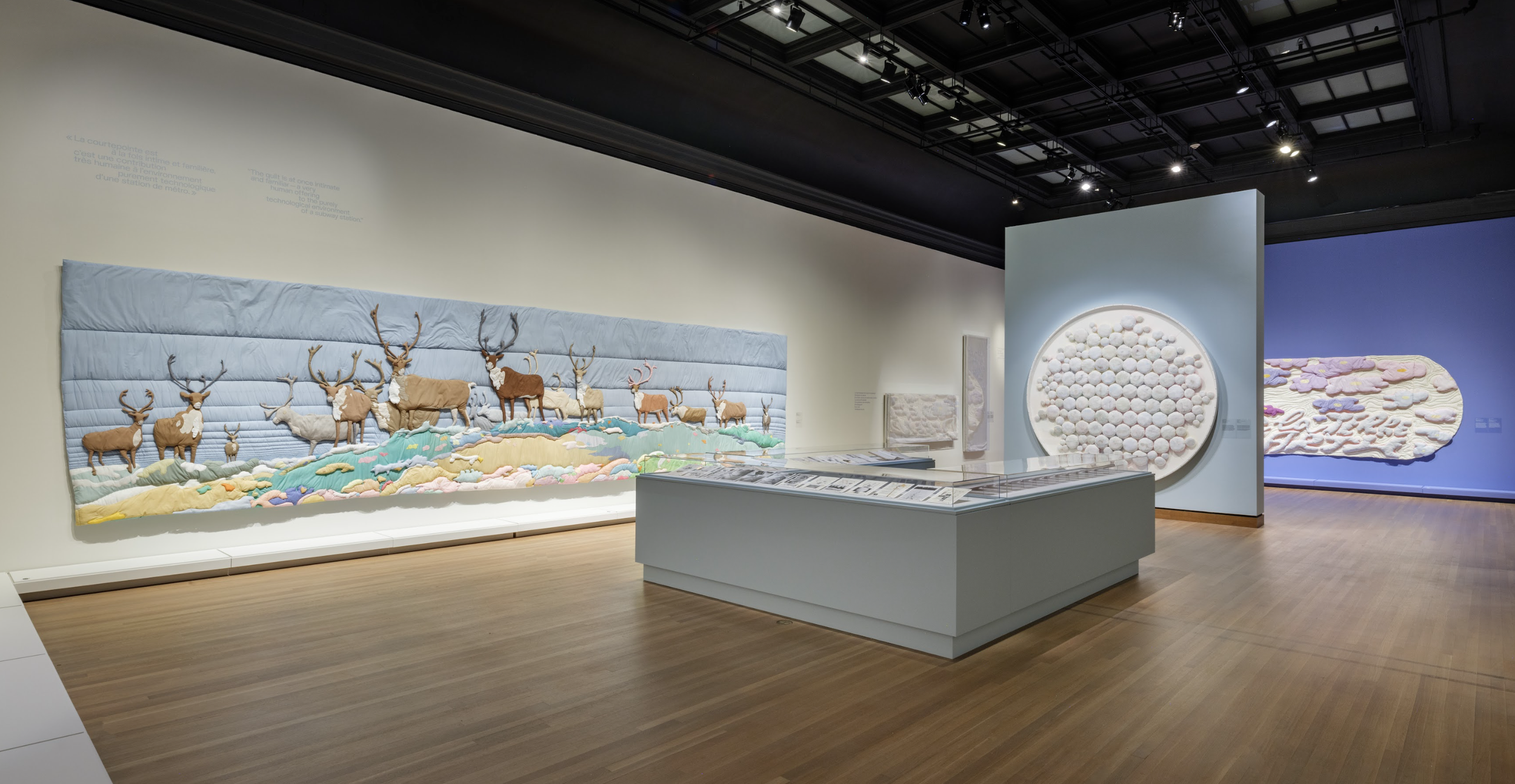
Left: Joyce Wieland, Barren Ground Caribou, 1977–78. Quilted cloth, 243.8 x 914.4 x 8.68 cm.
Right Forward: Joyce Wieland with sewing assistance by Joyce Martin, The Arctic Day, 1970-1971. Coloured pencil on cloth cushions and batting, 248.6 cm diameter.
View of the exhibition Joyce Wieland: Heart On. © National Gallery of Canada, Ottawa. Photo: Denis Farley. COURTESY OF THE MONTREAL MUSEUM OF FINE ARTS.
Likewise, Indigenous women across Turtle Island have used quilting and textile practices as tools for healing, commemoration, and resistance. These practices are not only artistic but ceremonial, often created in kinship-based collaboration and imbued with spiritual meaning. Wieland’s exhibition missed a critical opportunity to contextualize her practice within this broader tradition — failing to ask whose craft is deemed revolutionary, and whose has been historically ignored, despite carrying and evolving the form for generations.
If the exhibition had created space for these connections — both through curatorial interpretation and through community consultation or programming — it could have opened up a more generative and self-reflexive conversation about feminist art histories, settler complicity, and what solidarity really means in artistic practice. Without it, the exhibition speaks from a position of colonial authority, rather than from relation.
It is not simply about resisting the canon, but rethreading the narrative entirely. Wieland’s politics carried contradictions — but contradiction is not failure; it is a site of possibility. Rebellion as a curatorial principle insists that we do not simply display radical work — we use it to reimagine the very structures through which we show, frame, and interpret. The quilt is not only fabric, it is a field: A land to be reclaimed, a structure to be unstitched.
To truly honour Wieland’s legacy, future curatorial approaches must embrace these principles — not as add-ons, but as foundational curatorial ethics, a path forward for how we contextualize settler artists within frameworks that are accountable, relational, and transformative.
Pacita Abad: Colour Contained
Pacita Abad’s retrospective at the Art Gallery of Ontario, which ran from October 9, 2024, to January 19, 2025, was a rare and necessary celebration of a Filipina artist who saw the world through brilliant colour. Her trapunto paintings are rich, layered, and politically charged. Her fashion sense, vibrant and defiant. Her politics, global and community-centred. The art dazzled; the curation did not.
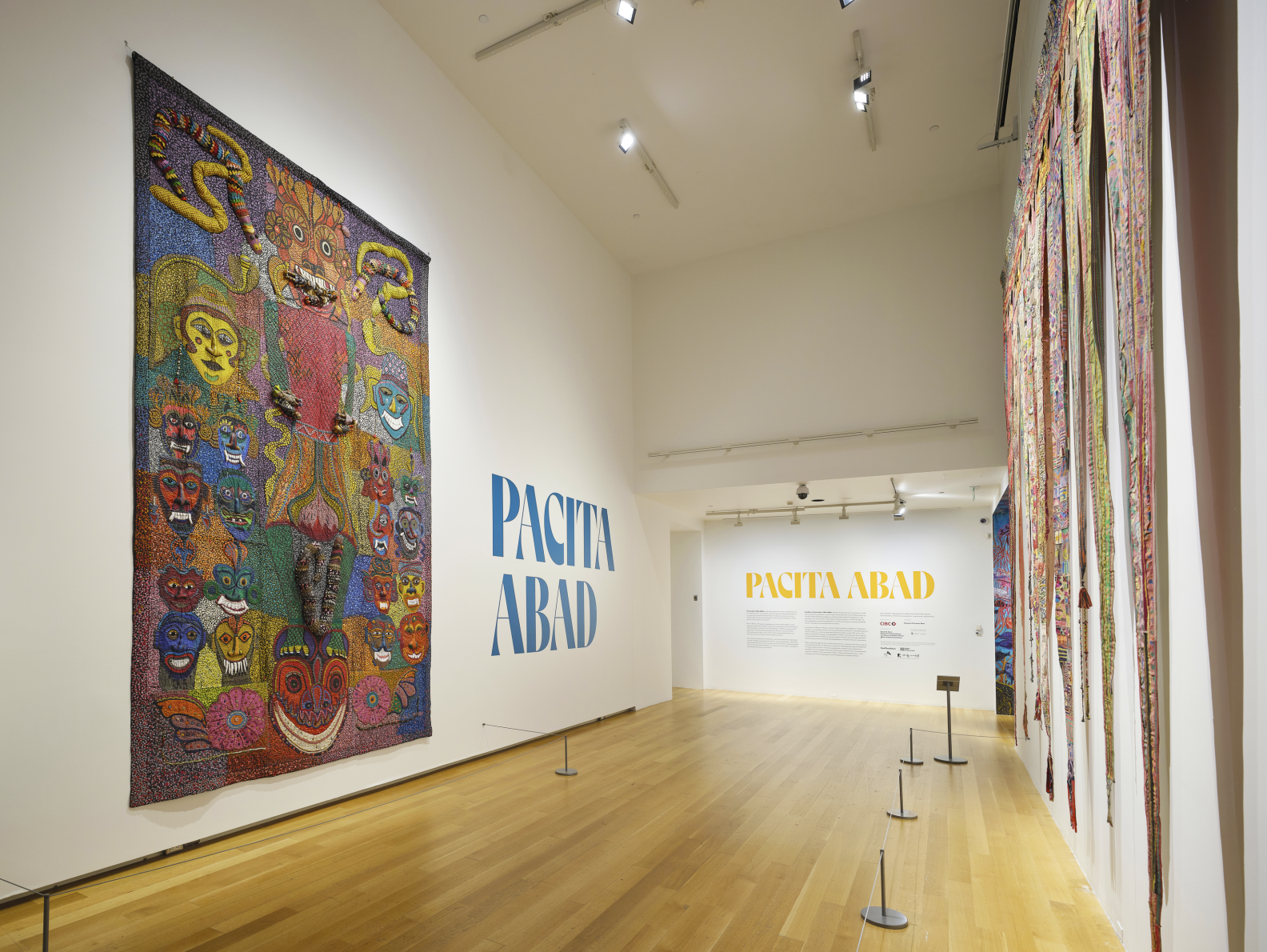
Installation view: Pacita Abad, October 9, 2024 – January 19, 2025, Art Gallery of Ontario. Pacita Abad is organized by the Walker Art Center, Minneapolis. Photo: AGO. ARTWORK COURTESY OF THE PACITA ABAD ART ESTATE.
The AGO is fortunate to possess a remarkably flexible and generous exhibition space, with soaring ceilings that in this case allowed Abad’s monumental quilts to be suspended from above like illuminated vitrails. These floating textiles evoked both the visual grandeur of church altarpieces and the colonial history of Spanish Catholicism in the Philippines. This spatial treatment offered moments of reverence, casting light on how Abad’s work spiritually and politically intervenes in colonial legacies. It was breathtaking to see these pieces take up space — quite literally — with scale and grace. This spatial gesture touched the curatorial principle of Off the Wall, allowing the textiles to transcend traditional framing and reclaim sacred verticality. Unfortunately, such curatorial brilliance was not sustained throughout.
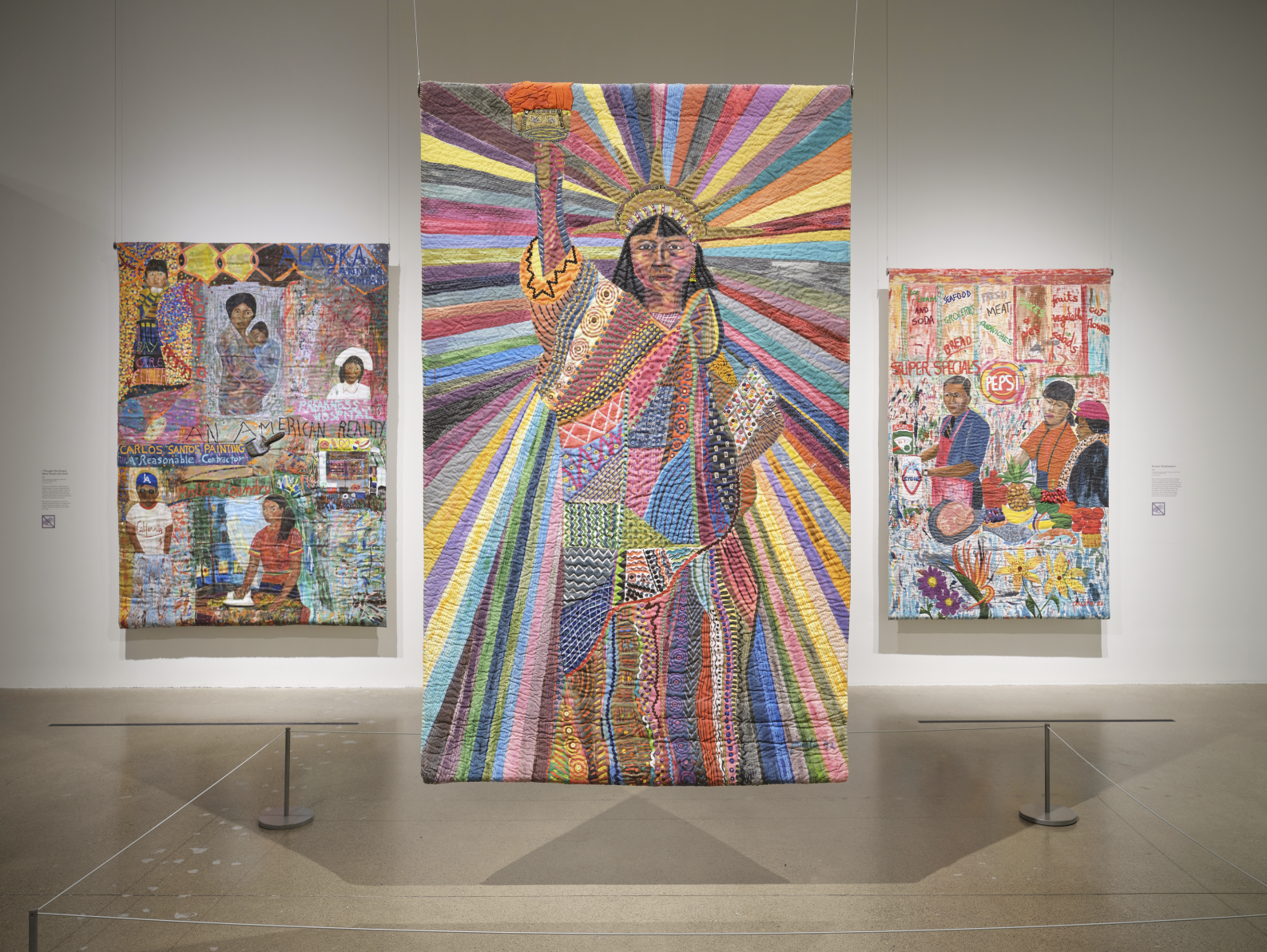
Left: Pacita Abad, I thought the streets were paved with gold, 1991. Acrylic and oil paint, wood bristle, painted canvas, painted cloth on stitched and padded canvas, 239 x 173 cm.
Center: Pacita Abad, L.A. Liberty, 1992. Acrylic, cotton yarn, plastic buttons, mirrors, gold thread, painted cloth on stitched and padded canvas, 239 x 148 cm.
Right: Pacita Abad, Korean Shopkeepers, 1993. Acrylic and oil paint, plastic buttons, sequins, beads, yarn, painted cloth on stitched and padded canvas, 267 x 155 cm.
Photo: AGO. ARTWORK COURTESY OF THE PACITA ABAD ART ESTATE.
The exhibition was arranged thematically and somewhat chronologically, guiding visitors through different periods and approaches in Abad’s practice. Early figurative and socially engaged works gave way to more abstract, vibrant trapunto pieces. It felt, at times, like walking through a wonderland — each room inviting visitors into a new immersive world she created, but the immersion was ephemeral. The white walls that dominated the show stripped the vibrancy and soul from her work. With the exception of a single blue-walled gallery toward the end of the exhibition — dedicated to her underwater series, full of jellyfish, coral, and marine ecologies — there was a lack of visual and atmospheric continuity. That stunning final room was a highlight. It was dreamy, enveloping, and joyous — making me want to linger longer. Sadly, it came only at the end of the exhibition.
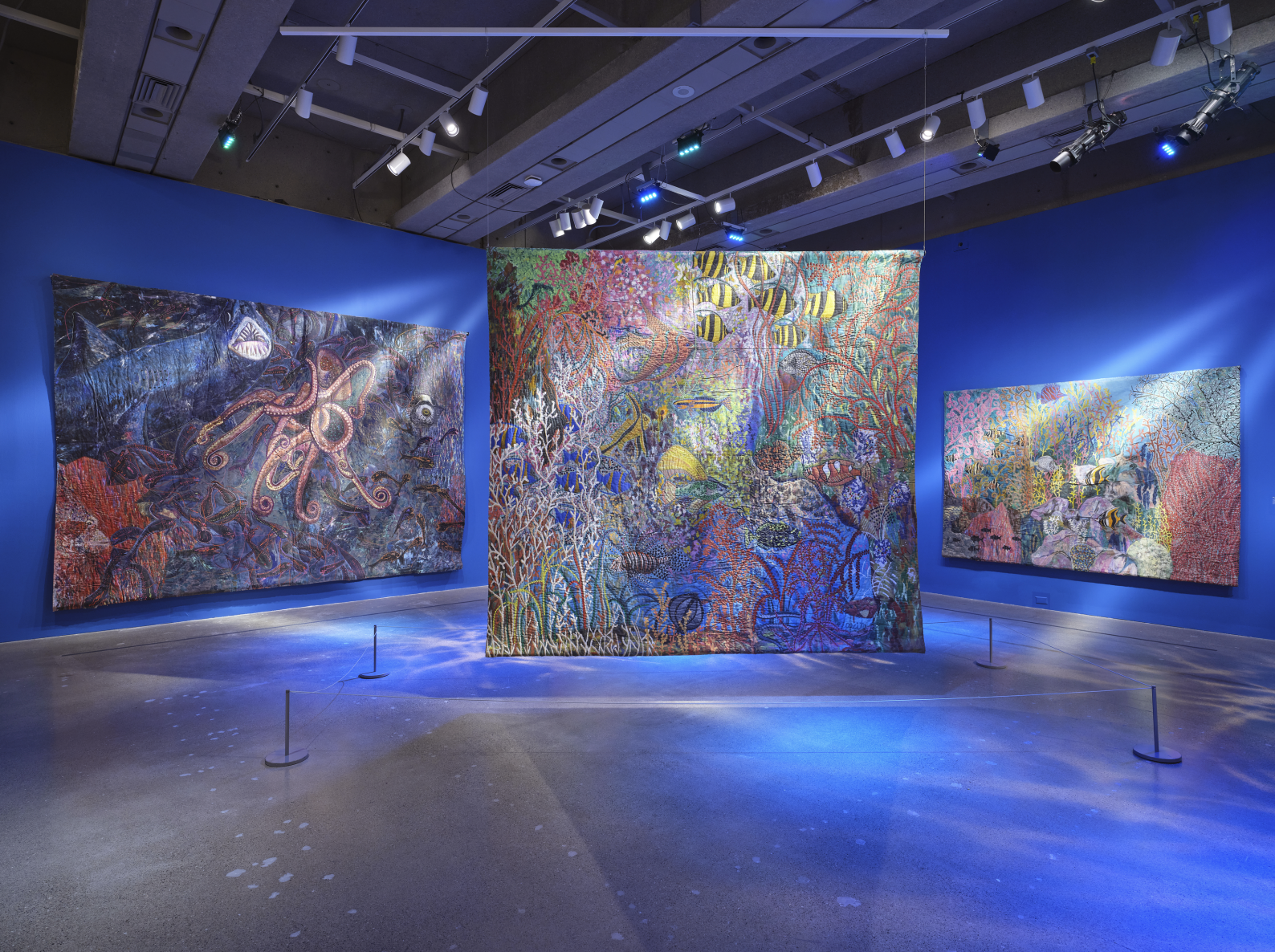
Center: Pacita Abad, Anilao at its best, 1986. Acrylic and oil paint, plastic buttons, mirrors and rhinestones on stitched and padded canvas, 295 x 318 cm.
Installation view: Pacita Abad, October 9, 2024 – January 19, 2025, Art Gallery of Ontario. Pacita Abad is organized by the Walker Art Center, Minneapolis. Photo: AGO. ARTWORK COURTESY OF THE PACITA ABAD ART ESTATE.
This curatorial flatness stood in opposition to Abad’s presence as an ambassador of colour. Her palette was not just a stylistic choice — it was an ideological position. By dulling her work through sterile presentation, the AGO missed the opportunity to fully engage with the joy and political resistance embedded in her art. Here, the principle of Joy as Refusal could have guided the curatorial tone — honouring her vibrancy not as visual delight alone, but as a strategy of resilience and bold cultural survival through meaningful community engagement. When I inquired about their strategy, the AGO stated they had brought on an external consultant. That is not a strategy — that is outsourcing accountability. Their earlier exhibition Faith and Fortune: Art Across the Global Spanish Empire from 2022 also failed to engage with Indigenous communities who continue to live with the aftermath of brutal Spanish colonization, leading to factual errors, misspellings of Indigenous nation names (including my own), and the perpetuation of harmful stereotypes. These are not isolated mistakes; these are patterns.
During Pacita Abad, members of the Filipino community criticized the AGO on social media for their censorship of “pro-Palestinian materials and products at Filipinx market honouring Abad." For a show meant to honour an artist so deeply engaged with community, justice, and resistance, this censorship was especially egregious. The institution missed the chance to build meaningful bridges with Filipino artists, organizers, and community leaders and to contextualize Abad’s work in conversation with those she inspired, and those who share her histories. It showed a disconnect between the AGO and the political commitments of Abad’s legacy.
Abad’s practice was not simply a celebration of multicultural aesthetics. It was rooted in lived experience, transnational dialogue, and activism. She created work that dissolved borders — geographic, artistic, and ideological. Her life embodied the potential of horizontal exchanges between racialized communities around the world. Yet the exhibition failed to reflect this. There was no substantive cross-cultural dialogue or exploration of the global solidarities that informed her work. The absence of such relational curatorial labour revealed a missed opportunity to foster meaningful Dialogue between the AGO, Abad’s work, and her community. The institution failed to create an exhibition that emerged in conversation with the very communities it invokes.
In the end, the retrospective was a surface-level homage to a profoundly complex artist. It gestured at her brilliance without doing the deep work of contextualization, collaboration, and critical engagement. Abad’s art invites us into vibrant, defiant, pluralistic worlds. This show gave us the door but never opened it all the way. But Pacita Abad’s legacy deserves more. She was not just an ambassador of colour — she was a weaver of worlds, a dissenter wrapped in sequins. And this is where Rebellion lives: in the borderlessness of her practice, in the urgency of her politics. Rebellion is a map for transformation. It reminds us that colour is not neutral. That joy, when unaccompanied by justice, remains incomplete. A curatorial framework informed by Off the Wall, Dialogue, Joy as Refusal, and Rebellion would not only honour her art — it would carry it forward as a tool for radical change.
Where We Go From Here
Textile artists are charting the future — thread by thread, stitch by stitch. Their works carry cosmologies, resistances, and rebirths. Community curators are not just responding to this brilliance; we are building the frameworks to hold it. We are placing textiles where they belong: not behind glass, but in relation. Not as artifacts, but as ancestors. Not as decoration, but as declaration.
The question is no longer Can institutions change — but Will they? Will museums continue to celebrate textiles while sidelining the very communities from which they come? Or will they finally embrace the radical ethics of curation rooted in relation, reciprocity, and rebellion?
Off the Wall reminds us that display is never neutral. Dialogue demands we listen to the makers and their kin. Joy as Refusal teaches us to celebrate without erasing complexity. And Rebellion invites us to unweave colonial patterns and rethread a future of collective care. The time for safe curation has passed. This is a call to action. To reimagine the gallery not as another shrine for colonial curatorial practices, but as a site of insurgent beauty, ceremonial action, and structural change. The textile shows us how. Now it’s our turn to weave a better curatorial future.