

Form and Timbre: The Cymbals of Philippe Gauthier-Boudreau
I’m walking through the basement corridors of a labyrinthine industrial building in Montréal’s Plateau neighbourhood. I’ve long forgotten the directions to where I’m going, so I’m following a precise, repetitive metallic sound: TOK, TOK, TOK.
It echoes around corners, ricocheting off stone and concrete walls and finally I arrive at PGB Cymbals, where Philippe Gauthier-Boudreau works as Canada’s only artisanal cymbal maker.
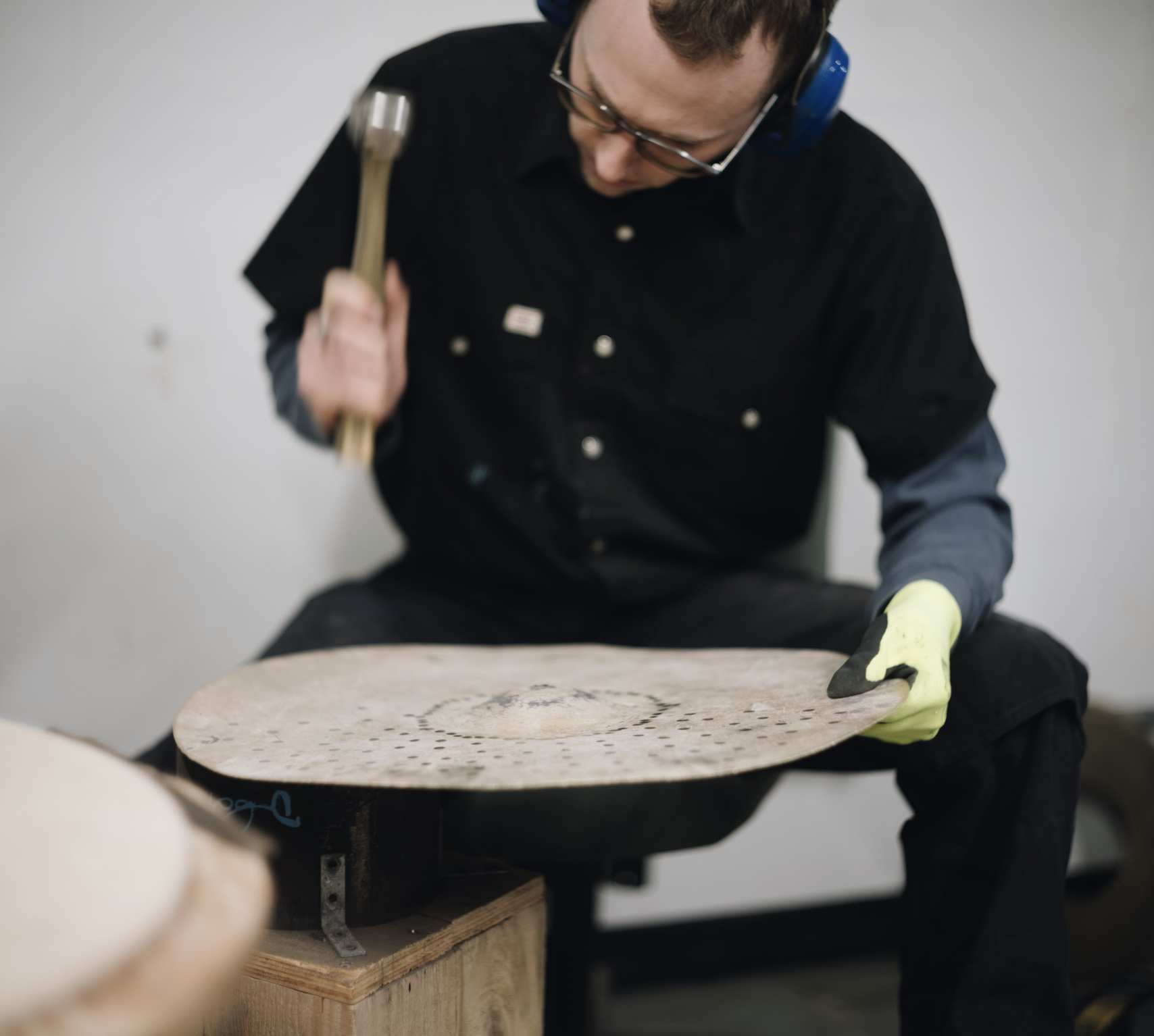
Philippe Gauthier-Boudreau hammering a B20 bronze cymbal blank, 2025. Photo: Tanea Hynes.
The abrasive sound is Phil’s hammer striking a flat disc of B20 bronze, referred to as the cymbal blank. In this context, noise is not an unwanted byproduct but a productive force, guiding Phil in the earliest stages. Through two layers of ear protection, the quick, dry TOK tells him that his hammer strokes are falling correctly, compressing the bronze against the anvil. Through this initial hammering process, Phil builds tension and structure into the otherwise flat and flexible bronze blank, shaping it slowly into a recognizable form.
As a drummer and PhD candidate researching instrument makers, I was excited when I learned about Phil’s work in late 2019. I visited his shop three years later, and was astounded by Phil’s ability to sense what might bring new life to an unremarkable, factory-made cymbal I brought for him to modify. In 2023, I acquired a PGB cymbal of my own — a 21″ Signature Ride. In spring 2025, I returned to Phil’s shop, spending an afternoon talking with him about his journey into the craft of cymbal-making and his relationship with its materials and tools.
The first cymbal-like instruments appeared in the Early Bronze Age, around 3000 BC. Bronze, an alloy made of copper and tin, was first used to make plates, vessels and armour, but its acoustic properties made it an ideal material for making musical instruments. Cymbals resembling the ones used by modern-day percussionists originated in the 17th century in the Ottoman Empire, where the Armenian metalsmith Avedis Zildjian I is credited with discovering the alloy used in most cymbals today: B20 bronze (80 per cent copper and 20 per cent tin).
From their early origins in Ottoman military bands, cymbals have become integral to many genres of music, where they might shape the emotional contours of a piece of music while driving it rhythmically forward. Tony Williams’ propulsive ride cymbal playing in the Miles Davis Quintet, John Bonham’s raucous hi-hats that kick off Led Zeppelin’s “Rock and Roll,” and the cymbal crashes in Russian composer Modest Mussorgsky’s “Great Gate of Kyiv” all testify to the power and centrality of cymbals in modern music.
In terms of organology — the study of musical instruments — cymbals are idiophones, meaning they produce sound by way of their own resonating bodies. Form, aesthetics and function are inseparable in a cymbal: altering its shape with a hammer or lathe, introducing oxidation to its surface, or even stamping it with a brand name affects its materiality and therefore its sound.
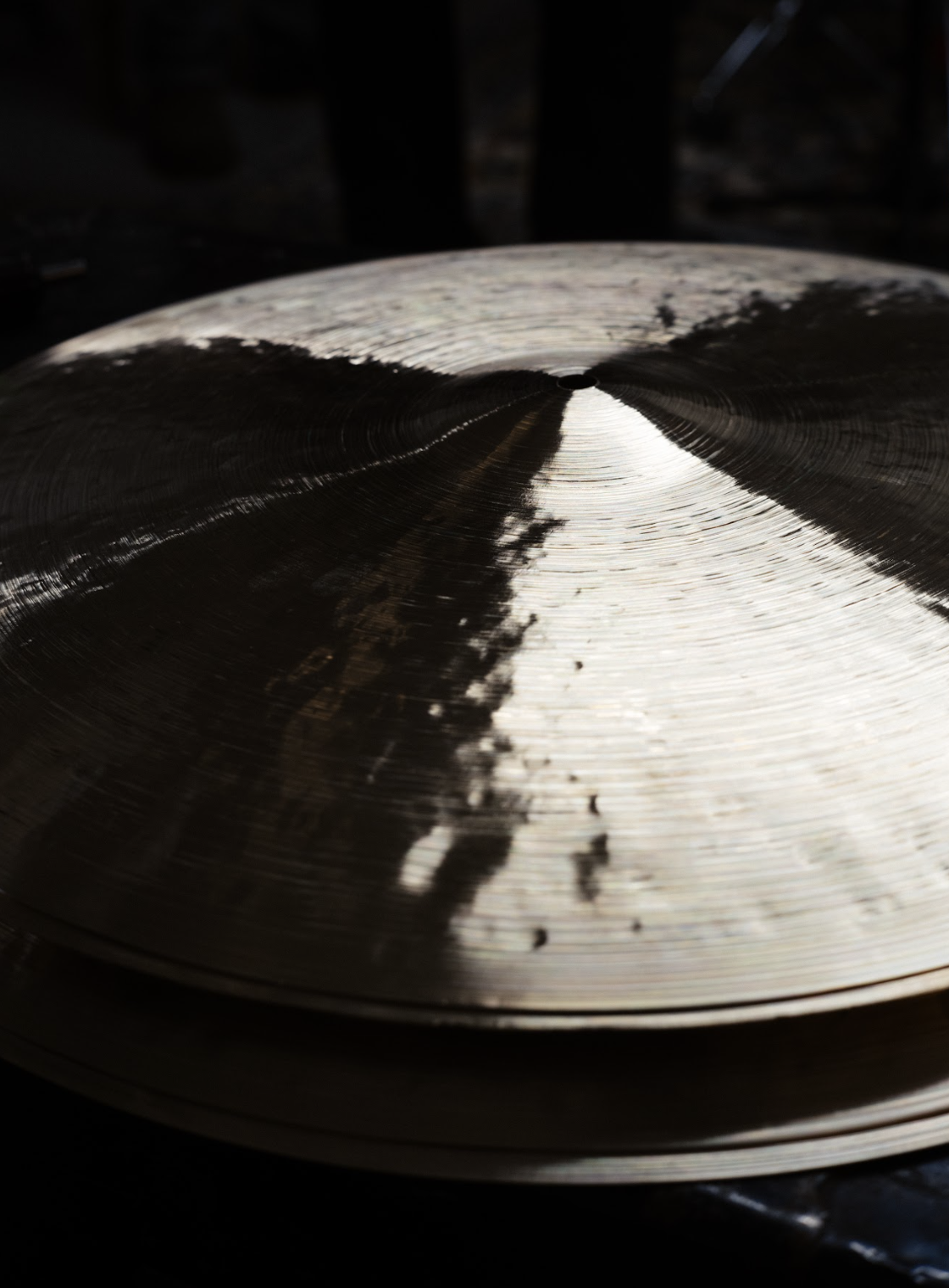
Detail view of a cymbal, 2025. Photo: Tanea Hynes.
Though he makes production models or series of cymbals, Phil’s work often requires using tools, techniques and an intimate understanding of B20 bronze to translate a customer’s description of a desired sound into a cymbal. But just as every handmade cymbal is unique, one cymbal may be heard quite differently by two people. At the heart of this problem are factors of perception, personal taste, and the very character of a cymbal’s sound. One cymbal may be higher or lower pitched than another, but a good cymbal doesn’t have a clear fundamental pitch like the musical tone produced by plucking a guitar string. Rather, depending on its musical application, a cymbal is valued for the sound of the stick’s initial impact and what happens after: the tonal spread (“wash”), textural complexity and harmonic depth of the vibrating bronze disc. These characteristics are all aspects of timbre, the quality of a sound that helps us identify its material source.
Timbre can be difficult to describe, but drummers often use adjectives like dark, bright, dry, clean, complex or trashy to describe a cymbal’s sound. The nuances of a cymbal’s sound also depend on how, and by whom, it is played: the shape and material of the stick, the weight of the arm propelling it, and even the tightness of the grip on the stick all make a difference. Cymbals are therefore very personal instruments for drummers. Like many drummers, I have cymbals that I would not part with, and I am constantly looking for “the one.”
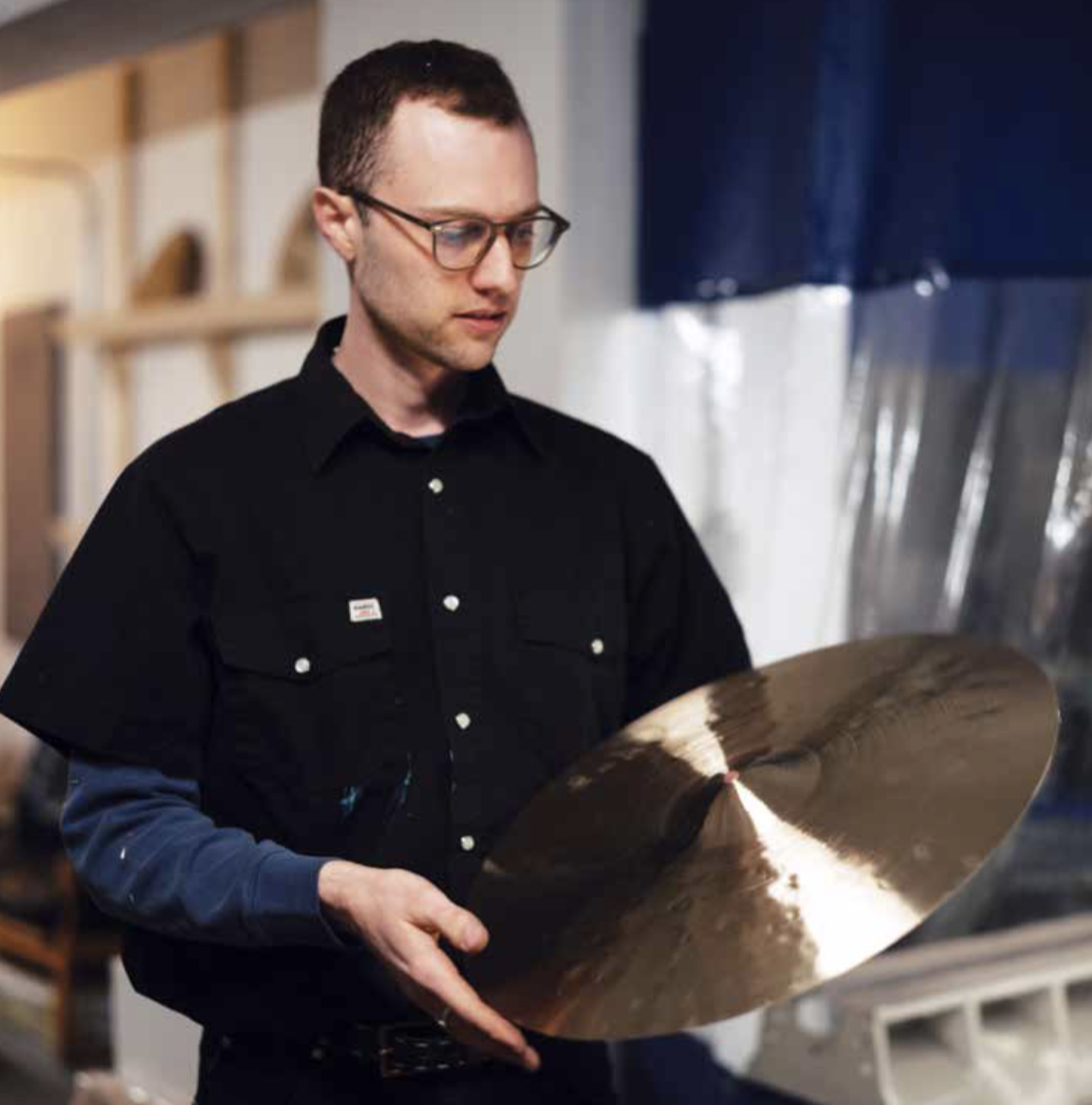
Philippe Gauthier-Boudreau inspecting a cymbal, 2025. Photo: Tanea Hynes.
Making a career out of making musical instruments made sense for Phil. He grew up in a musical family on Montréal’s North Shore: his mother, Johanne Gauthier, plays bass viol in Baroque and Renaissance ensembles. His father, Jean-Luc Boudreau, is an experimental musician who, in the 1980s, turned to making replicas of Baroque and Renaissance recorders based on his scientific and historical research. Phil played drums in bands throughout adolescence and eventually attended Concordia to study jazz. His journey into cymbal-making began when his drum professor, Jim Doxas, brought a cymbal made by Jesse Simpson to one of their lessons. Phil remembers that cymbal as sonically foreign and a completely different type of instrument than cymbals he had previously experienced. It was a pivotal moment.
“I was intrigued by cymbals,” Phil tells me, “because it was a bit mysterious how that instrument functioned by itself. Just this one piece of metal that constituted the whole instrument.”
When he began researching cymbal-making, he found very little information besides obscure internet forums and blog posts that used a strange new vocabulary — words like tension, complexity, curvature and texture — to describe the material and resulting sonic character of cymbals. Phil ordered blanks and tools from a foundry in Turkey, and began teaching himself how to shape the tarnished blanks into musical instruments. He posted his progress to an Instagram page, which eventually caught the eye of Brazilian cymbal maker Francisco Domene, who invited Phil to intern with him in early 2019. At the workshop, about 250 km west of São Paulo, Domene passed on techniques learned from years of study with cymbal makers in Turkey.
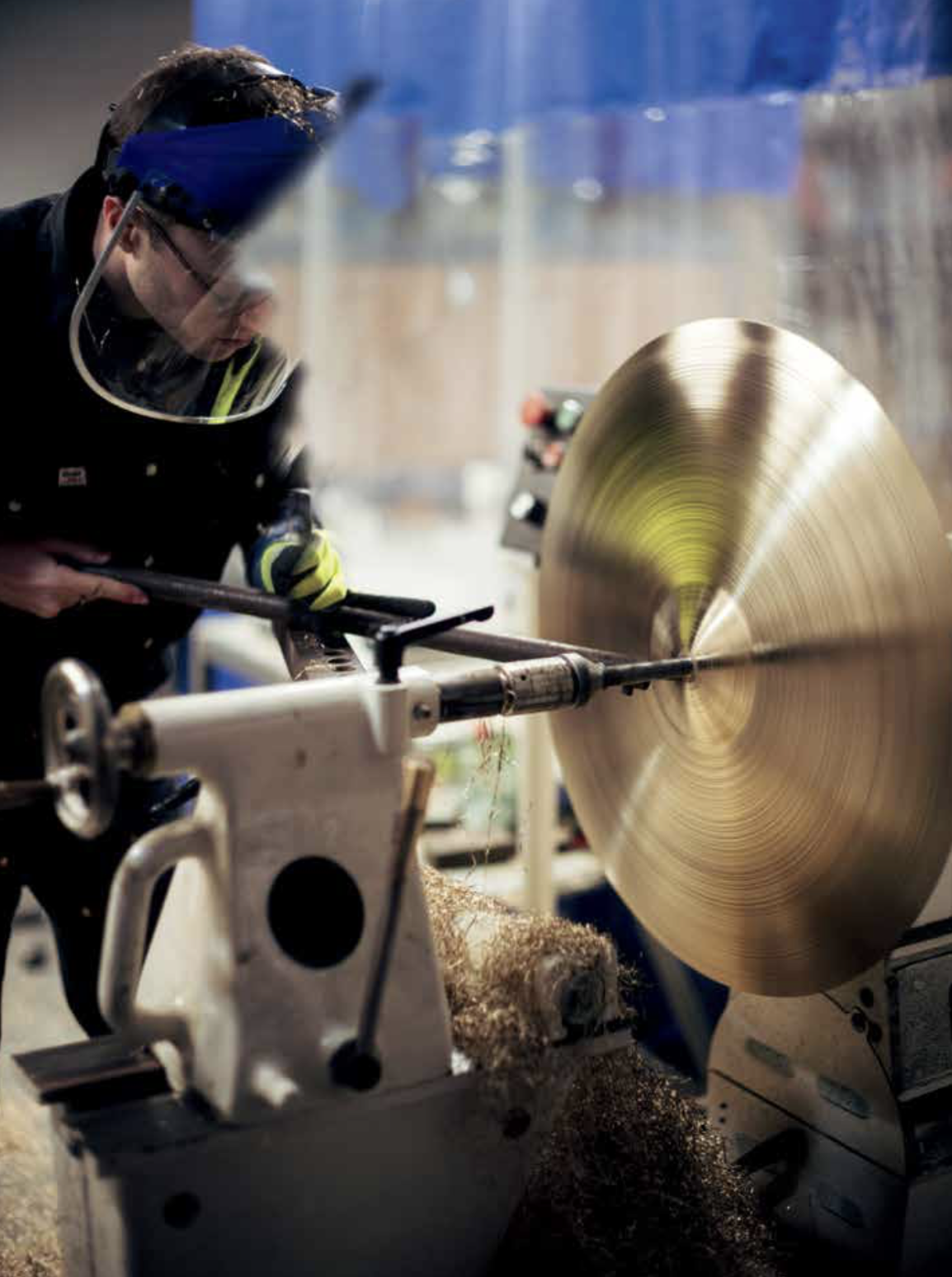
Philippe Gauthier-Boudreau lathing the cymbal, 2025. Photo: Tanea Hynes.
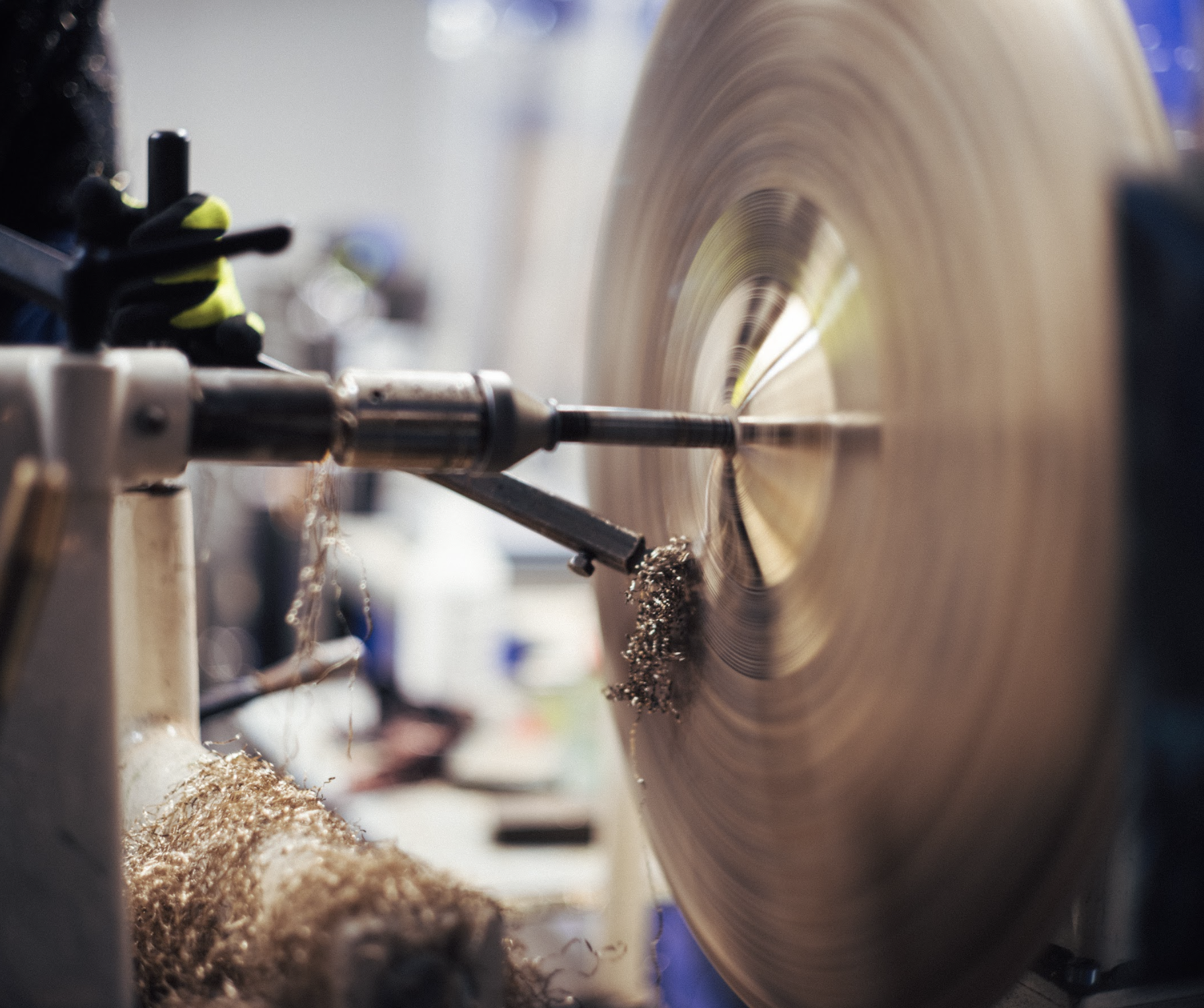
Since his trip to Brazil, Phil’s understanding of how the bronze discs generate sound has deepened and he has refined his approach to shaping them. The process begins by choosing a blank with a size and weight that corresponds to the cymbal he wants to create. By striking the blank with an open hand, Phil hears the range of frequencies it can potentially produce. He begins with the initial hammering process, distributing hammer marks that compress the metal, stretching and spreading it out to create the desired shape. This adds what he refers to as “controlled chaos,” disrupting the composition of the bronze at a molecular level. After initial hammering, Phil almost always lathes the cymbal to strip away the crust left on the blank from the forge. The unfinished cymbal is then set aside for days or weeks while the metal returns to a more stable state. After this resting period, the cymbal’s sound also stabilizes. At this point, Phil begins to play the cymbal and make adjustments with additional lathing, hammering, and oxidization.
By repeating this process hundreds of times, Phil has learned how bronze behaves through processes of hammering and lathing but also how it hardens and stabilizes over time. As a drummer, he knows that the relationship between musician and cymbal is both tactile and sonic, so he uses his material knowledge to make cymbals that are more lively and responsive; cymbals that have a stronger rebound and are more fun to interact with.
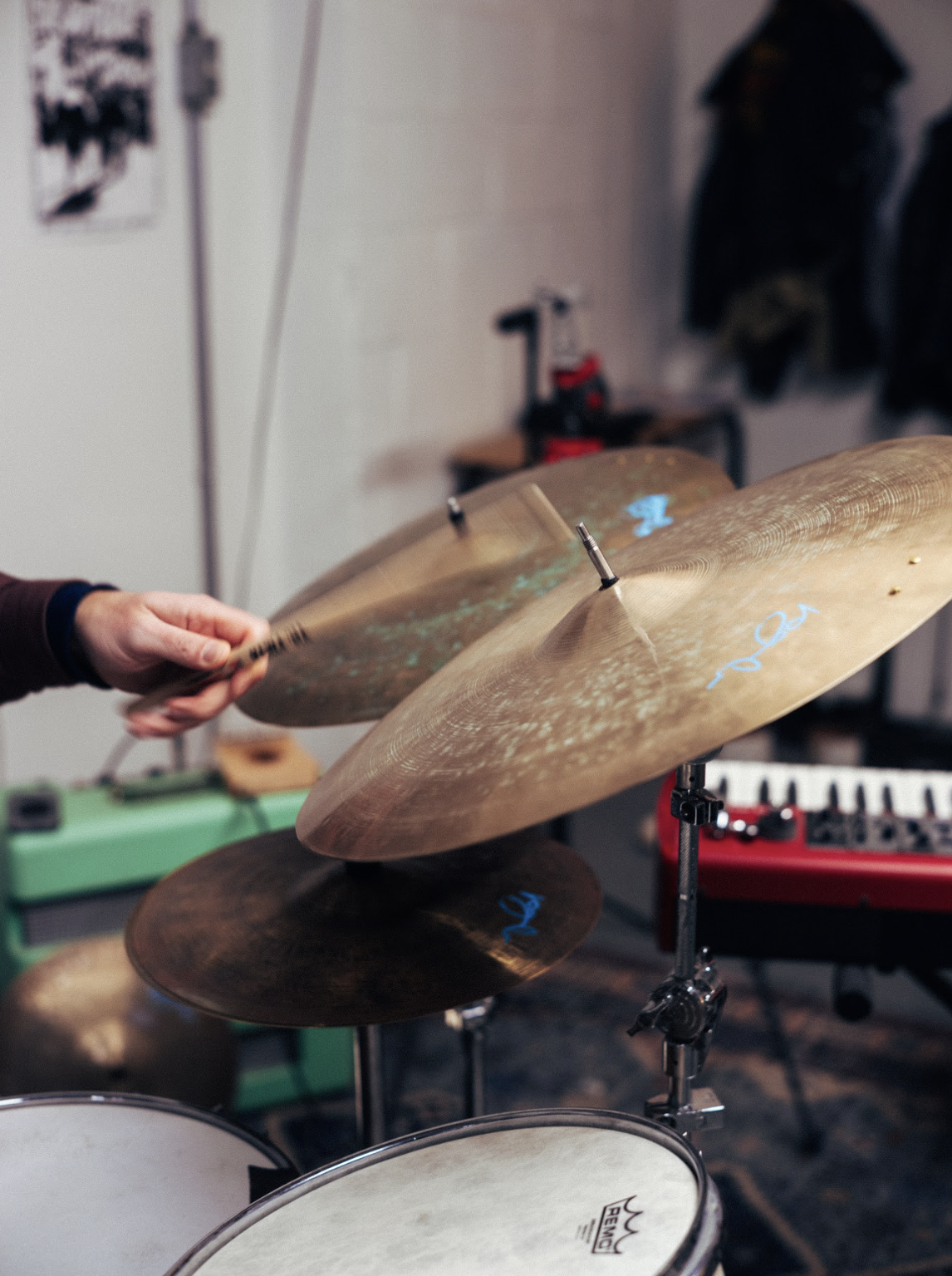
Testing the sound, 2025. Photo: Tanea Hynes.
While some larger cymbal companies increasingly use computer-controlled tools to speed up production while mimicking the traditional techniques of human artisans, this mode of production makes it difficult for them to adjust to ever-changing demands of contemporary musicians. Phil, on the other hand, can respond quickly to the needs of his customers, who turn to him for instruments that challenge traditional cymbal designs and bring new sounds to their creative projects.
“Cymbal-making is a way to express myself,” he tells me. “To be able to try things without judgement and allow myself to fuck up — to be able to try things and have a creative approach to making the cymbals.”
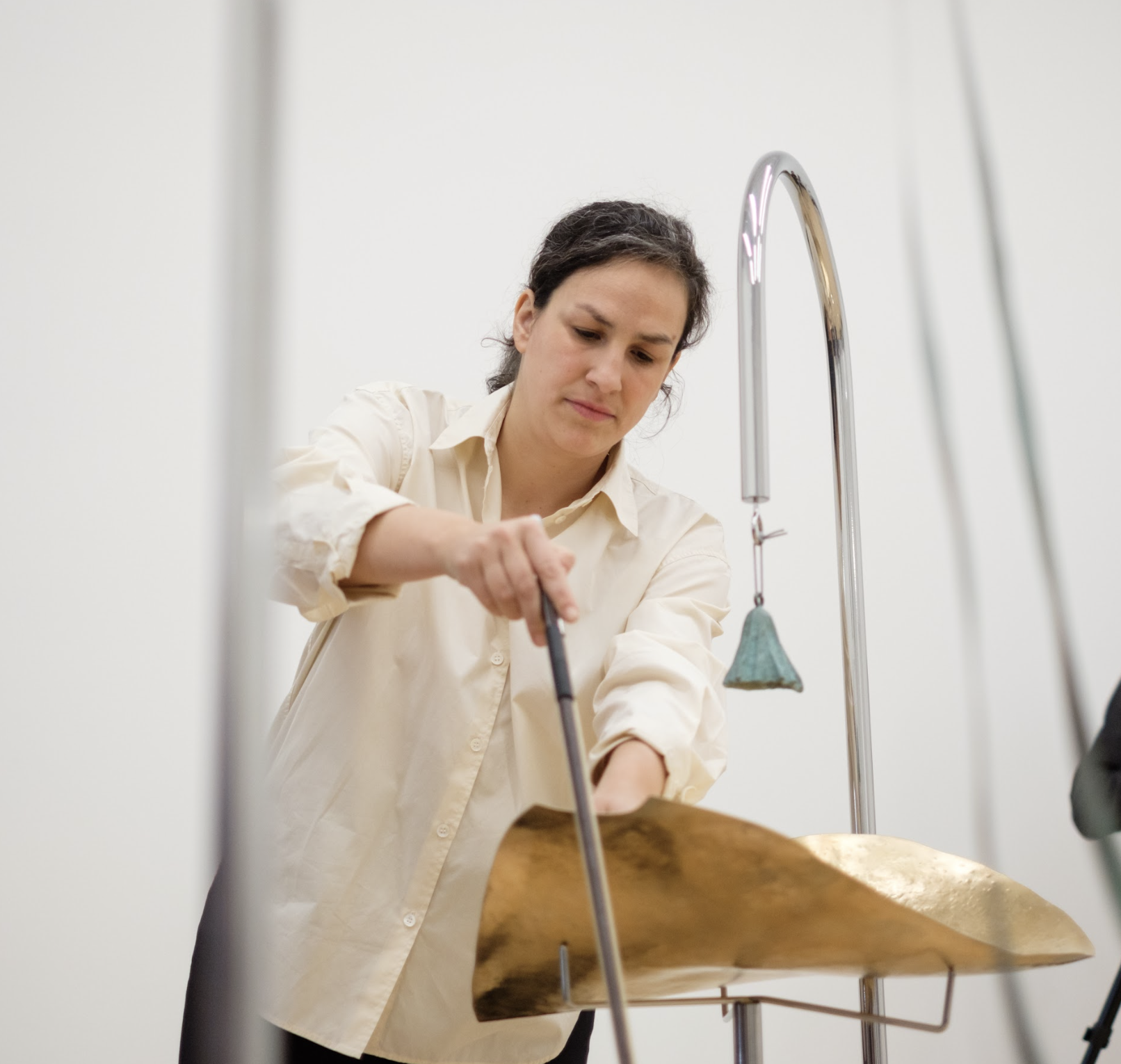
Marie-Michelle Deschamps and Corinne René, Première adresse, performance at AXENEO7, 2023. Photo: Jonathan Lorange. COURTESY OF THE ARTIST.
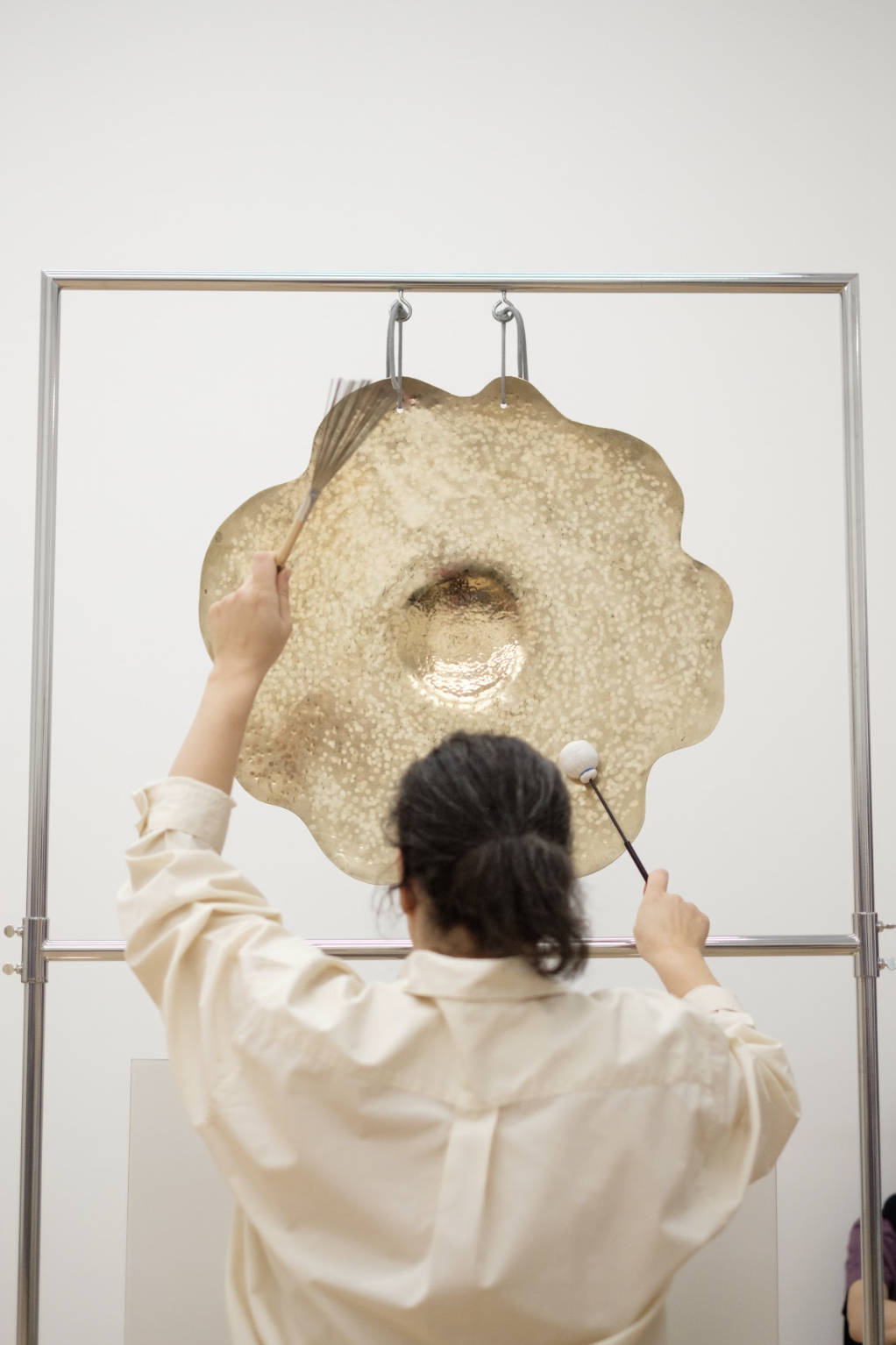
Marie-Michelle Deschamps and Corinne René, Première adresse, performance at AXENEO7, 2023. Photo: Jonathan Lorange. COURTESY OF THE ARTIST.
Besides making cymbals for drummers, in 2023, Phil collaborated with visual artist Marie-Michelle Deschamps and percussionist Corinne René to make sound sculptures for an installation called Première adresse. The goal of the project was to create new forms of percussion, and therefore new sounds. Like Phil’s cymbals, these pieces are intended to invite interaction and improvisation between human and material, while also foregrounding the aesthetic dimensions of their materiality.
PGB Cymbals:
https://pgbcymbals.com/
This article was published in the Fall/Winter 2025-2026 issue of Studio Magazine.


