

Expansive Craft
Vitrine des créateurs exhibition at BeCraft Gallery, 2025. COURTESY OF BECRAFT.
What does it mean to practise craft under the conditions of the contemporary? Between technologies and tactile practices, the relationship between hand and material is constantly being renegotiated. In this interaction, craftsmanship loses its established historical boundary. Mechanical techniques intertwine with the handmade in a reflective gesture that looks back at the origins of the human urge to create.
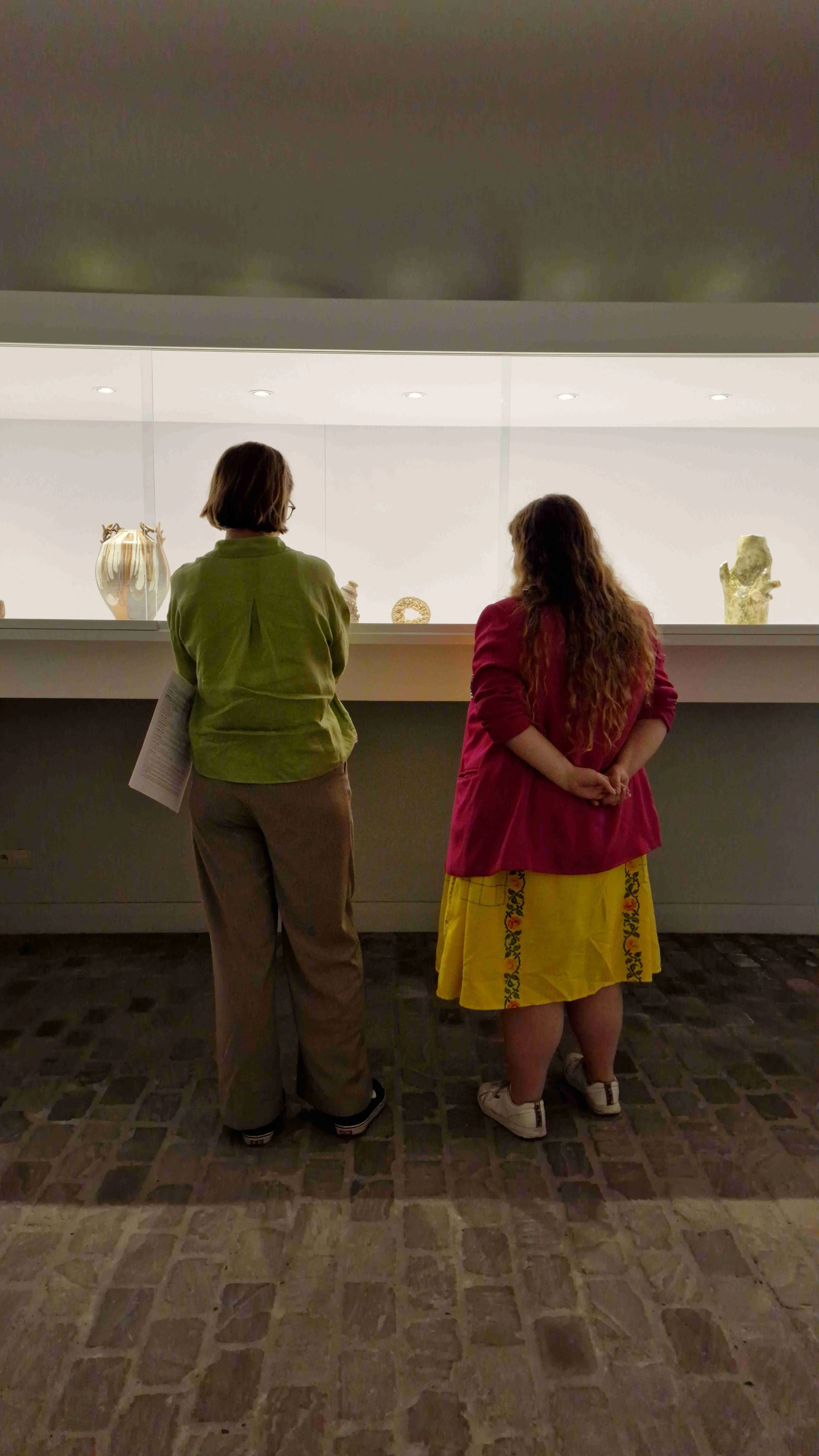
Craft writing workshop at BeCraft Gallery with Jodie de Verney and Lera Kotsyuba, 2025. Photo: Nathanaël Thiry.
The workshop at BeCraft gallery in Mons, Belgium, on July 29, 2025, guided by interim editor-in-chief Lera Kotsyuba, alongside the exhibition Vitrine des créateurs, approached writing about contemporary craft not merely to see or experience craft as a return to artisanal traditions, but in its context, as a critical exploration in which the return to traditional techniques is taken up as a method in both the making and the experiencing of the material. Technology and material are not separate entities but continuously shape one another: together they generate new forms of knowledge. By recognizing their mutual interdependence, it becomes clear how this dynamic can open space for new ways of collaboration.

Vitrine des créateurs exhibition at BeCraft Gallery, 2025. COURTESY OF BECRAFT.
This reveals a shifting understanding of what craftsmanship can mean: not fixed in tradition of technique, material, or form, but constantly redefined by its encounters. These influences redefine the way craftsmanship is both perceived and valued, but the real challenge lies in transcending the restrictive boundaries of institutions that keep fine art’s autonomous vision and craft’s embodied practice apart. Consider craft not as an aesthetic result, but rather as a political witness that articulates the memory of resistance. In a culture driven by immediacy, where individuality is constantly diminished by consumption, craft insists on slowness. These kinds of gestures are not consumed, but inhabited through slow movements in which ethics and matter meet.

Vitrine des créateurs exhibition at BeCraft Gallery, 2025. COURTESY OF BECRAFT.
The intimacy of carefully crafted objects sharpens our attention to authenticity in the manufactured object. It resists the immediate consumption prescribed by today’s economy. Glenn Adamson, an art and design historian specializing in craft and material culture, argues that craft has its own rhythm, that each repetition of the hand becomes a fixed temporary experience. This rhythm is more than a process; it is a political act. It reveals the skill inherent in the muscle memory of the body; every trace and “imperfection” shows the maker’s hand. The rhythm of craft becomes a silent form of resistance: a refusal to surrender to the speed of consumption, a reminder that time can also be made by hand [1].

Grégoire Vigneron, Notre Dame, 2025. Paper, 75 cm x 125 cm. COURTESY OF BECRAFT AND THE ARTIST.
Technology is transforming the ideology of making, reshaping labour in how we understand craftsmanship. Makers such as Grégoire Vigneron, known by his artist name Tokowo, illustrate this principle. Notre Dame (2025), a monumental paper sculpture draped over a chair as a supporting structure, was part of the exhibition Vitrine des créateurs at BeCraft gallery. This work embodies the dialogue between the digital and the handmade. Vigneron combines innovative paper techniques and creates self-supporting structures without glue. His manual process of cutting, folding, and assembling emphasizes precision and the craftsmanship of the maker, while his use of digital cutting machines acts as a connecting link rather than a replacement. Here, technology supports the working methods without losing the focus on expertise. In this way, Vigneron’s work resonates with Glenn Adamson’s reflections on craft and temporality. The repetition of skilled labour embeds time within the object itself, in its making. Craft, for Adamson, resists the logic of capitalism. Its value cannot be measured by speed or efficiency, but rather by experience and accumulated knowledge. Vigneron’s Notre Dame invites us to experience patience as a process. Folded contours emerge like a pattern of creation. The maker moves within a pace so ingrained that time and gesture become entwined. As Glenn Adamson observes, a craftsman may spend ten years perfecting a skill that now takes only ten minutes to execute; those ten years remain silently inscribed in the material [2].
The integration of digital technology into the handmade process exposes the quiet assumption that new tools might displace tradition. In reality, the digital does not erase the craft; it temporarily disrupts it, only to be absorbed again into a renewed understanding of skill. Through Notre Dame, technology and craft meet in transformation, affirming that today, craftsmanship is not displaced by innovation but expanded by it.
1. Glenn Adamson, “An Interview with Glenn Adamson,” Studio Magazine vol. 17, no. 1 (Spring/Summer 2022): 33.
2. Adamson, 2022, 34.
This article was published in the Spring/Summer 2026 issue of Studio Magazine.