
Review: Memory as Material in Nithikul Nimkulrat’s Remembered & Forgotten
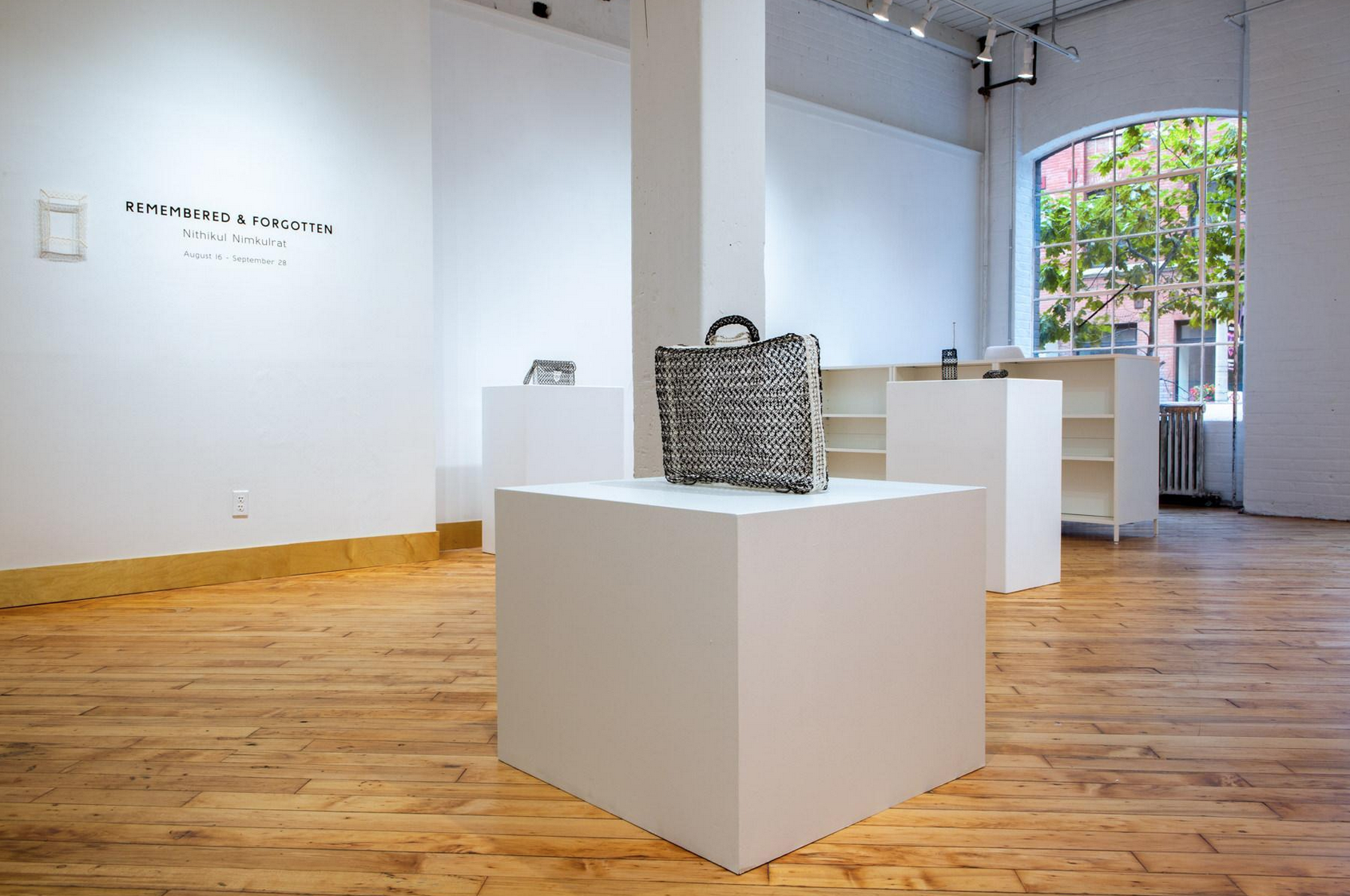
Remembered & Forgotten, Craft Ontario Gallery, installation view, 2025. Photo: Jocelyn Reynolds. COURTESY OF CRAFT ONTARIO.
Memories are never linear. Textile artist, designer, and educator Nithikul Nimkulrat explores the intricacy of memory in her exhibition, Remembered & Forgotten. The exhibition took place August 16–September 28, 2025, at Craft Ontario’s new gallery space in the historic 401 Richmond building in Toronto, Ontario. The work reflects on the artist's relationship with her father as he navigated memory loss due to Alzheimer’s disease.
The show comprises eleven black-and-white paper string sculptures. Each sculpture engages knotting patterns inspired by tiling theory, covering a surface in geometric patterns without overlap, a technique Nimkulrat developed over decades of collaborative research with mathematicians. Care is imbued in every sculpture. The artist spent countless hours hand-tying thousands of knots to construct everyday objects that evoke memories of her father. A picture frame, a briefcase, a Motorola cellphone, a pen, a letter in an envelope, and an ice cream cone are just some of the life-sized sculptures featured in the exhibition.
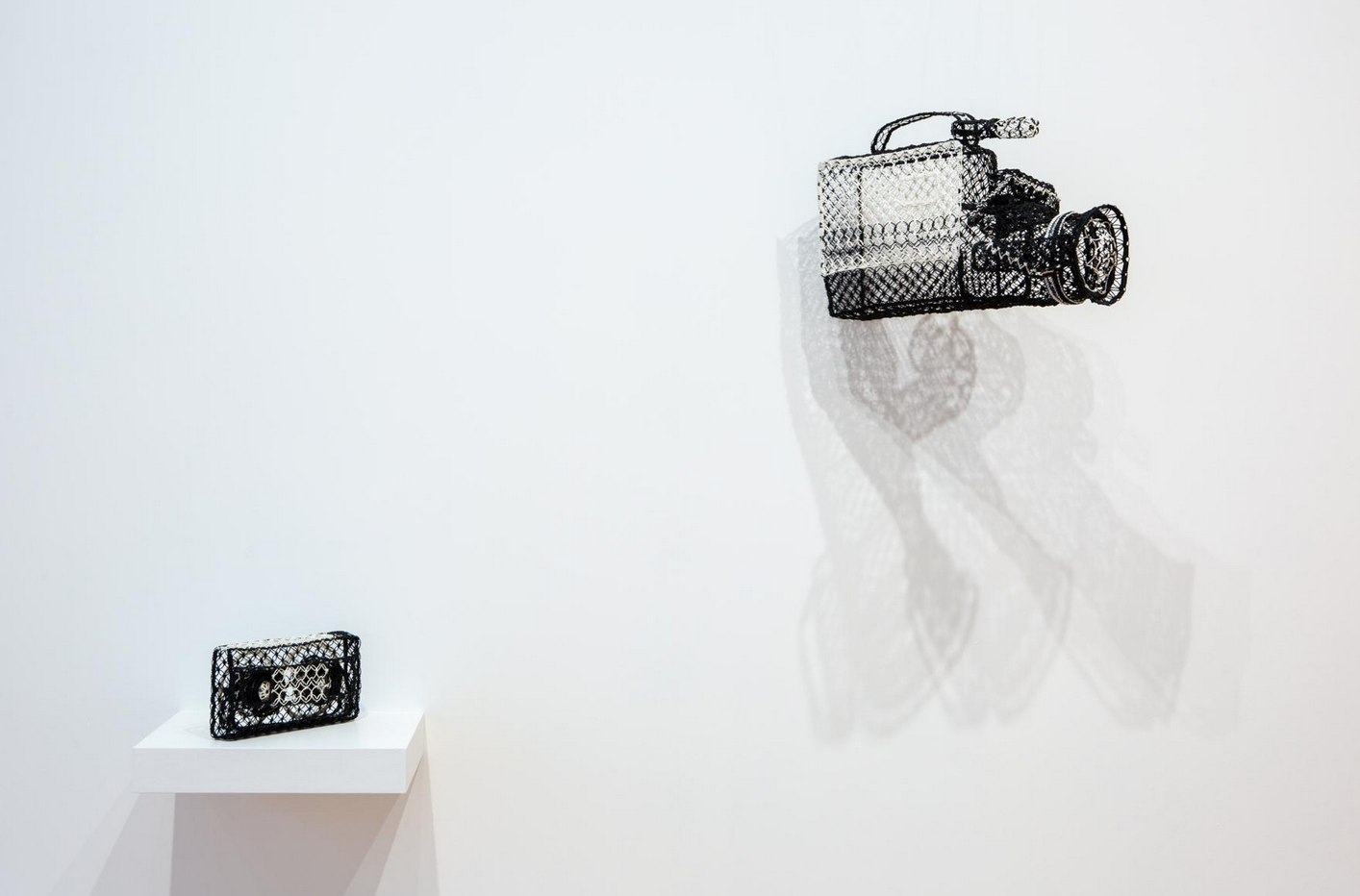
Left: Nithikul Nimkulrat, THE VHS, 2024. Hand-knotted black and white paper string, 10.16 x 3.18 x 20.32 cm. Right: Nithikul Nimkulrat, THE VIDEO CAMERA, 2025. Hand-knotted black and white paper string, 20.32 x 36.83 x 22.86 cm. Photo: Jocelyn Reynolds. COURTESY OF CRAFT ONTARIO.
Every object is intentionally placed. On the right side of the gallery, THE VIDEO CAMERA (2025) hangs from a nylon wire. To the camera’s left, a VHS tape, aptly titled THE VHS (2024), sits on a floating shelf positioned slightly below. Nimkulrat’s knots, both meticulous and meditative, explore connections between traditional craft and the dynamic possibilities of technology as methods of memory keeping. In THE VIDEO CAMERA and THE VHS Nimkulrat’s mathematical knotting turns familiar mechanical objects into organic, vulnerable forms, rendered silent and inert. Throughout the exhibition, each time we are reminded of the past, we are invited to piece together fragments of what we remember.
Nimkulrat’s meditation on memories with her father similarly relies on repetition. Each paper knot becomes a small act of recollection and reconstruction. There are no reels turning inside of THE VHS, and THE VIDEO CAMERA captures no images. By selecting these objects and stripping them of their function, Nimkulrat transforms them into conceptual sculptures that address the impermanence of memory and the way details can fade or disappear over time. Within the fragile materiality of paper, and in the process of making sense of her experiences, she is left with objects that can only mimic the real things.
The interlocking black-and-white paper string creates a porous lattice that allows viewers to see through each sculpture, as though through the gaps in memory itself. Not only are the pieces signifiers of specific memories for the artist, but they also echo objects recognizable to the viewer. Nimkulrat offers the work to us without contextualizing each piece’s significance. The work floats in space as if plucked from the artist's mind and placed in the room. They are husks of memories unbeknownst to us, but they remind us of memories of our own.
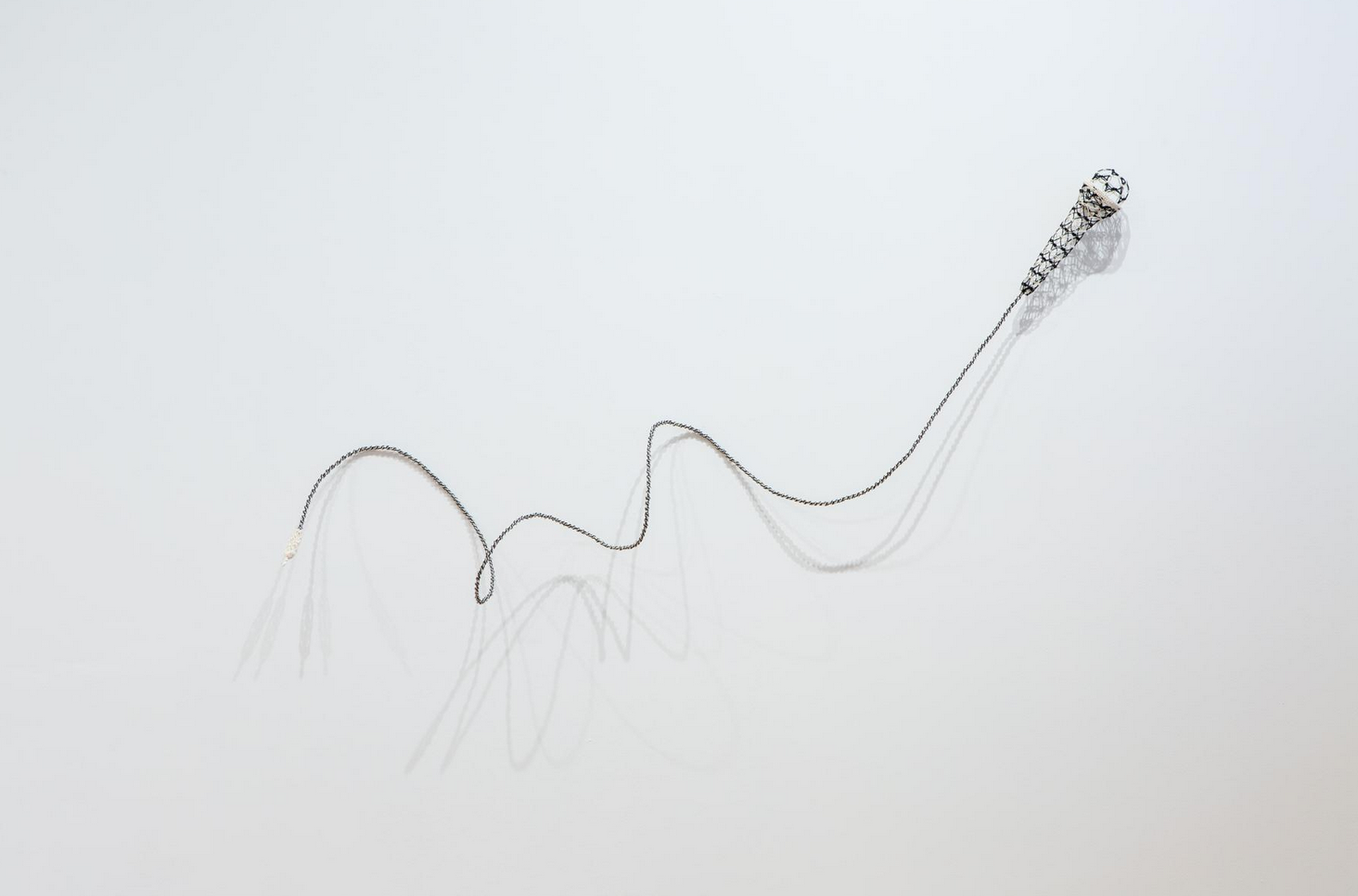
Nithikul Nimkulrat, THE CORDED MICROPHONE, 2024. Hand-knotted black and white paper string, 27.94 x 30.48 x 5.72 cm. Photo: Jocelyn Reynolds. COURTESY OF CRAFT ONTARIO.
On the opposite wall of the gallery, THE CORDED MICROPHONE (2024) has also found its way out of Nimkulrat’s memory and into the liminal space of the gallery. The microphone, while knotted in a similar fashion to the other sculptures, stands out due to the gestural nature of its cord. The wire curves and twists, resembling audio waveforms or an unclear signature. The microphone suggests a memory of sound — a voice, a song, or perhaps a moment shared between the artist and her father.
Remembered & Forgotten successfully creates a tender dialogue between the work, artist, and spectator. In doing so, Nimkulrat challenges the fleeting nature of memory by giving it symbolic weight. The act of hand-knotting each sculpture is a holistic and thoughtful practice that ties the artist’s recollections directly into the work: with each knot, she binds them into a physical form, while acknowledging their inevitable instability. Ultimately, Nithikul Nimkulrat asks us to contemplate how we record, store, and recall memories.
We would like to acknowledge funding support from the Ontario Arts Council and the Government of Ontario.