
Repetition and Precision - An Interview with Pauline Loctin
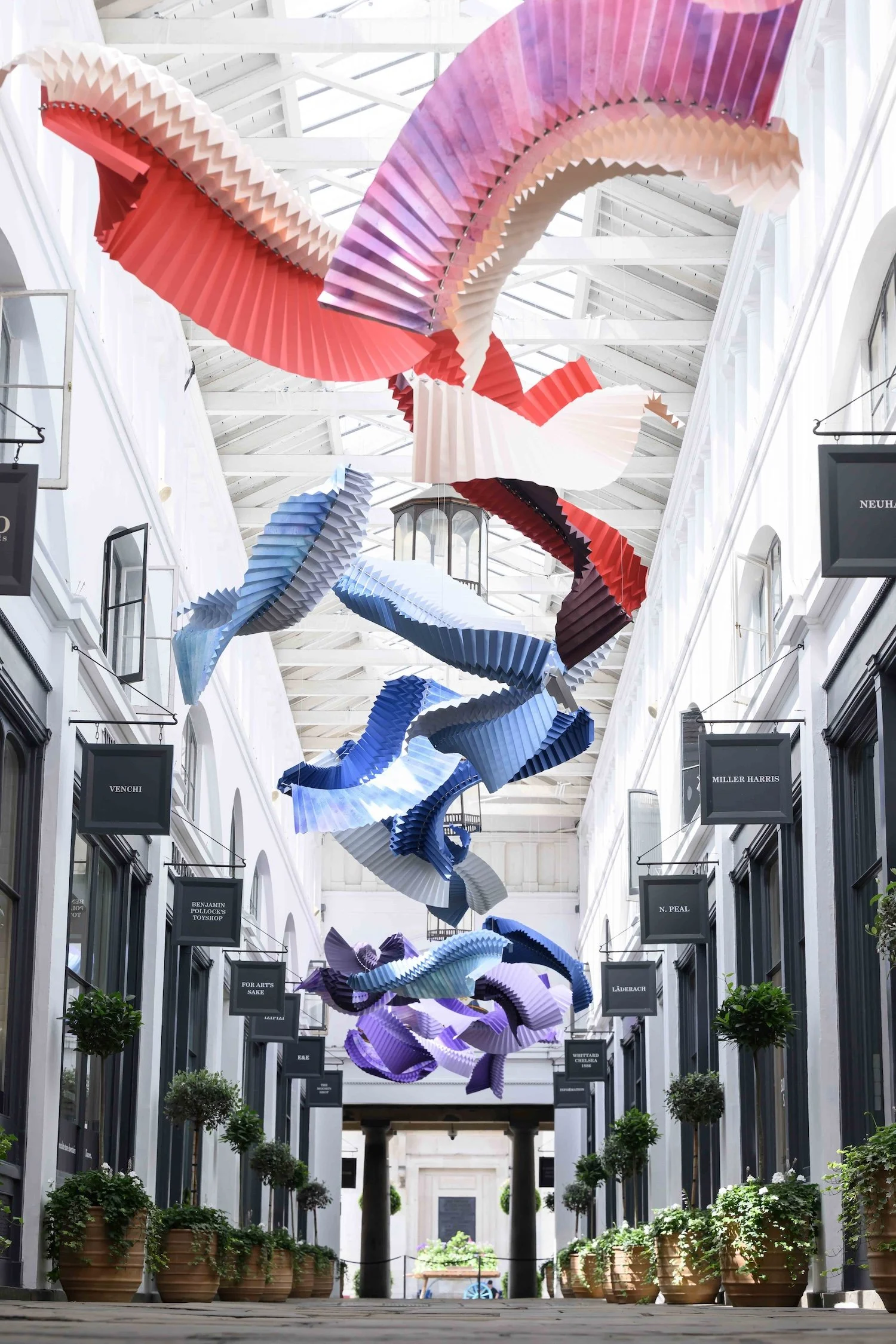
A Century of Becoming (2026) is the latest installation by Canadian paper artist Pauline Loctin, to celebrate 100 years of the Royal Ballet School. Resplendent amidst the architecture of Covent Gardens in London, UK, the 25 individual components that make up the aerial installation bring together craft and public space. Interim Editor-in-Chief Lera Kotsyuba spoke with the artist about the influence of architecture and movement in crafting the installation, which is on view at the Market Building’s Central Avenue, from June 22 to September 21, 2026.
Pauline Loctin, A Century of Becoming, 2026. Paper installation. Photo: Paul Grover. COURTESY OF THE ARTIST.
Lera Kotsyuba: How do you approach activating a space through your practice? What is unique about paper and paper folding that invites material exploration?
Pauline Loctin: I approach a space as something that already holds its own history, rhythms and memories. My role is not simply to place an object within it, but to create a relationship between the work, the architecture and the people moving through the space. I think of my sculptures almost as gestures within an existing environment – they can alter our perception of scale, light, movement and time.
Paper is particularly powerful in this sense because it is both incredibly familiar and remarkably transformative. It is light and seemingly fragile, but through folding it can acquire structure, volume and presence. A single sheet can become something architectural without losing the memory of its original flatness.
Folding is also a form of accumulation. One fold is simple; thousands of folds become a landscape, a rhythm, a body. I am interested in that tension between the vulnerability of paper and the strength that emerges through repetition. The material records the action of the hand, so the finished sculpture contains a trace of time, labour, and touch.
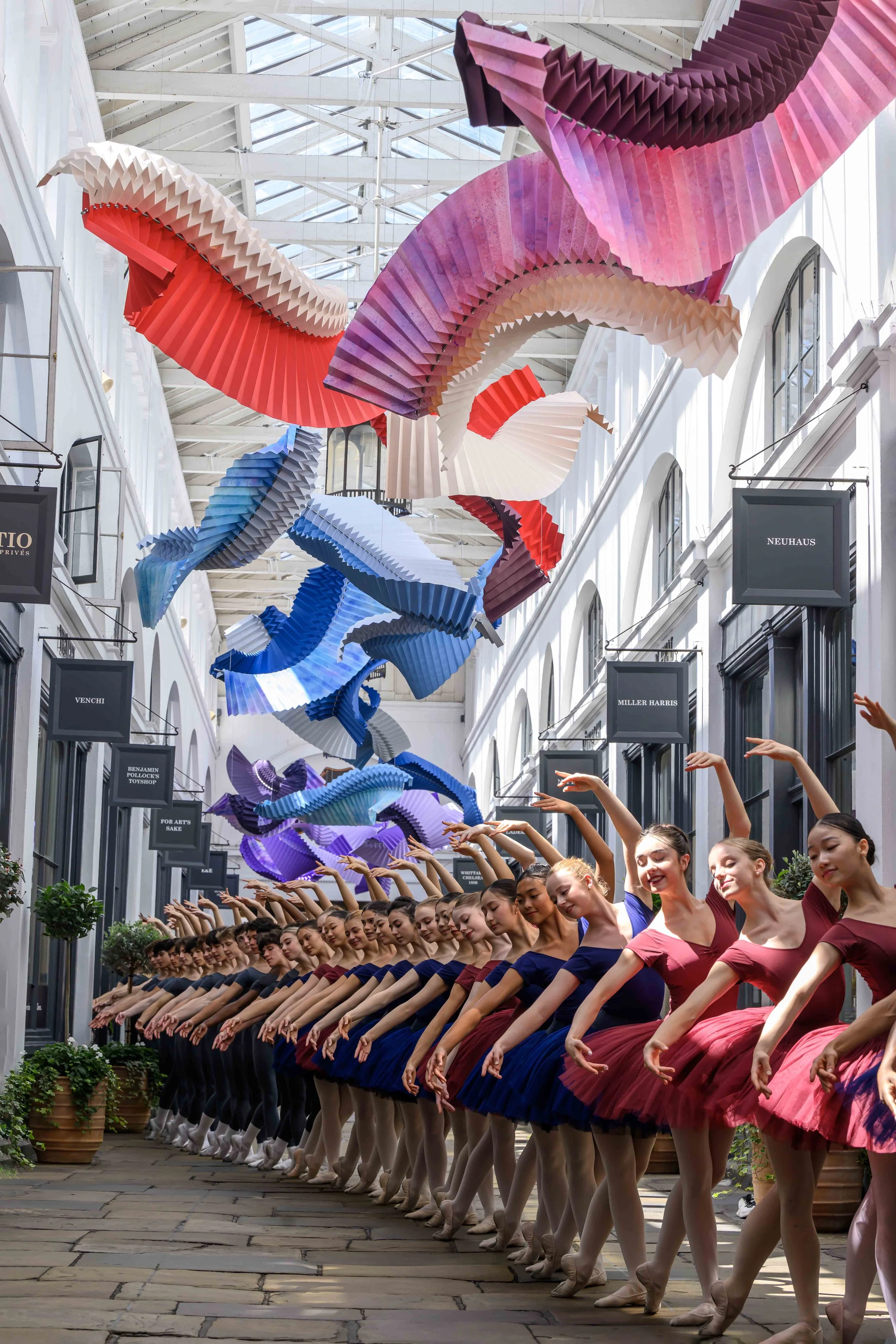
A Century of Becoming installation with dancers from the Royal Ballet School, London, UK. Photo: Paul Grover. COURTESY OF THE ARTIST.
LK: Many of your projects engage with music and movement, how do they influence and translate into your sculptures?
PL: My relationship with movement comes very much from my background as a classical violinist. I trained for many years and eventually played in an orchestra, where I had the opportunity to participate in performances that accompanied ballet dancers on stage. This experience created a very direct connection for me between music, movement, and the body.
I don't try to illustrate music literally in my sculptures. Instead, I translate some of its structures into the physical language of folding. Repetition becomes rhythm; variations in a fold become phrasing; density and scale can create moments of tension and release. There is also something very musical about the relationship between a single gesture and the larger composition.
My experience of playing alongside dancers is particularly relevant to A Century of Becoming (2026). Ballet is an art form built through repetition, precision, discipline and an extraordinary awareness of the body in space. These are qualities that also resonate deeply with my own process of folding.
This is why I often describe myself as a sculptor of folds and, more broadly, a sculptor of the senses. I am interested in how something that is physically still can nevertheless suggest movement, how the eye travels across a surface, how the body moves around a sculpture, and how a repeated gesture can create a sense of duration.
LK: For this project, A Century of Becoming, how did you approach engagement with a historic building? How did the architecture influence your approach?
PL: Architecture was a very important starting point for me. One of the elements that particularly caught my attention was the Bridge of Aspiration design by Wilkinson Eyre Architects, which connects the Royal Ballet School buildings across Floral Street to the Royal Opera House in Covent Garden.. I was struck by the visual dialogue between the twisting bridge and the language of folding that I have developed in my practice. It became an important reference for thinking about the idea of connection, movement between two spaces, and architecture becoming almost sculptural in itself.
Covent Garden also carries a very particular history. It is a place shaped by performance, commerce, gathering, and constant movement. Its relationship with the Royal Ballet School introduced another layer of history connected to the body, discipline, repetition, and the transmission of knowledge across generations.
I wanted the installation to respond to this history without becoming overly literal. The sculptures are suspended within the architecture, creating a dialogue between the existing structures and the folded forms. Their verticality responds to the scale of the space, while their strong colours and repeated forms introduce a new rhythm into the environment.
The title A Century of Becoming reflects this idea of history as something living rather than fixed. The installation became a way of thinking about the relationship between past, present and future, and about how traditions continue to evolve through the people who inherit and reinterpret them.
LK: How is movement through the space a consideration for the project? How does the project engage with time — movement of people through the space, rhythms of past and present daily lives — and how are these echoed in your work?
PL: Movement was fundamental to the project because the sculptures are experienced while walking through the space. There is no single fixed viewpoint. As people move, the works change in relation to one another, to the architecture and to the viewer.
I was interested in creating something that would be encountered gradually. From one position, you might see the folds as a dense, almost graphic surface; from another, the repetition and volume of the folds create a completely different rhythm. The strong colours also shift in perception depending on where you are standing and how the sculptures relate to the surrounding architecture and light.
This connects to my understanding of time. Each sculpture contains an enormous amount of accumulated time:more than 200 sheets of paper were individually folded, resulting in over 26,000 folds across the installation. That physical labour is embedded in the work, even though the viewer encounters only the final form.
There is an interesting parallel between this and the life of Covent Garden itself. The building has witnessed generations of people passing through it, each leaving only a temporary trace. The installation similarly exists within a continuous flow of movement: people arrive, pass through, pause, look, and continue. The sculptures remain suspended while everything around them changes.
And there is another connection to the Royal Ballet School: the daily rhythm of training. Ballet dancers repeat movements thousands of times in order to develop a sense of precision and embodiment. My own process has a similar relationship to repetition. Each fold is a small physical gesture, but through thousands of repetitions, the labour of making becomes a larger form.
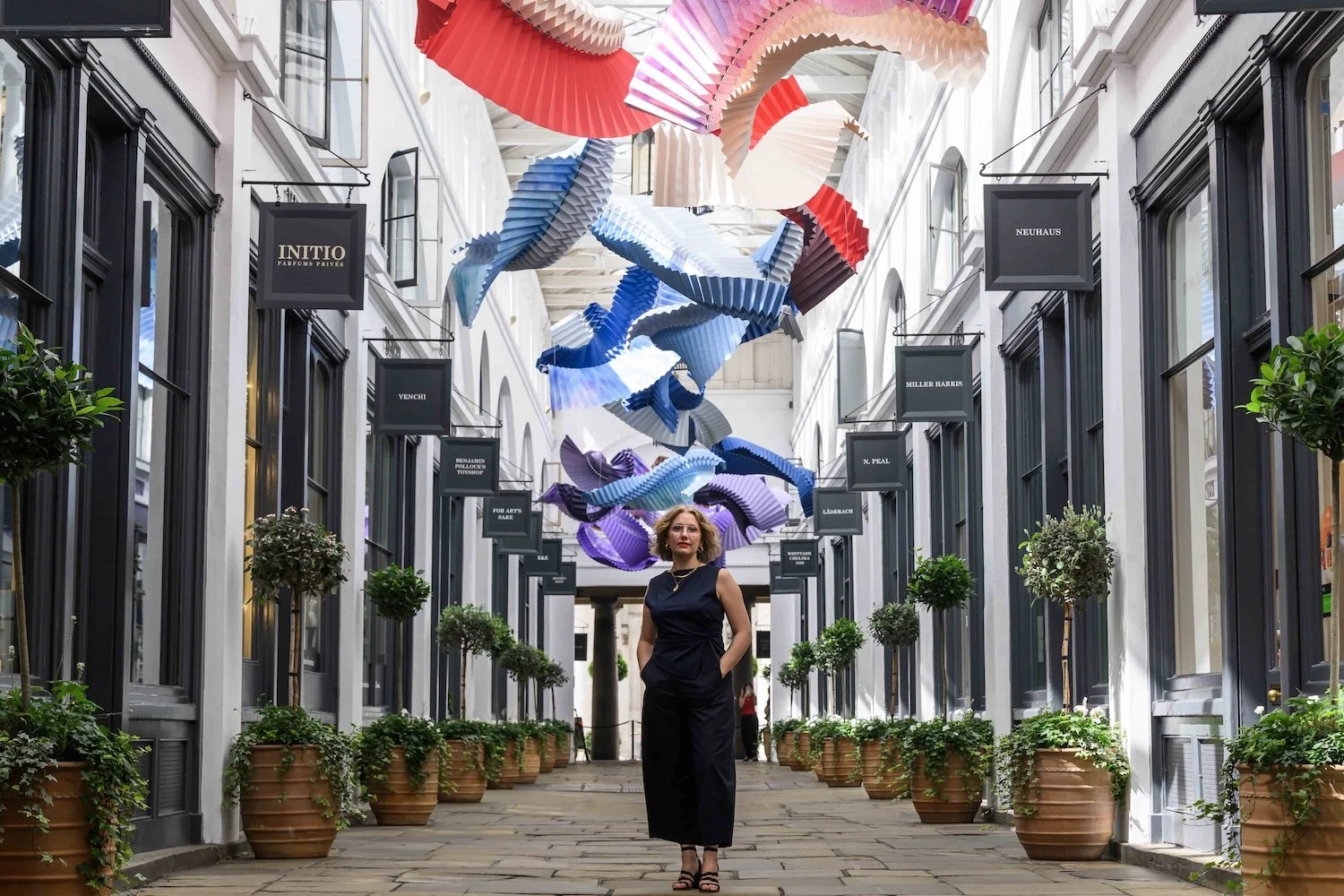
Pauline Loctin with her installation, A Century of Becoming, at Covent Garden Market Square, London, UK. Photo: Paul Grover. COURTESY OF THE ARTIST.
LK: How do you foster learning and knowledge transmission through your practice? What do you see as the future of continued craftsmanship with paper?
PL: For me, craftsmanship is fundamentally about transmission. Folding is a knowledge that can be passed from one hand to another, but it is also something that changes through each person who learns it. I am interested in that balance between preserving a gesture and allowing it to evolve.
I often think of craftsmanship as embodied knowledge. It is not only something we understand intellectually; it is something we learn through repetition, touch, and the body. This is particularly important to me because so much knowledge is now mediated through screens and images. Working with paper brings us back to physical attention to the pace of the hand and the material's response.
I believe the future of paper craftsmanship lies precisely in this dialogue between inherited knowledge and experimentation. Traditional folding techniques can become a starting point for contemporary practice rather than something fixed in the past. New papers, sustainable materials, digital fabrication and large-scale production methods can all expand what is possible, while the fundamental intelligence of the hand remains essential.
For me, continuing craftsmanship does not mean simply reproducing what has been done before. It means understanding the knowledge embedded in a technique and finding new ways to make it speak to the present.
You can read Studio’s previous article on Pauline Loctin’s work, written by Amanda Shore, from our Spring/Summer 2022 issue online.