
Métis Beadwork Resurgence
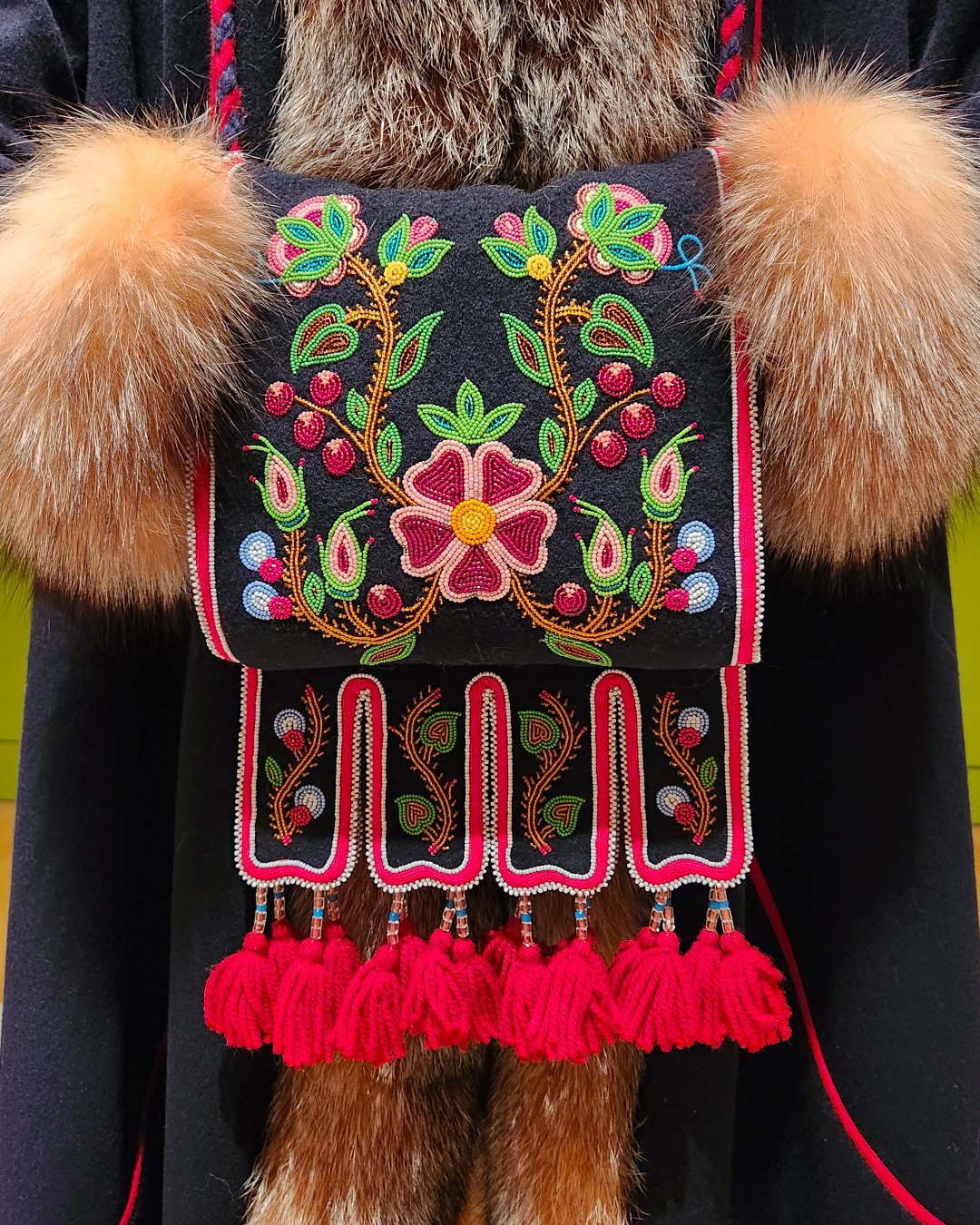
Jennine Krauchi, The Lady (detail), 2022. Fabric, fur and beads. COURTESY OF THE ARTIST.
Jennine Krauchi is an internationally recognized Métis beadwork artist whose career has encompassed national exhibitions, many awards, and community leadership in the arts. Vi Houssin is an emerging beadwork artist whose work is rooted in Métis cultural traditions and expansive through contemporary iterations. Both artists are based in Winnipeg, Manitoba, and the two met through the Foundation Mentorship Program through Mentoring Artists for Women’s Art. In early spring of 2026, the two shared a conversation about the vitality of Métis artistic expression and history, the importance of beadwork as an artistic practice, and the possibilities inherent in the medium.
JK
When I started, you know, beadwork was always around. From the time I was a very, very young girl growing up, there always seemed to be beadwork around. My dad loved beadwork. My mom did beadwork. So I can’t remember a time that it wasn’t there.
But at that time, too, it was never looked at as an art form. It was almost to the point that it was coming to an end.
VH
I have the complete opposite start. I was raised with no beadwork. My father’s family was quite disconnected from our heritage, so there was no beadwork around. There was no beadwork in my life until after I started working with the Métis government, and our mutual friend, my first teacher, David Heinrichs, was hosting a beading workshop through the Two-Spirit Michif Local. And that’s how I picked it up. And I just never stopped.
It’s so funny. Our community sometimes feels so small and you’ve played such a huge role in David’s life as a mentor, and then David was my first mentor, and now we’re both working together and consistently learning from you. It’s so funny how these lineages of artistic mentorship happen in our community.
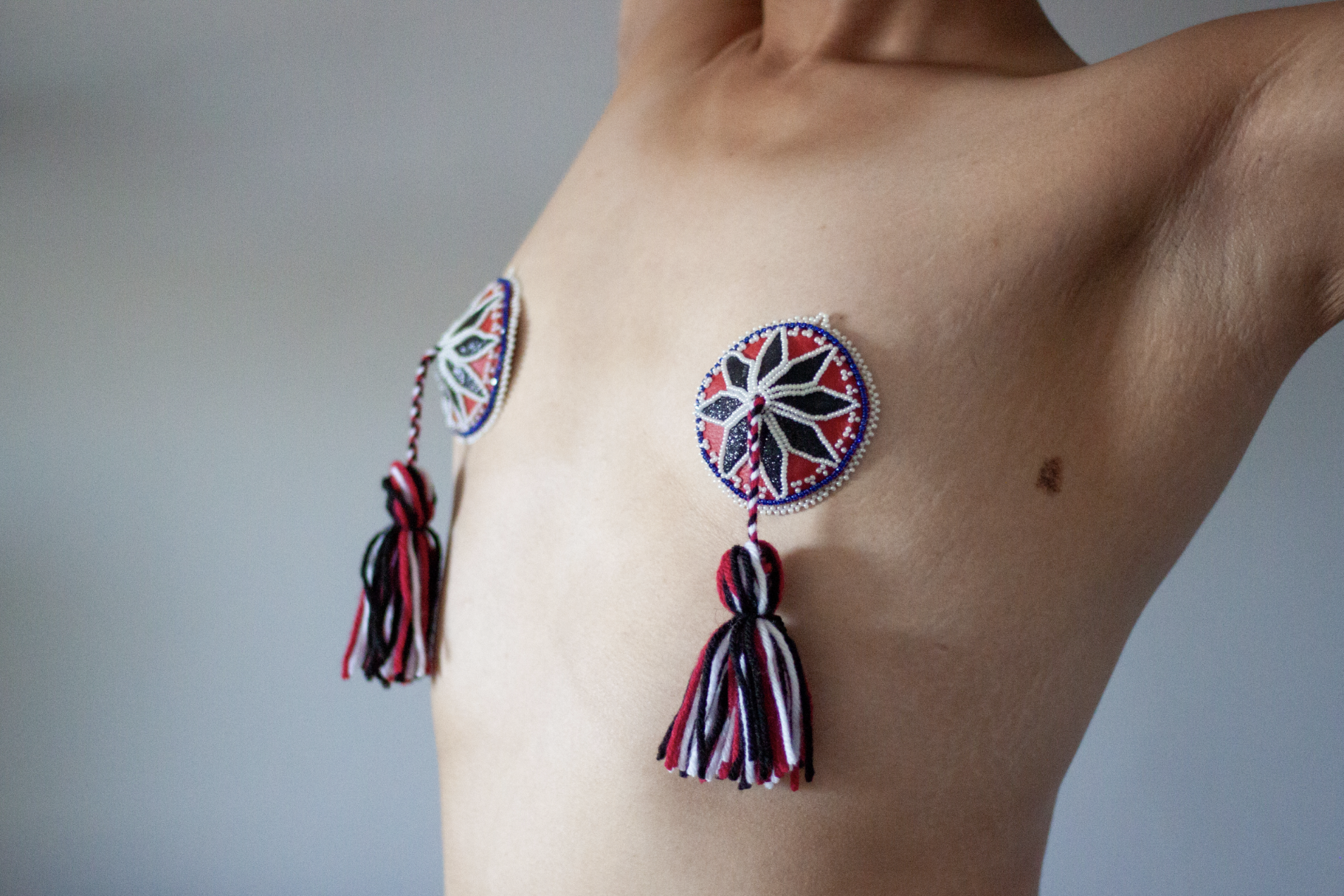
Vi Houssin, Nipple pasties, 2024. Glass beads, rhinestone banding, nylon thread, vinyl, hide, yarn, each 15 x 8 cm. COURTESY OF THE ARTIST.
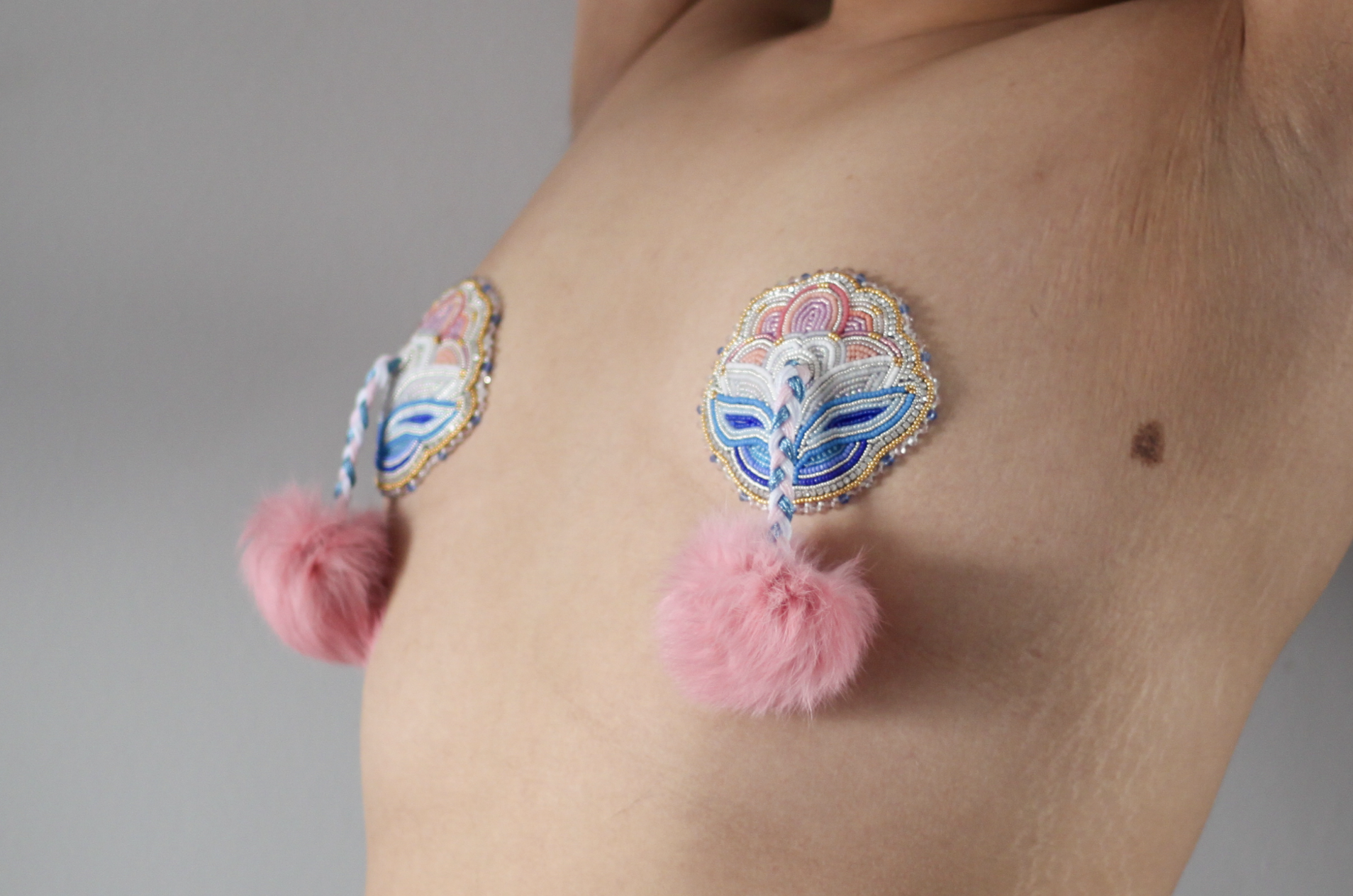
Vi Houssin, Nipple Pasties II, 2026. Size 11 & 15 glass seed beads, crystal bicone beads, nylon thread, rhinestone banding, felt, vinyl, embroidery thread, rabbit fur, each 15 x 8 cm. COURTESY OF THE ARTIST.
JK
And I’m constantly on the other side of that, I’m constantly learning from young people and the contemporary beadwork that they are doing. I just have to sort of jump out of this box I’m in and try something new. And they bring that out in me and I just love it. I love seeing the beadwork that they’re doing. What Vi is doing now and some of the younger beaders that are coming out, it’s contemporary.
And I enjoy that beadwork just as much as I enjoy the old pieces. It’s revitalization of our beadwork in a totally different way, and it’s really a joy to see consistently. The mentorship between us, it’s back and forth.
VH
Well, I mean, I hunted you out. I saw your name listed as a mentor for the Foundation Mentorship Program through Mentoring Artists for Women’s Art for this year-long program I was like, this is an opportunity I cannot pass up.
It was one of those cases of “absolutely meet your heroes.” We got on immediately. That connection was so fast. And what I found so beautiful about our mentorship was, I came to you being like, “I want to learn the traditional techniques. I want to learn how to make moccasins and how to make octopus bags and I want to learn how to make florals” and stuff like that. I wanted to learn the foundations. But you were the one who really pushed me to keep getting weirder, because you knew that was where my heart was.
JK
I think because at times in my life, too, people have told me not to do a certain thing, to do it this way or not to do it that way. And I never wanted to give that feeling to anybody else.
You do what you love to do and what comes from the heart, and that’s what it’s all about.
One bead at a time.
VH
And to me, you’re the Google of beading techniques. There is not a problem that I could bring to you that you wouldn’t have a solution for. So having someone to answer questions and help find solutions was invaluable.
But never once did I ever feel like you imposed any ideas of what had to be done or how things should be done. You’ve always been incredibly encouraging, and also the biggest wealth of knowledge in the world.
For me, I find that the fear of doing can be so paralyzing. I try to combat my fear or my uncertainty or my anxiety when it comes to making art by just doing the damn thing. Just jumping into it. And if I make a mistake, it can always be fixed.
What’s your approach? Are you very, very meticulous with your work or are you kind of devil-may-care?
JK
No, I’m sort of in between, I would say. You know, as I get older, I get a little bit bolder. Just like, okay, let’s just get at it, eh? Just start cutting, you know? And like you said, anything can be fixed.
VH
The idea that there’s a right way to do something I think is rooted in this kind of fear that a lot of reconnecting Métis have about connecting with culture in so many ways. There’s this fear, this trepidation of engaging with culture, engaging with ceremony, engaging with beadwork, engaging with community, of what is the right way to do this and what is the wrong way to do this. The truth is, the only way to learn it is by doing it. And you’re always going to make mistakes. But if you let your fear stop you, nothing’s ever going to get done.
My first floral pieces looked like nothing, but they’re so special. I hold them very tenderly because it’s the story of this person who didn’t know, who hadn’t done the research yet, who hadn’t spent hours and hours with grandmother pieces, but who was trying her best. And I think there’s a little bit of valour in that, too. So I hope.
JK
Your very first piece of beadwork, I think, should be the beadwork that you’re most proud of, because that is the piece that starts the whole journey, your beadwork journey, and that shows you how you have progressed along the way.
Whether you give that piece away or you keep it yourself, you should always be very proud of that very first piece.
VH
Do you remember your first piece?
JK
It was a little daisy chain. And I did it with this woman, Dorothy Francis. We were going to, it was called the Indian and Métis Friendship Centre, and it was on Donald Street. It was one of the first in Canada.
And I met Dorothy Francis there, and she showed me. That was the first time I ever picked up beads to really do anything. I was probably about 6 or 7, and my mom kept it. Most of it I did myself, but at the little end of it, there’s a little native chief that’s all beaded.
VH
Oh, my gosh. Too cute.
JK
I still have that piece.
And that’s the same thing with you, Vi. You look at your very first piece. Boy, you’ve come a long way in a very short time.
VH
I have a great teacher.
JK
Oh, well, hey. Great student.
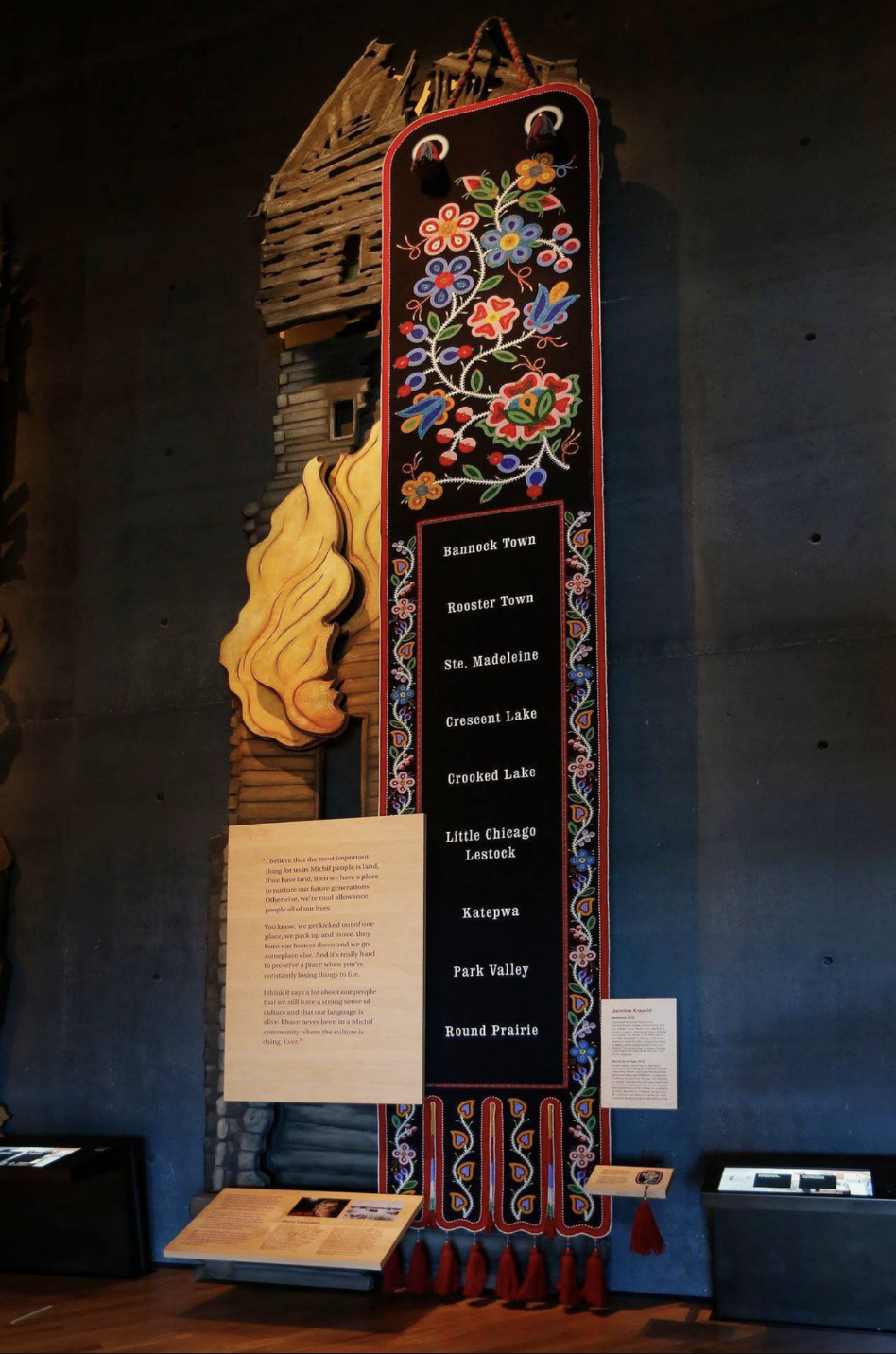
Jennine Krauchi and Jenny Meyer, Octopus Bag, 2013. Beadwork on felt. 700 x 150 cm. Photo: John Woods. COURTESY OF THE CANADIAN MUSEUM OF HUMAN RIGHTS.
VH
I don’t think that there’s anybody in our community who would ever see you as strictly a traditional beadwork artist. You, from the jump, have consistently been changing the game. I remember standing in worship of your octopus bag at the Canadian Museum for Human Rights.
This 22-foot tall thing, it was like a titan to me. You are consistently experimenting. I think that we push each other. You and me and all of our group that we have together, we’re always going weird places.
JK
We are. It’s such a personal thing. We all feed off one another.
The first project we really worked on as a group was in 2024 when we made pieces inspired by the pad saddle from Switzerland, for the Cantonal Museum of Archaeology and History in Lausanne.
VH
That was the first time that I’ve had the honour of showing my work alongside you. You are the greatest living beadwork artist in my eyes. I am so in awe of you consistently.
And the great thing about our relationship and beadwork is it’s never about competition, and it’s never about trying to meet each other where we’re at, but it’s trying to carve out pieces of ourselves from this shared cloth that we have.
JK
That was an interesting piece to do because the pad saddle is such an old piece. It’s actually one of the oldest pieces of Métis beadwork, and it’s not even here in Canada. It’s in Switzerland.
So to do this project, and all of us taking inspiration from that pad saddle, and every one of us was so different. Five different pieces.
VH
And that’s so beautiful, I think, and very evocative of the spirit of Métis work, too. We have these traditional techniques, these materials, these motifs, these styles that are so distinctly encapsulated within our culture.
But all of the artists within our nation are constantly branching out and finding new ways to expand upon these ideas, yourself included, of course. And that’s what I think is so magical, is it’s just growing, growing.
JK
And the thing was, as far as Métis beadwork or beadwork period, it wasn’t even looked at as an art form until just recently.
It was people like Dr. Sherry Farell Racette, Dr. Cathy Mattes, a few others along the way, that really opened the door for a lot of us as beadworkers to show it as art.
I don’t feel I could really say that I was an artist until I had a piece in an art gallery, and that happened not that long ago. And the next morning I woke up saying, yeah, I could honestly say I’m a beadwork artist.
VH
When was the first time that you exhibited in a gallery?
JK
That was A Hard Birth at the Winnipeg Art Gallery in 2022.
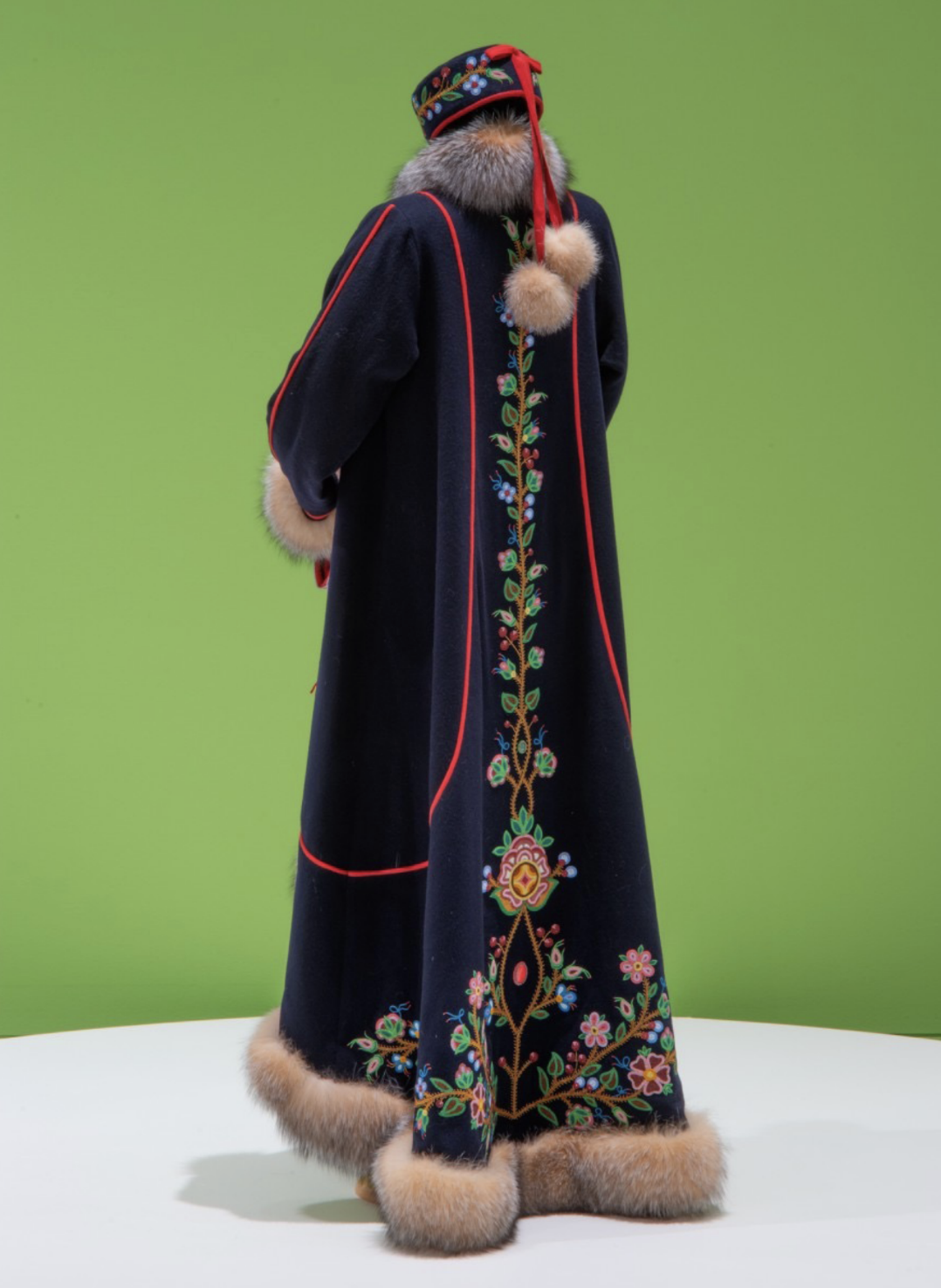
Jennine Krauchi, The Lady (Coat, fire bag muff, and hat), 2022. Fabric, fur and beads. COURTESY OF THE ARTIST.
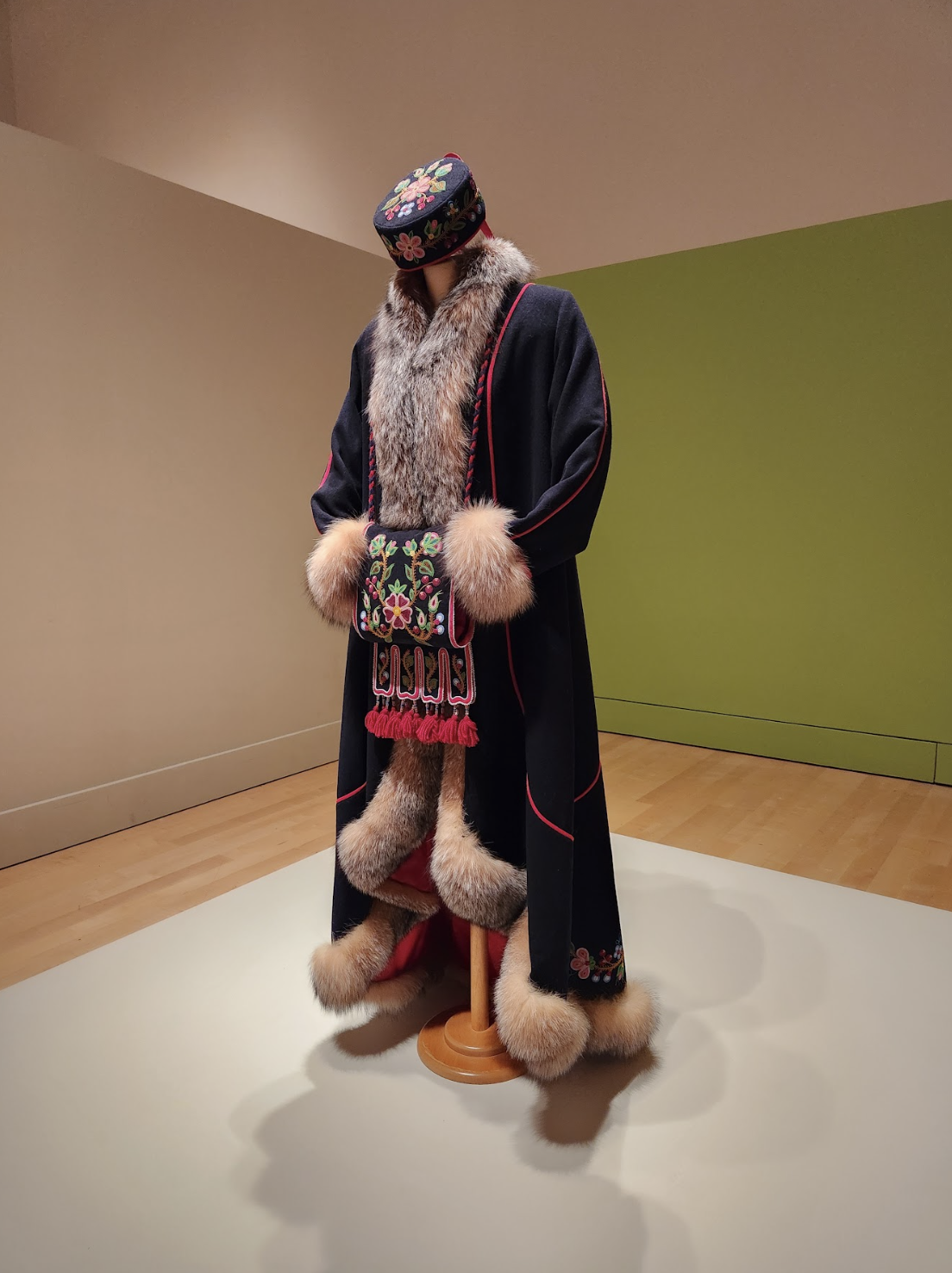
Jennine Krauchi, The Lady (Coat, fire bag muff, and hat), 2022. Fabric, fur and beads. COURTESY OF THE ARTIST.
VH
I went to see that show. It is insane that the first time that you felt confident enough to call yourself an artist, a fine artist, I was already cognizant of the art world. That’s insane because you’re a titan.
You’re the real deal. And that just goes to show how undervalued our people’s art has been for so long.
JK
For so long. Yes. It was sort of looked at as sort of like, “oh, isn’t that nice? You’re doing a nice little craft.” But it’s really exploded in the last, not even 10 years, I would say. And you’ve had how many solo shows?
VH
Just one.
Where’s yours, though? When’s your solo show?
JK
No, no. I like working along with other people. Vi’s already had this one show that was, as far as I’m concerned, probably the most personal show of not just vibes, but of beadwork.
For me, it was very emotional to go into that show. Maybe others didn’t see it that way, but that was a show that was Vi.
That was digging way down in Vi’s life, and I saw it all right there in beadwork, and it was a really emotional show. And it was the most beautiful show. I didn’t think you had it in you.
VH
Well, yeah, I love to surprise you.
I think that beadwork has this reputation or stereotype that all of our work is happy or positive or reverent, in a sense. But as Indigenous people, as human beings living on this land, we’ve all experienced profound pain. We’ve all experienced profound loss. We’ve all experienced profound anger. And it’s so important that we have a space to express that, just like any other artist, like any other artistic medium.
And so with that solo show, I was really excited to transform, like so many beadwork artists have been doing for a long time, that perception of what beadwork can be and also what beadwork should be.
JK
And you did.
Vi always makes me smile a lot.
VH
Krauchi! You’re my favorite.
I do have a question, because you’ve been beading for your whole life, but you’ve only been exhibiting your work publicly for less than 10 years. Your approach to art and your approach to sharing your work, how did that change from creating works specifically for people in private to sharing it with the general public?
JK
I think the real change happened through the MAWA Mentorship Program and meeting you and Claire Johnson, everybody that was working at and being involved with MAWA. There were a few folks that decided that maybe we could get some art grants, treat it like any other art form. And I never even thought of ever doing an art CV, you know.
And also it gave me the chance to go out there and help new artists, because there were a lot of people that helped me through this in the art field. And I thought, oh, geez, this is getting really embarrassing because it’s like, okay, I’ll be getting this or getting that. But then the more I thought of it, the more it’s like, no, it’s not for me. It’s for these young people that are coming along. These young ones that are coming along right now, I’m telling you, they are really beating down a path.
It’s a transition, going into the art field. Boy, it’s been very, very rewarding. Not just financially, but really rewarding to know that we can stand behind our art. We can look at it and feel proud and see it in galleries. It’s been a big step for all of us involved.
There were a lot of people that said we’re going to do it to make sure that our beadwork is looked at that way.
VH
Yes. And you became this huge advocate for the medium. I mean, you’ve been renowned, of course, within the Métis community and within the beadwork community for so long, but within the four years since A Hard Birth, you received the Manitoba Arts Award of Distinction. That is the biggest arts award in the province. Has that been difficult for you to navigate? Moving from one level of recognition to this other level of recognition?
JK
Yes.
VH
Because you’re so humble?
JK
And the recognition and all of that. It has been very humbling. It’s like ... I just don’t want to make it about me. You know, because it’s not.
You know, there’s all the people that came before me. It was a real change. Of course, I always feel very honoured, but there’s times when I feel, “Is somebody gonna find out about me?” You know, that’s sort of like, oh no
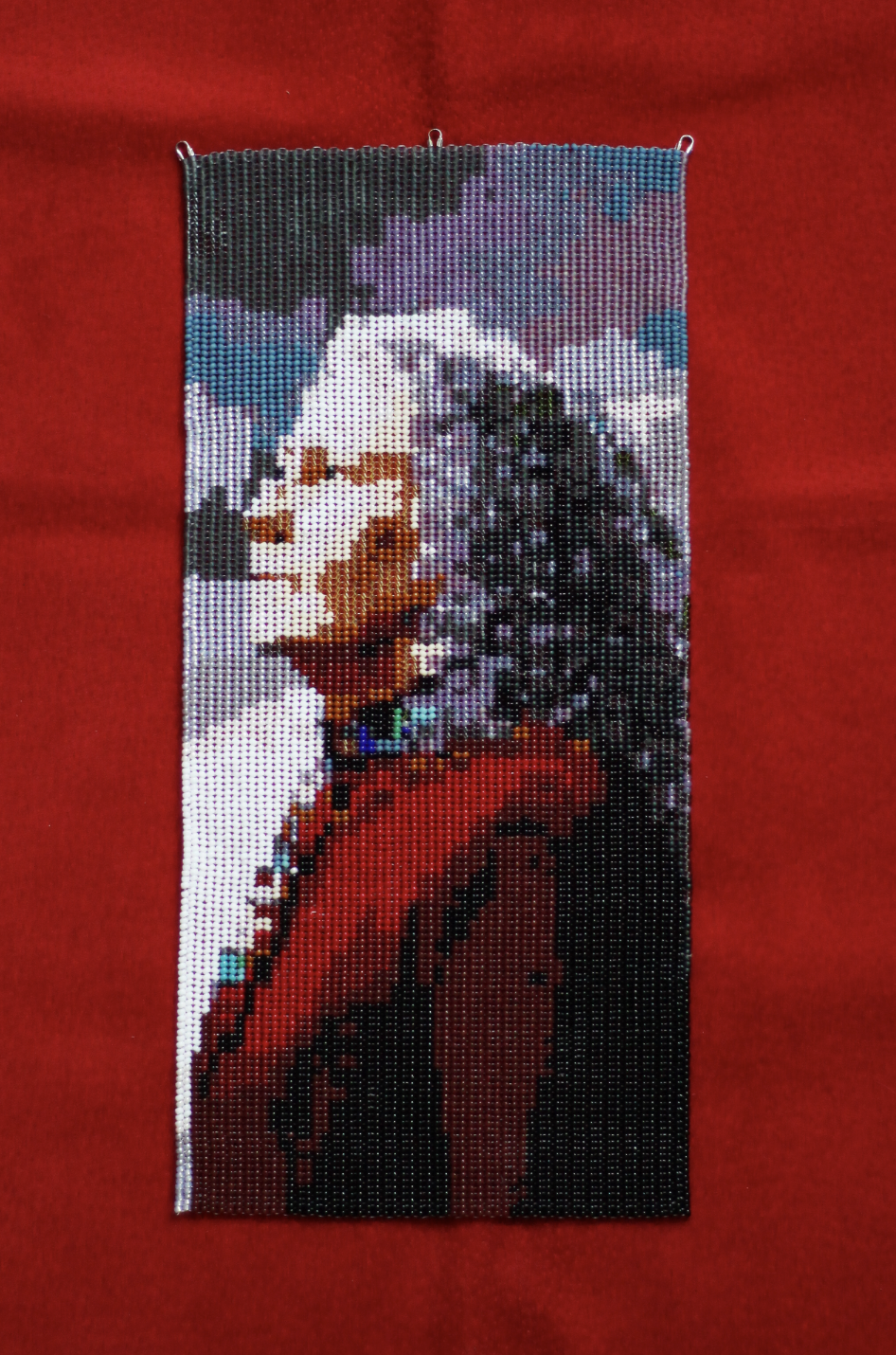
Vi Houssin, Jennine, 2023. Seed beads, nylon thread, wire guardians, 26.7 x 12.7 cm. COURTESY OF THE ARTIST.
VH
You’re so humble. You hate hearing this, but you’re my North Star. You are the pinnacle of so much for me, including art.
JK
I am coming towards the end of my life, you know? I’ve got so many other things that I’m going to make in beadwork, that I want to do and I will be doing, but, you know, I have a heavy duty deadline. But I’m here to see all of this happening, and it’s like, I should be so lucky. But Vi’s work is a different type of work.
You know, Vi also does know the old way. Knows the history of our old grandmother work. And I think it’s like anything else, it’s like music or any other art. You have to know the history of it before you can go and take it that other step.
VH
Yeah, you have to know the rules before you break them. It’s so practical for a craftsperson as well, because if you are trying new techniques or you are experimenting, you may think that you are breaking completely new ground. But I guarantee there are grandmother pieces that have covered that ground before, and they have made the same mistakes that you have, and they have found the same remedies that you will. It’s so important to research and know where our work comes from before you start to turn things on its head.
JK
Yeah.
VH
I mean, so much of my work is inspired by the grandmother pieces. So much in ways that are both perceptible and imperceptible. And not just the grandmother pieces. I mean, your work as well, has been such a core inspiration.
I have a strong opinion. Like so many beadwork artists, I didn’t come from an arts background. I didn’t go to university for this. I don’t have a BFA or whatever.
I’ve never had a professional arts class in my life, so I’m a completely uneducated source on this matter, but I firmly believe this: the difference between whatever is hanging in the Louvre and what is hidden away for decades and decades in museum archives isn’t skill. The difference is misogyny and racism.
The skill and talent and power and impact that Métis women have and put into our beadwork is no less than big statues and big paintings that cost tens of billions of dollars and hide behind bulletproof glass.
The only difference is how they’re treated and how they are marketed.
And I’ll always stand behind that. Métis art, to me, is some of the most beautiful, meticulous, skilful work in the world, and it deserves to be treated as such.
JK
It was never given the credit it deserved.
VH
All of these works, these beautiful, beautiful works misattributed to the wrong nations, much less given names and reported and recorded who created these works. It’s such a shame in so many ways.
That’s part of the work that I think that we’re doing is finally getting recognition for the generations and generations and generations of women who have put so much of their lives and so much of their spirits into this medium.
JK
I know I said it before, but I’ve never thought in my lifetime I would see it this way, because at one point, too, it was against the law. At one time, it wasn’t possible. You know, beadwork almost did die. It almost came to an end. And in the way things are now, it’s never going to come to an end. It is always going to be here ... and it’s here to stay.
VH
Beadwork is encompassing. I’m so interested in the disparity between beadwork as an artistic medium and other artistic mediums, because I believe so firmly that we should be treated with the same respect as any other artistic medium. And yet it is different.
It is something that is so special and holds a lot of spirit to us. It’s hard to communicate.
JK
Well, it connects us, really, to our culture. Being Métis, that’s a connection. For myself when I’m beading and I’m working, there’s this connection that I just feel when I’m involved with beads.
Other people may have it in other ways, other Métis people. But, when you think about our beadwork and you think about how it just about faded away, and there were a lot of reasons that that happened. People decided that maybe they would hide their beadwork.
They would tuck it away in a drawer or put it in a box and hide it someplace. But there was always something there. A lot of them kept it. So I always sort of feel that, you know. Sure, we were made to feel ashamed that we’re Métis. I still feel because of those pieces being hidden away somewhere, there was something inside us that said, no, we were still very proud. Deep down inside, we were still very proud of who we were and who we are. There were two things that were almost lost: our language and our beadwork, because those identified us more than anything else. People didn’t wear their beadwork anymore because right away, you’d be identified as being Métis.
So to sit and do a piece of beadwork, whether it’s a jacket or just something that I just wanted to make, it’s the strong connection that I have to my culture, and I grew up with a lot of my culture, and I grew up with a lot of pride and being proud of my Métis culture. So there’s that.
Because our beadwork is floral, it’s happy. It’s all about stems going here and there and connecting. It’s almost like our genealogy. First thing we say when we meet another Métis person is, where are you from? What’s your background? You know, what are your family names? Somehow in there, we’re going to be connected. So in some ways, that’s kind of like our beadwork, it’s always kind of connected somehow.
VH
For me, it’s also a deeply spiritual practice. I feel something within me that I don’t feel with other artistic mediums. It transports me to a whole other place, and I feel that spirit. I feel that anima in the works in a way that I don’t experience with any other medium.
I think it’s because with beadwork, you can see time, you can see care, you can see attention, you can see passion. So it’s very strong.
I think even if I wasn’t pursuing beadwork as an artistic medium or as an arts career, I would still be beading. I don’t think I know how to stop anymore. It’s just a part of me.
JK
Yeah, that’s exactly right. It’s one of the biggest clubs around, you know. You know, it’s all over the country. Doesn’t matter where you go, especially in Indigenous communities, you’re bound to find a few people that know how to bead and you connect.
Where you go in Canada, you’ll find a beader.
VH
It’s crazy what you can do with a needle, thread, beads and some fabric. Change the world.
JK
Yeah.
VH
You changed mine, Jennine.
JK
Well, you rock mine.
VH
Thank you. My goodness.
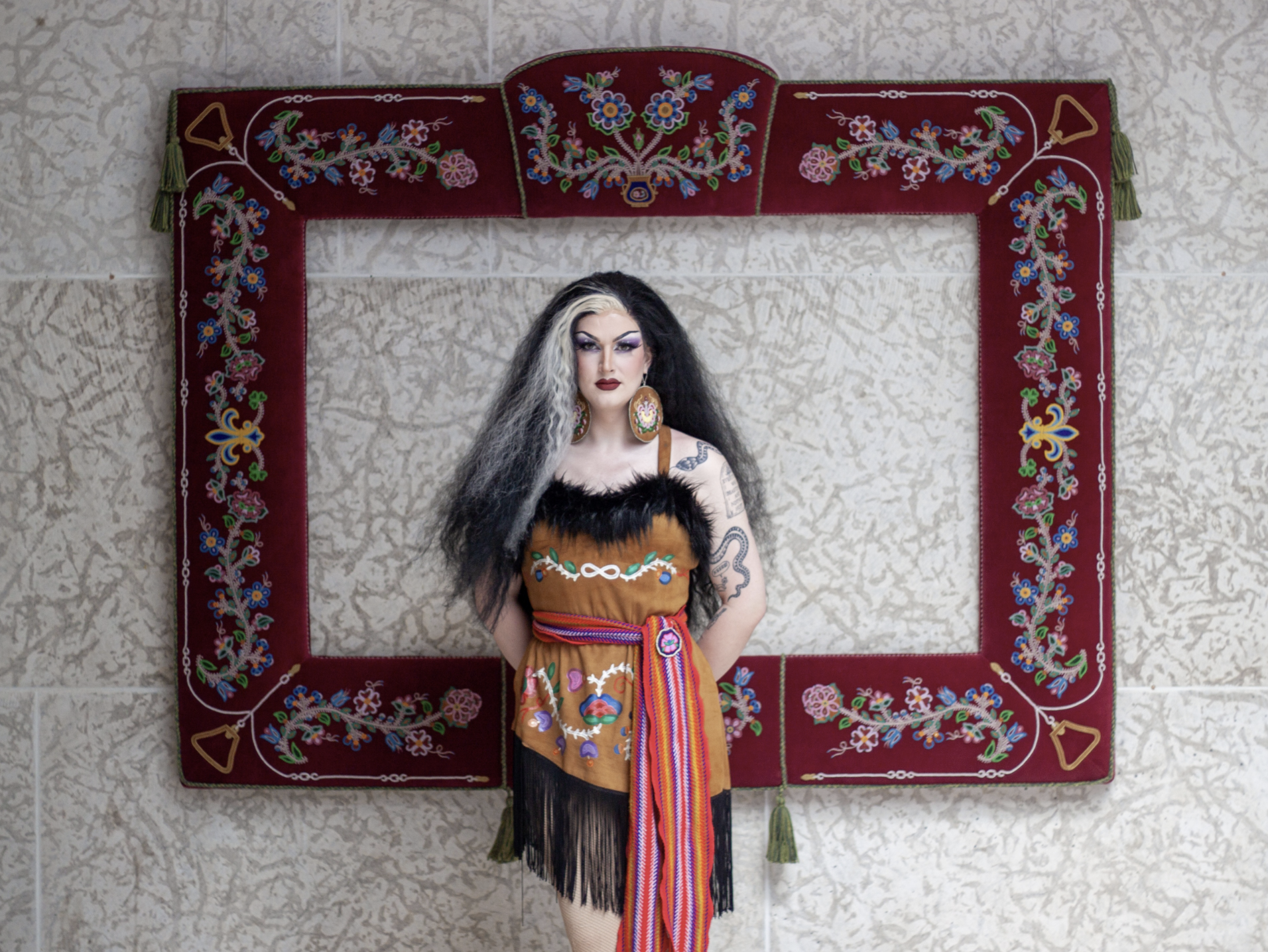
Vi Houssin in her drag persona standing in front of Jennine Krauchi’s beaded picture frame, 2024. COURTESY OF THE ARTIST.
JK
I see a really, really bright future for beadwork. I wish I could live another 50 years to see what it would be like in 50 years from now.
VH
Consistently, I’m seeing works that I could never imagine. Carrie Allison’s we tend to care show at the Winnipeg Art Gallery just exploded my mind. And Nico Williams’ Bingo show last summer at PHI in Montreal was just game changing. I think the future is unimaginable because the creativity of our people is boundless. But I do hope that beadwork is always still grounded in community.
I think that’s so important that we maintain this closeness and this lack of jealousy and competition. And this sharing of knowledge between generations that we have. I think that is what makes this medium so special.
JK
Because, you know, when I first started beading and getting really involved in some of the first workshops and getting together with other beaders, we could hardly fill a kitchen table with Métis beaders.
And now, I would say, we can fill auditoriums. I bet you there isn’t one Métis household that doesn’t have one or two Métis people sitting at a table doing beadwork.
It’s just taken off. A resurgence.