
One Bead at a Time
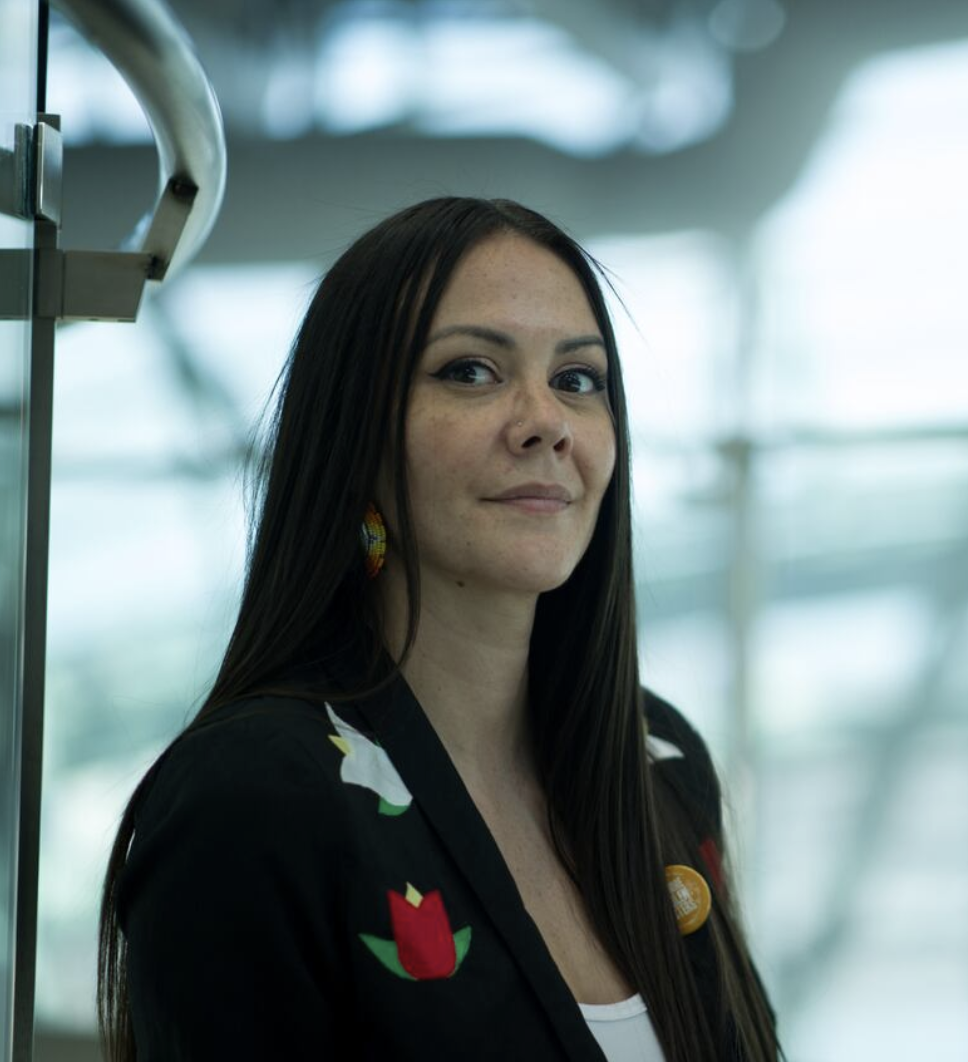
Tammy G. Wolfe. PHOTO: ROY SABAY PHOTOGRAPHY.
As a proud First Nation Ininiw Iskwew (Cree woman) originating from Norway House Cree Nation in northern Manitoba, Canada, I have always carried a profound interest and significant connection to my identity, my culture, and the rich traditions of Indigenous art practices.
As a longtime beader, artist, and emerging Indigenous fashion designer with Red Hummingbird Designs, this connection existed long before I had the language to describe it, long before I was consciously aware of its presence, and even before I had any direct exposure to the cultural teachings that would later shape my profound journey with beadwork. It was as though this bond was woven into the very fabric of my being — an invisible thread linking me to generations of knowledge, resilience, and spirit — and I know now, this connection can be called blood memory: “In Indigenous thought ‘blood memory’ is the occurrence of an experience of those that have gone before us being embedded in our physical and psychological being.” [1]
One special moment occurred for me when I was just eight years old, when I was living on reserve in Pimacikamak First Nation (Cross Lake), Manitoba. It was during this time that I was introduced to the intricate and beautiful art of beadwork. I was given a fishing tackle box full of beads from my uncle’s mother. The beads I found in it were very old and I was strongly encouraged to use them to begin creating beaded pieces. The fact that I did not have a traditional teacher, inspired me to begin the arduous task of teaching myself through trial and error, highlighting my blood memory connection to the beads. That experience etched itself into my memory and being, becoming a pivotal moment that would be a crucial aspect of my own journey back to culture, strengthening my identity and urging me to find out who I was and where I come from. It took only a single bead to plant the seeds of inspiration and curiosity that would grow over the years, compelling me to seek out deeper connections to my heritage, my community, and the artistic practices that are so integral to our identity as Ininiwak (Cree People).
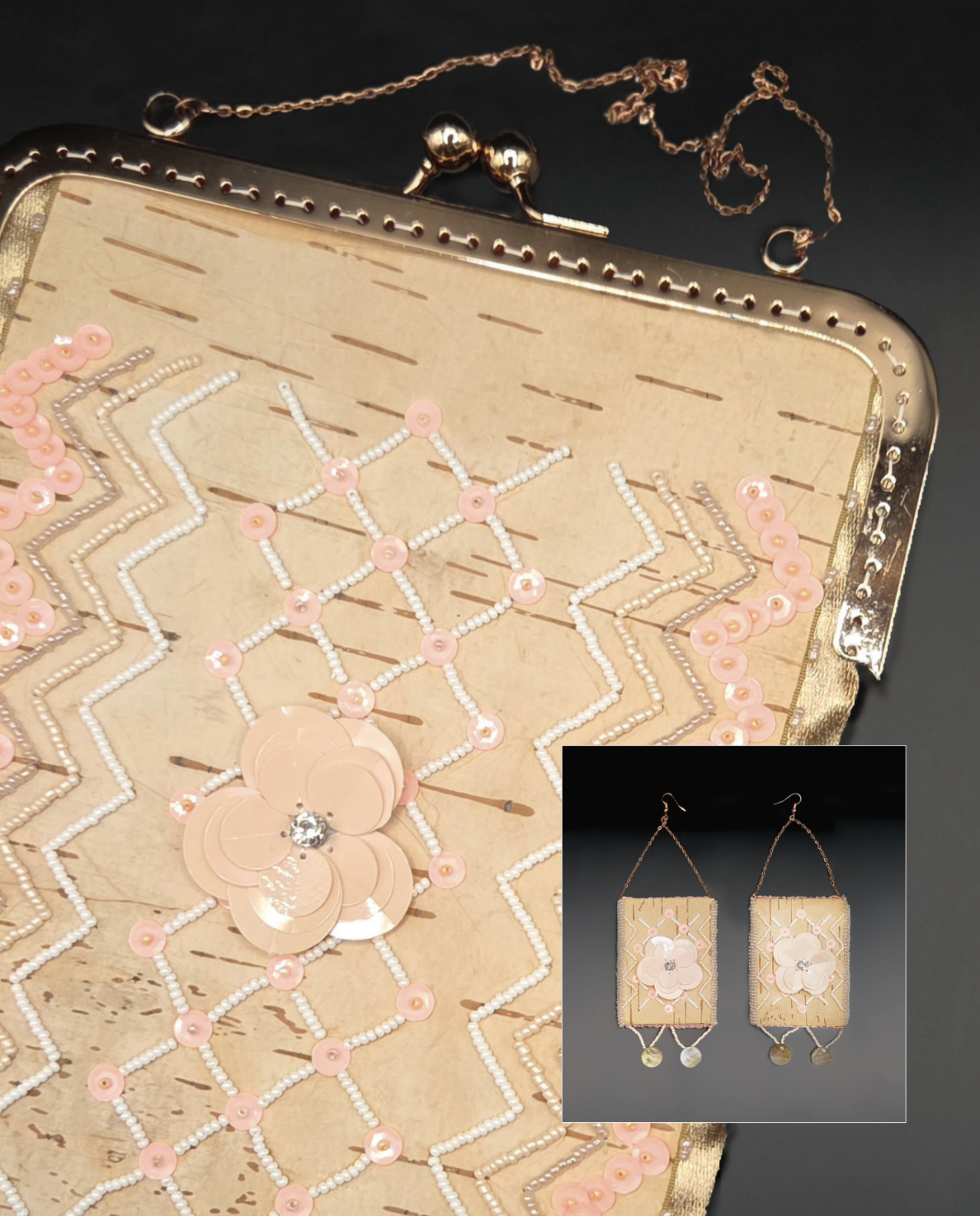
Tammy G. Wolfe, Birchbark Bag and Earring Set, 2025. Birchbark, metal, beads and thread. Bag 17 x 23 cm, earrings 6 x 9 cm. PHOTO: TAMMY G. WOLFE.
I have most recently been involved in three fashion shows in 2025 — at the 25th Annual Manito Ahbee Festival, in Saskatchewan Fashion Week, and in CRAFTED on the Catwalk — that featured my beaded jewellery as wearable art. Each beaded piece was created to tell a story of land, medicine, and spirit, connecting to Indigenous culture and traditions, constructed with not only glass beads but also traditional materials, highlighting both the past and contemporary expression. I created the green thunderbirds in shades of green that mimic nature, the land and hold sacred teachings related to my connection to being thunderbird clan. The birchbark bag and matching earrings were inspired by an embroidery pattern found in a Godey’s Lady’s Book magazine, printed in 1861. I utilized this pattern as inspiration to connect to the ancestral traditions of adaptation and inspiration from early contact between Indigenous Peoples and settlers. The use of birchbark and beads to create this set highlights how traditional practices and ancestral traditions evolved into modernity.
My path to reclaiming and nurturing this connection has been shaped by painful disruptions. Like many other Indigenous Peoples within Canada, I experienced a deep disconnection from both my mother and my home community; a separation rooted in the devastating legacy of colonialism. My mother was apprehended during the 60s Scoop, and I too was taken through the child welfare system — systems which were created and specifically designed to target and sever Indigenous children from their families, languages, and cultural lifeways, much like residential schools. These experiences significantly fractured my access to cultural knowledge and weakened my physical and emotional ties to the community that should have been my foundation. Like so many Indigenous Peoples across Turtle Island (North America), I have felt the weight of systemic injustices that have eroded our collective sense of belonging and distorted our identities, creating lasting disconnections and disruptions to our relationships to land, language, and artistic expression. The impacts of discriminatory practices can still be felt today, but we can also see the surge of reconnections to traditional beadwork and other forms of art-based practices of Indigenous Peoples within Canada and across Turtle Island today.
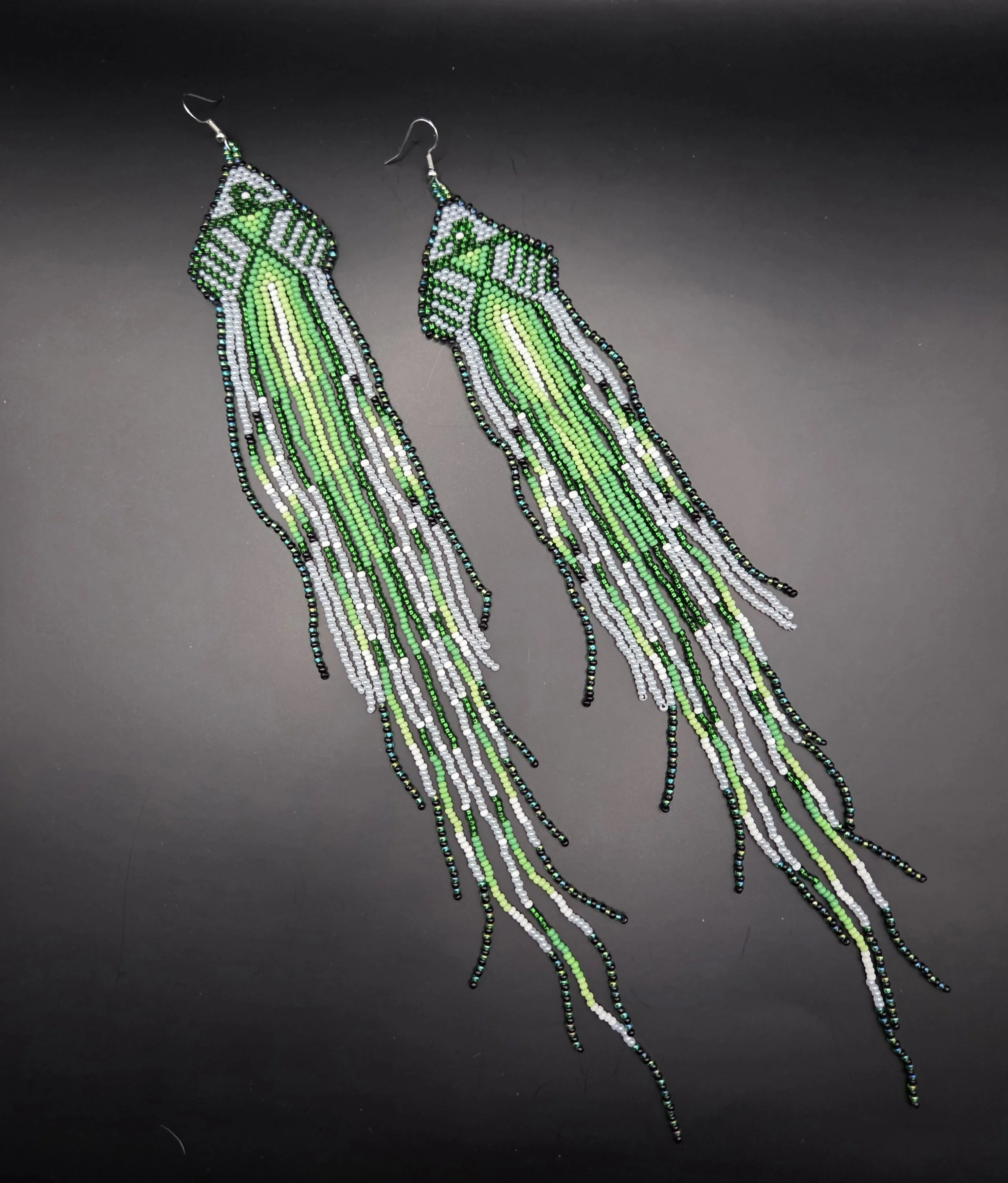
Tammy G. Wolfe, Green Earrings, 2025. Beads, metal and thread, 5 x 30 cm. PHOTO: TAMMY G. WOLFE.
I recently coined the term “Indigenous renaissance” which speaks to how Indigenous Peoples in droves have been inspired to pick up and reconnect with our traditional practices, made possible by finding and building community on the internet, and the disruption of the COVID-19 pandemic as a catalyst to reconnect to culture. Despite many historical ruptures, there have been moments of profound reconnection for myself and others, moments that have reignited the flame of cultural memory and spiritual belonging. In this moment, people are taking notice of Indigenous artists and their crafts, and many are being given national platforms to showcase their work in major museums throughout Canada and North America.
We offer the teaching of the spirit bead, one bead that is unlike the rest. We purposefully or maybe even unintentionally find a bead out of place, or of a different colour, that makes its way into our work. This is the Creator's humbling of our creation, in order to teach us that we are all imperfect beings, that we must remain humble. With this idea in mind, I want to celebrate beadwork outside historical collections kept in museums. Historical and contemporary beadwork should not only be observed in museums or art galleries as specimens, hidden behind glass and untouchable, paid to be viewed and placed behind a rope by colonial powers. Beadwork is to be worn, shared, held, touched, and spoken to, as if it were a relative, because it is. These items are not meant to be stowed and tucked away under a colonial framework of access, but celebrated within community through wahkotowin (kinship) practices, because beads connect us to one another. I don’t know how many times I have stopped someone on the street or been stopped by people that remark “I love your earrings! Where did you get them? Did you make these?” These simple gestures build community with this beautiful artform. When someone wears my beadwork and designs I want them to feel beautiful. I want them to feel confident; they should be proud of being Indigenous and who they are. It shows that beadwork can and should be worn and celebrated in our everyday lives. Beading practices are not out of our reach.
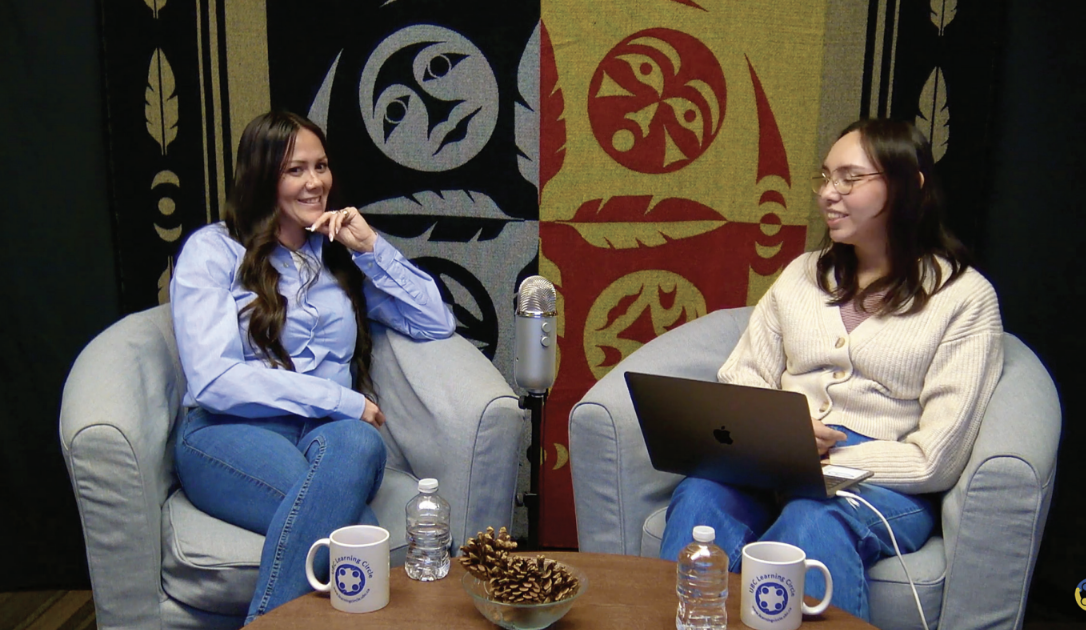
Still from an online interview Beadwork is Medicine. Strengthening Our Communities, Featuring: Tammy Wolfe. Moderated by Sarain Squakin. IMAGE COURTESY OF UBC LEARNING CENTRE | CENTRE FOR EXCELLENCE IN INDIGENOUS HEALTH.
During the COVID-19 pandemic, I was gratefully able to share my gifts to teach beadwork by holding free beading workshops to the public, online via Zoom. This experience was community creating and building with many individuals across Turtle Island. The access to holding online workshops and the ability to meet with a wide variety of different people helped to facilitate not only connection to culture, identity and the ability to share beadwork skills, Indigenous teachings and language, but the building of relationships, a sense of belonging and wahkotowin within the Indigenous community through beadwork. I feel grateful to be able to support new learners and help to build their connection to beadwork and also encourage the sharing of their gifts, their beadwork, and newfound knowledge with others.
As an artist, maker and designer I also want to celebrate beaders who make work for their community, who choose to make wearable art: earrings, hairpieces, belts and accessories. The beaders I admire are the ones who are quiet, the ones who have sat with their heads down and their beads and needle up. The ones who sit at the markets with their displays of pairs of earrings, their hat bands, and car mirror hangings. The ones who have used beadwork to heal, to reconnect and to show who they are proudly. The beaders who don’t have thousands of followers on social media, but create as if they were being watched by the generations of our ancestors who have come before us.
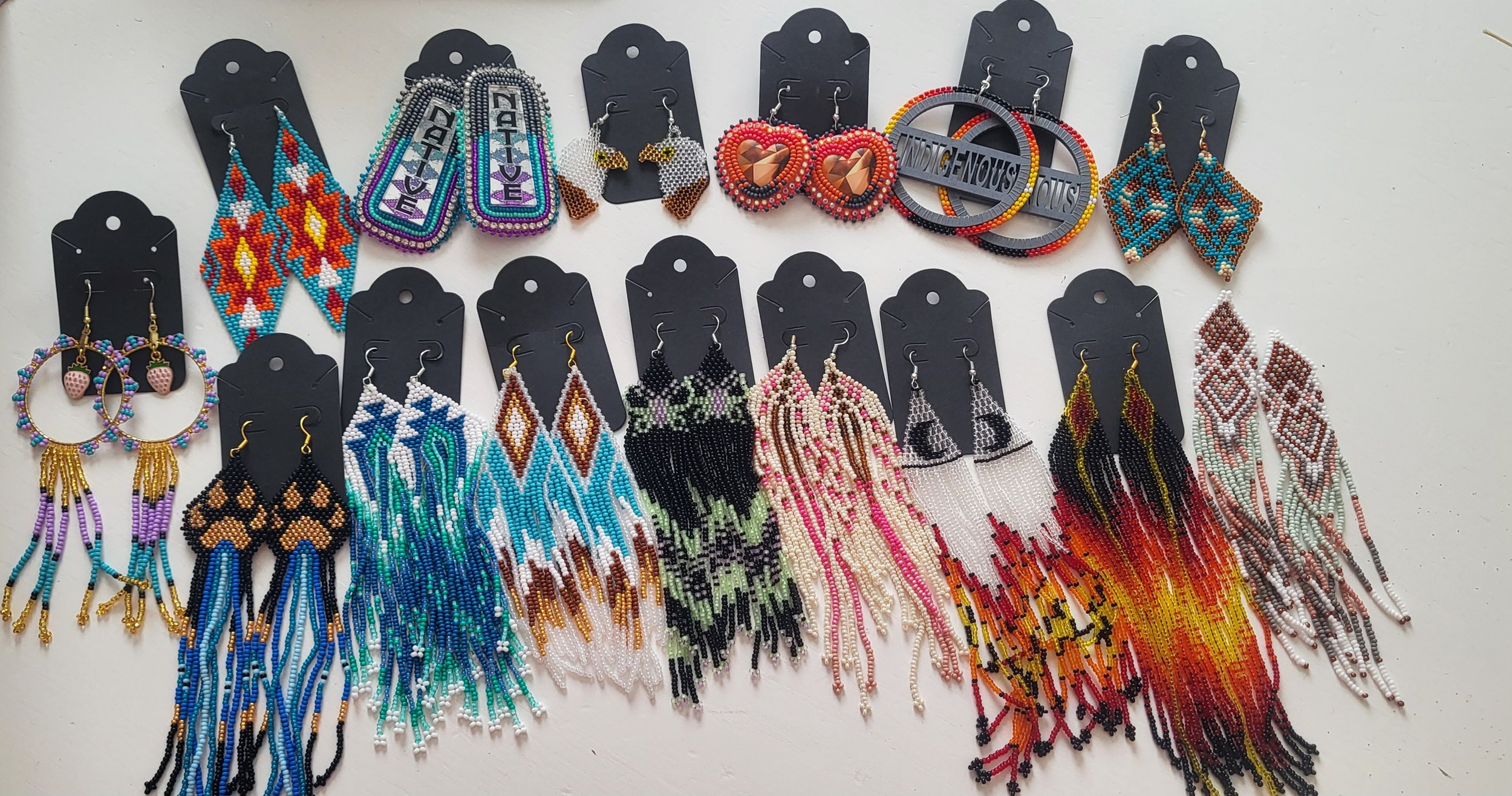
Beaded Earring Collection by Monica Ballantyne, 2026. Beads, metal and thread, Dimensions variable. Photo: Tammy G. Wolfe.
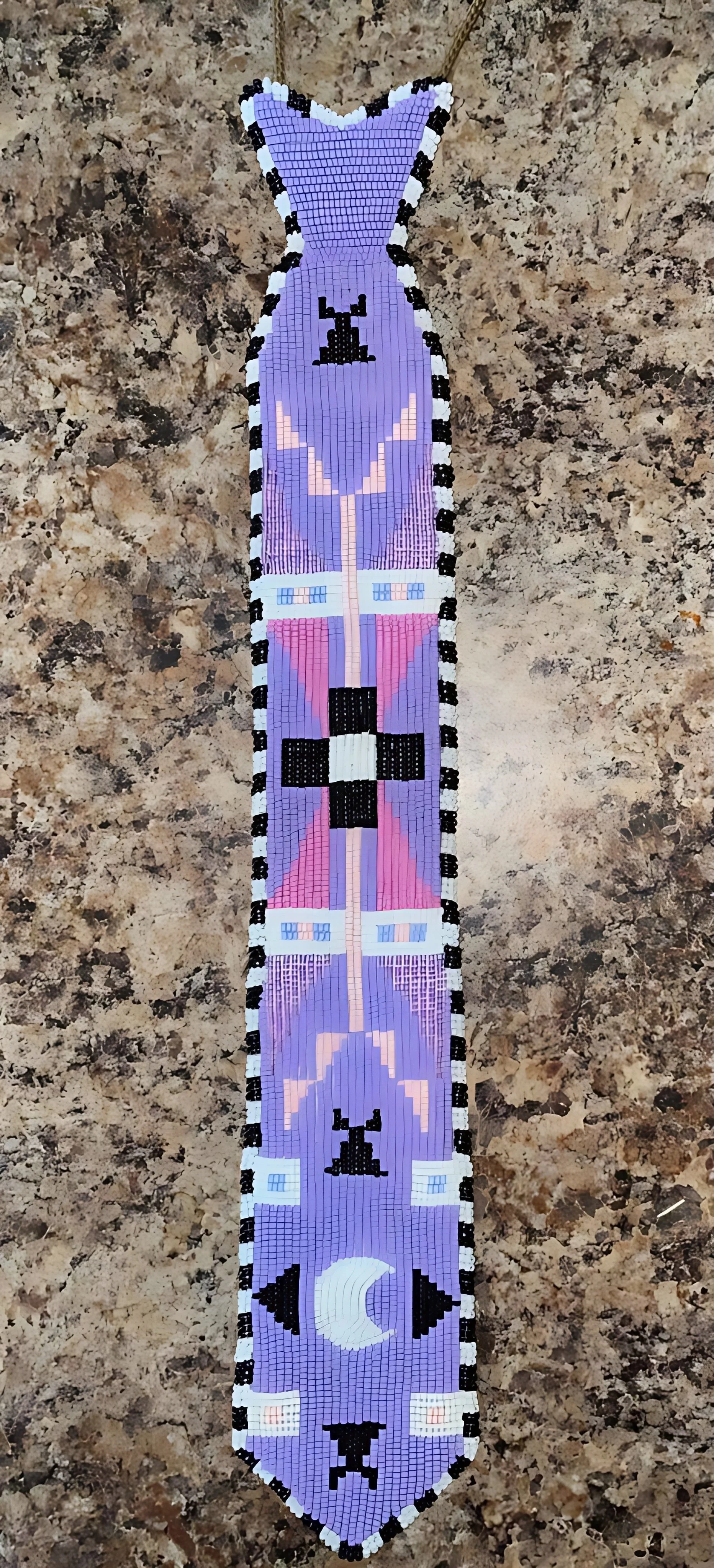
Trina Bull Bear, Beaded Tie, 2025. Beads, metal and thread. 6 x 42 cm: Photo: Tammy G. Wolfe.
Beaders like Kim Schellenberger and Rachael Clarke who originate from Norway House Cree Nation. Rachel’s beadwork represents the time and meticulous care it takes to begin a pair of moccasins which are constructed after the beadwork is completed. There are many steps that need to be completed after the beadwork is done on the vamp.
Monica Ballantyne who is connected to Lac Seul, Ontario, and Trina Bull Bear who is from Siksika Nation. Monica’s beadwork shows the consistency of time, patience and creative artistry that it takes to build a collection of earrings to be shown at a local market or showcase. Often the creative process is overlooked and undervalued as beadwork is seen as being so effortlessly created. Her collection of beaded pieces help to shine a light on the patience required to bead.
Trina’s beaded tie is one of the most unique pieces I have come across. I enjoy beadwork that is one of a kind and showcases the creative skill it takes an artist to dream up a never-before-seen design. Her creation highlights the versatility of beadwork and how it can be adapted to create pieces that can dress up a tailored suit or be paired with a sewn ribbon shirt for that extra flair.
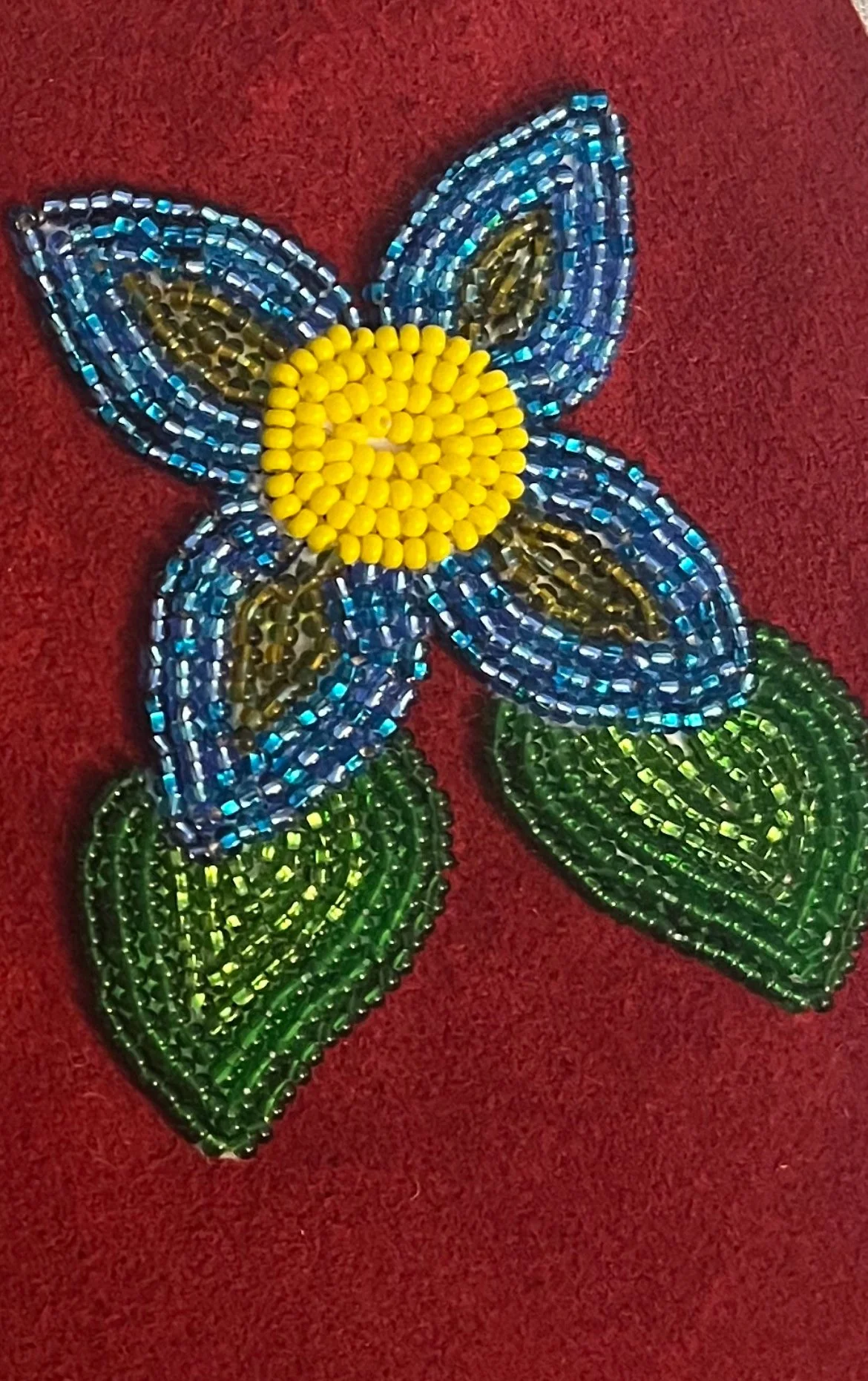
Rachel Clarke, Blue Flower, 2025. Beads, thread and hide. 7.5 x 9 cm, Photo: Tammy G. Wolfe.
Their beadwork inspires me because of their diversity and intention behind their artistry. These beaders are thriving, by mastering their craft, mastering their design techniques and producing one-of-a-kind beadwork that shows their skills, talents and gifts. It honours their spirit and community, and the love that they have put into the hours upon hours of time, creating one bead at a time. The beaders who are not being recognized within museums or on national platforms are also decolonizing one bead at a time by asserting their culture, traditions, and nation’s generational knowledge systems through their beadwork despite the impacts of colonization, the Indian Act, cultural disruption and disconnection. The beaders who are reclaiming, taking up space in their communities or teaching others with their beads, exposing others with just one bead, like myself. They are the ones that I admire because they continue to show the world our beautiful multifaceted Indigenous culture and how it is attainable and within reach to join a vibrant community, to learn from and with each other.
So if you are one of those beaders connecting to knowledge, resilience, and spirit, you don’t need accolades or mass recognition. You don’t need a huge following or the colonial recognition of a museum exhibit; we see your humility; we see the love and prayers you put in your beads. Keep creating for the ones you love and for our ancestors, and continue bringing beads to the world one bead at a time.
[1] Renee Linklater, Decolonizing Trauma Work: Indigenous Stories and Strategies (Winnipeg: Fernwood Publishing, 2014).
This article is from the Spring/Summer 2026 issue of Studio Magazine.