
Paul Wm. Leathers
Red Deer, Alberta
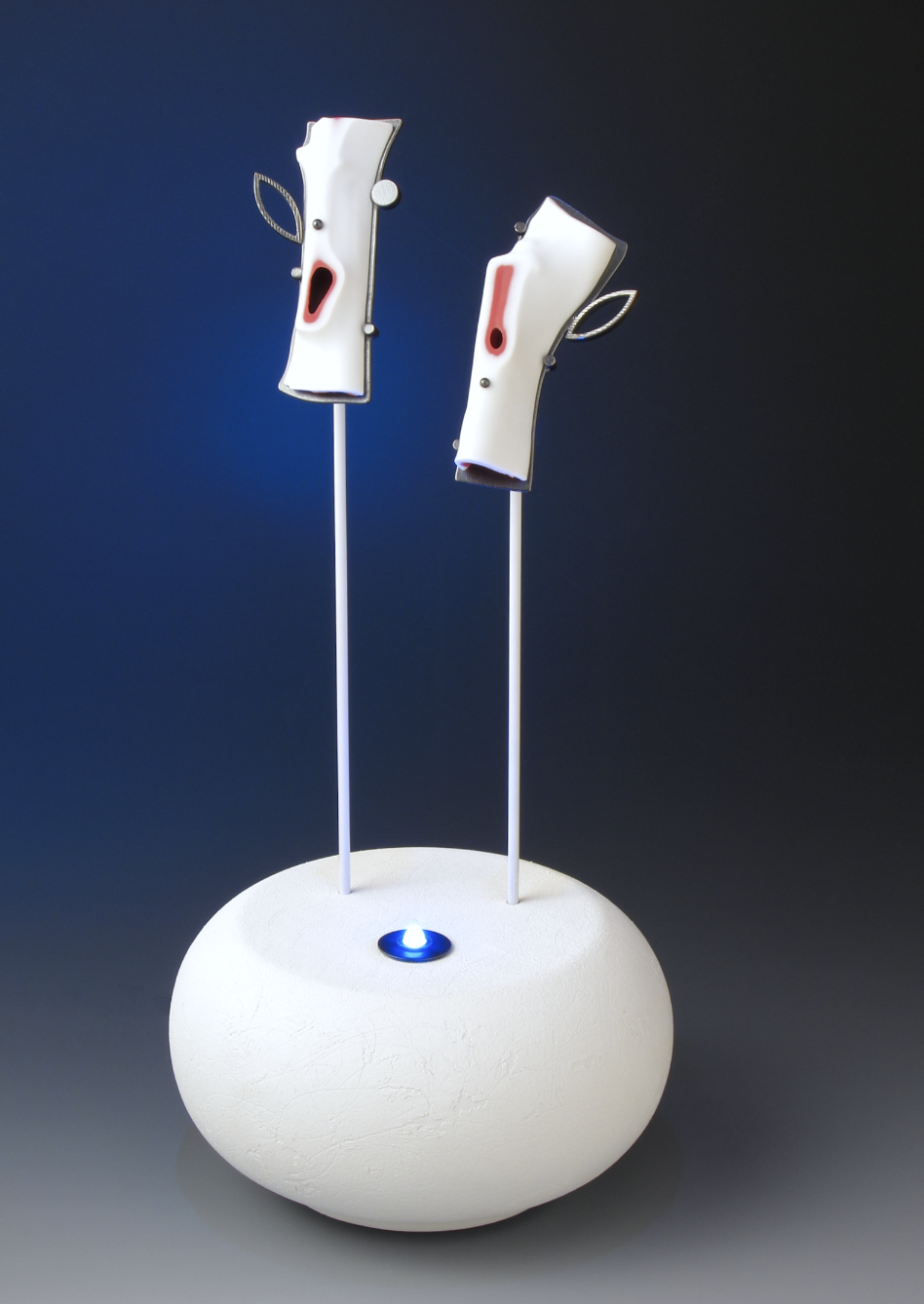
Paul Wm. Leathers, JDZ Fragment Brooch (Red Inside) #1 & #2 on illuminated stand, 2013. Oxidized Sterling silver with coloured porcelain, copper, steel, wood, paint, silicone, plastic, LED and transformer. 23 x 11 x 11 cm. COURTESY OF THE ARTIST.
Studio: How would you describe your approach to your medium? What made you choose it?
Paul Wm. Leathers: Introduced to metalsmithing in my late teens, my choice of the medium was both circumstantial and intuitive. Early training combined design thinking with technical skill, and I was drawn immediately to its precision and demands. Metal requires commitment, foresight, and a willingness to work through process in a disciplined way, while at the same time, offering extraordinary expressive range.I tend to think of the medium as a fluid site where traditions and innovation intersect, andam particularly interested in the dialogue between historical and emergent technologies. While lost wax casting, die forming, and surface enrichment remain foundational, I regularly integrate digital tools such as 3D printing, laser cutting, and photo-based processes. While this often leads to objects that sit between jewellery, sculpture, and artifact, it is not about novelty, but rather about extending the language of the medium—testing how new tools and processes can reveal different kinds of precision or complexity. Jewellery continues to interest me because of its intimacy and its relationship to the body. Even when the work scales outward into objects or installations, I remain attentive to that sense of proximity—how an object may be encountered, and how it carries meaning across contexts. Over time, what has sustained my choice is the medium’s capacity for expansion. It has allowed me to move laterally—into teaching, writing, research, and international engagement—while maintaining a coherent material core. In that sense, metalsmithing has been less a specialization and more a framework: a way of thinking through making, where curiosity, technical rigor, and responsiveness to material remain central.
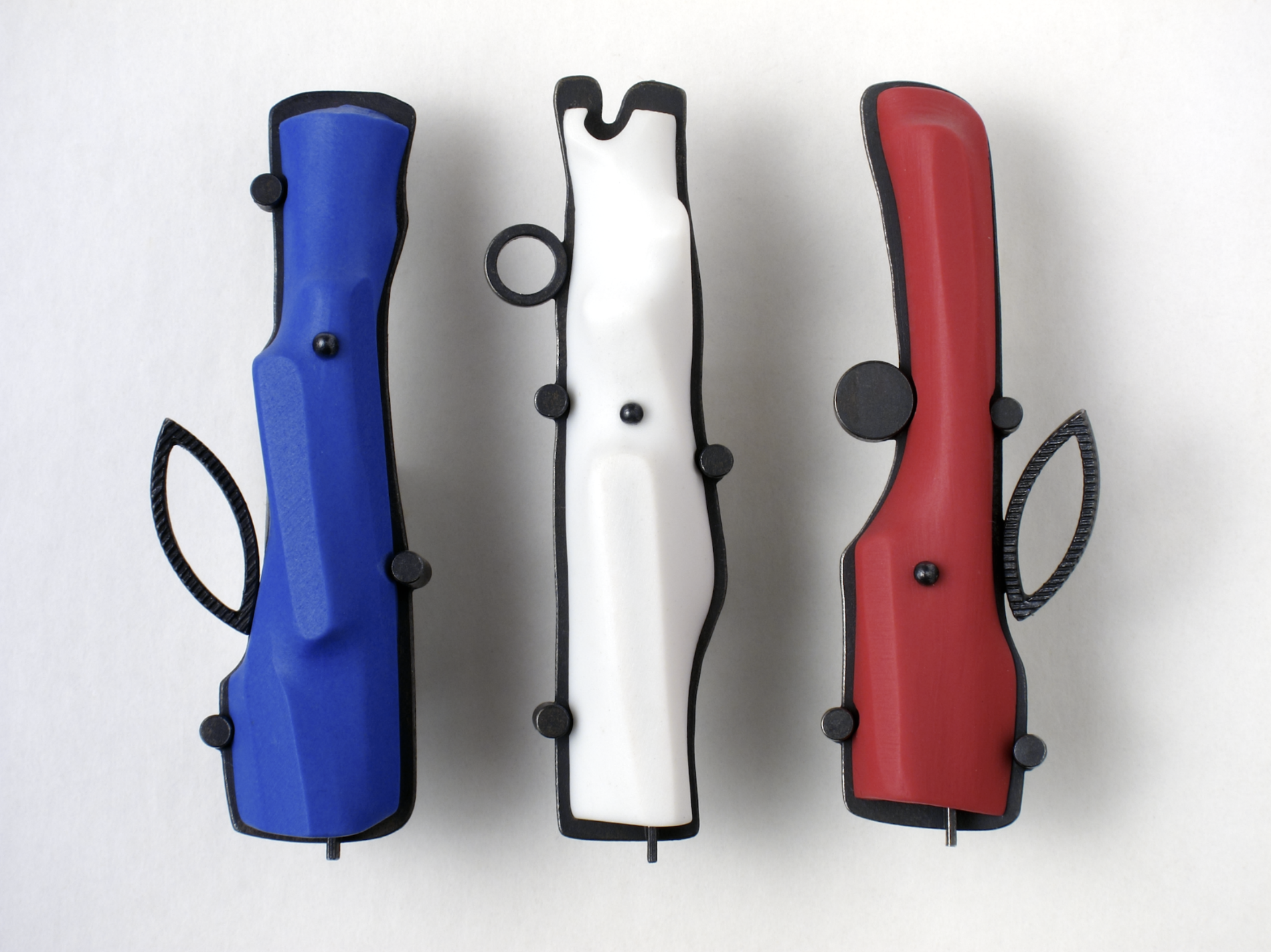
Paul Wm. Leathers, JDZ Fragment (Blue & White; The New Red) #1–#3, brooches, 2012. Oxidized Sterling silver with slip-cast coloured porcelains. 6 x 2 x 1.2 cm each. COURTESY OF THE ARTIST.
S: How would you describe yourself, personally and professionally?
PWL: I would describe myself as a designer/maker—someone grounded in material, process, and the discipline of sustained inquiry. My practice has always been driven by curiosity: about how materials behave, how techniques evolve, and how ideas develop. Exhibition, for me, is an extension of that process: a way to enter into dialogue with broader audiences, whether locally or internationally. I value those exchanges, particularly the opportunities to engage across disciplines and cultures, as they continually reshape how I understand my own work.Teaching and mentorship are important. Whether in formal academic settings, workshops, or informal studio contexts, I’m interested in equipping others with both technical fluency and a framework for critical reflection. The goal is not simply skill acquisition, but fostering independence, adaptability, and a deeper awareness of the craft. Personally, I’m committed to service. That has meant involvement in governance, peer assessment, and advocacy, helping to shape the conditions under which contemporary craft can evolve. I take that responsibility seriously, particularly the need to support emerging practitioners and to sustain meaningful standards of practice.I see myself as working at a nexus: between hand and machine, tradition and innovation, object and idea, studio practice and cultural exchange. That in-between space is where the making and the work stays alive.
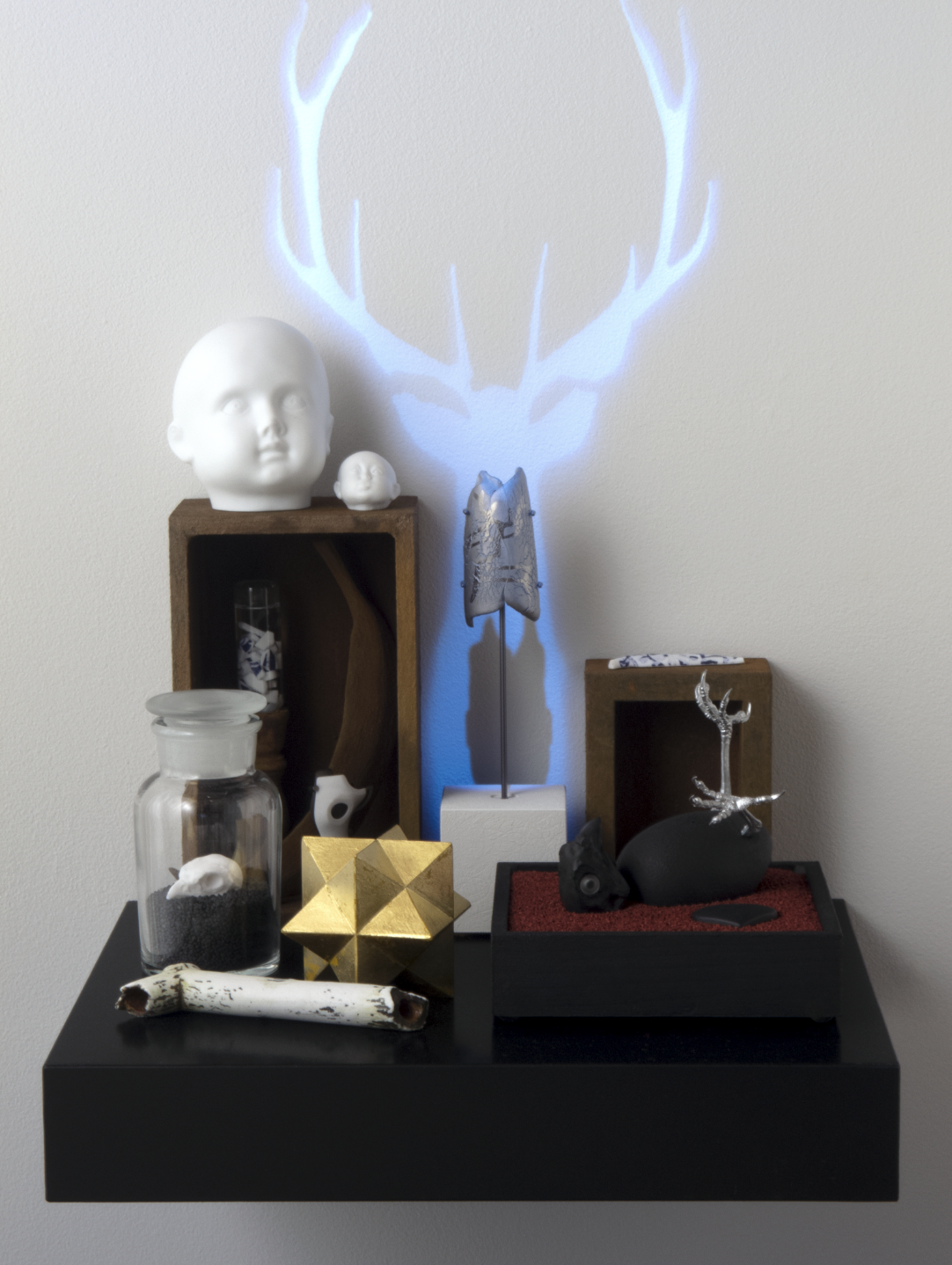
Paul Wm. Leathers, Cabinet, mysterious contents of, 304 (V.9.0), installation with removable brooch, 2003–2021. 24Kt. gold leaf, Sterling silver, porcelain, Hydrocal, glass, pewter, titanium PVD, water, powdered graphite, wood, MDF, paint and projected light effect, 30 x 26 x 26 cm. COURTESY OF THE ARTIST.
S: What inspires you?
PWL: I am inspired by the idea that objects can carry meaning beyond utility or adornment—that they can operate as sites of reflection, memory, and transformation. The brooch, the vessel, the small object: these forms hold an intimacy that allows for complex conversations about value, presence, and the human impulse to make. It is within that space—between the intimate and the expansive—that my work continues to find its direction. I am motivated by histories—of craft, of technique, of cultural exchange. Whether looking to ancient metal practices or the transmission of knowledge across continents, I see making as part of a much longer continuum. That dialogue, between bodies of knowledge as much as between materials, is a deep source of inspiration.Testing how distinct disciplines can converge into shared, hybrid forms that challenge conventional boundaries between craft, sculpture, and installation has opened my practice and expanded how material boundaries are understood. Collaboration, where the exchange itself becomes a generative force, has deepened this inquiry—especially my long-standing work with ceramic artist, Trudy Golley. Our shared investigations into hybrid processes and emergent technologies create a kind of friction that produces new forms—objects that could not exist within a single material language, particularly where materials assert agency through transformation. Residencies and teaching engagements in places like China and Australia have reinforced this, revealing both the specificity and universality of making cultures. The act of articulating process, of witnessing others encounter material for the first time—or re-encounter it differently—feeds back into my own studio thinking. There is a responsibility in that exchange, but also a renewal. These experiences continually reshape my understanding of what it means to work as a contemporary craftsperson in a global context.
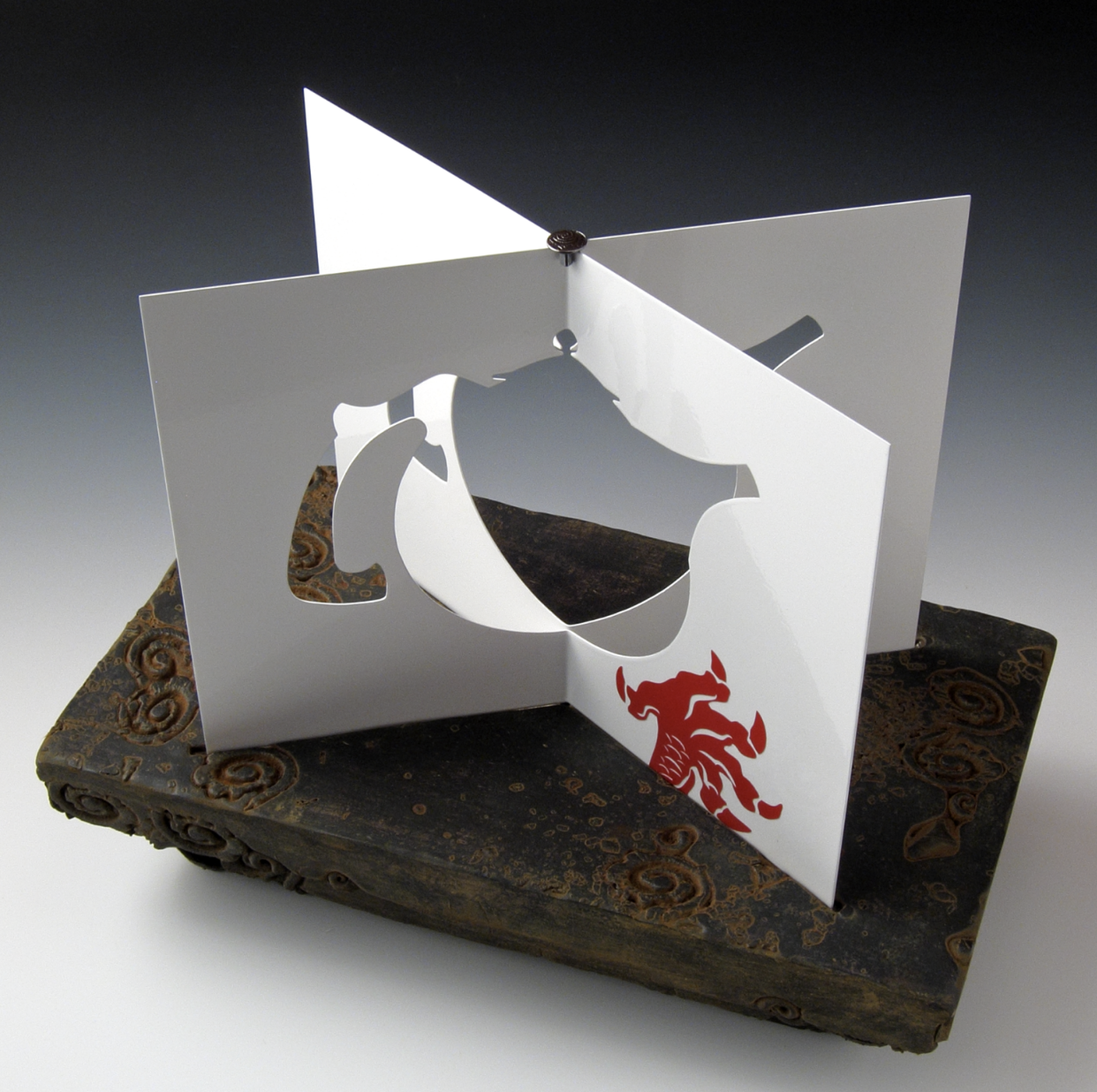
Paul Wm. Leathers, Dragon’s Pearl Teapot, 2012. Multi-fired glazed ceramic with rust finish, oxidised Sterling silver, powder coated aluminum and 3M Scotchlite™, 21.5 x 26 x 14.5 cm. Collaboration with ceramic artist, Trudy Golley. COURTESY OF THE ARTIST.
S: What do you see as your contribution to the field of your craft?
PWL: My contribution lies in advancing a practice within broader cultural, interdisciplinary, and international contexts.Through decades of teaching, leading workshops, and presenting lectures, I have emphasized the importance of technical fluency paired with critical inquiry—encouraging artists to understand not just how something is made, but why it matters. My focus on areas such as photo-documentation, design process, and professional practice has also aimed to equip artists with the tools necessary to sustain and articulate their work within an increasingly complex cultural landscape. Service has been another core aspect of my contribution. Through roles with the Royal Canadian Academy of Arts, Manitoba Crafts Council, Canada Council peer assessment, and various advisory and jury positions, I have participated in shaping the infrastructure that supports and advances the field. This work—often invisible—has been essential in advocating for standards, fostering opportunities, and contributing to the long-term health of the craft sector. Finally, my international engagement—through exhibitions, residencies, and teaching in Asia, Australia, Europe, and North America—has contributed to a broader dialogue around contemporary jewellery and craft. By positioning Canadian practice within a global context, I have sought to both represent and challenge the field, encouraging cross-cultural exchange and a more expansive understanding of what craft can be. Taken together, my contribution is not located in a single object or achievement, but in the cumulative effort to connect making, thinking, teaching, and community—advancing a field that is as intellectually vital as it is materially grounded.
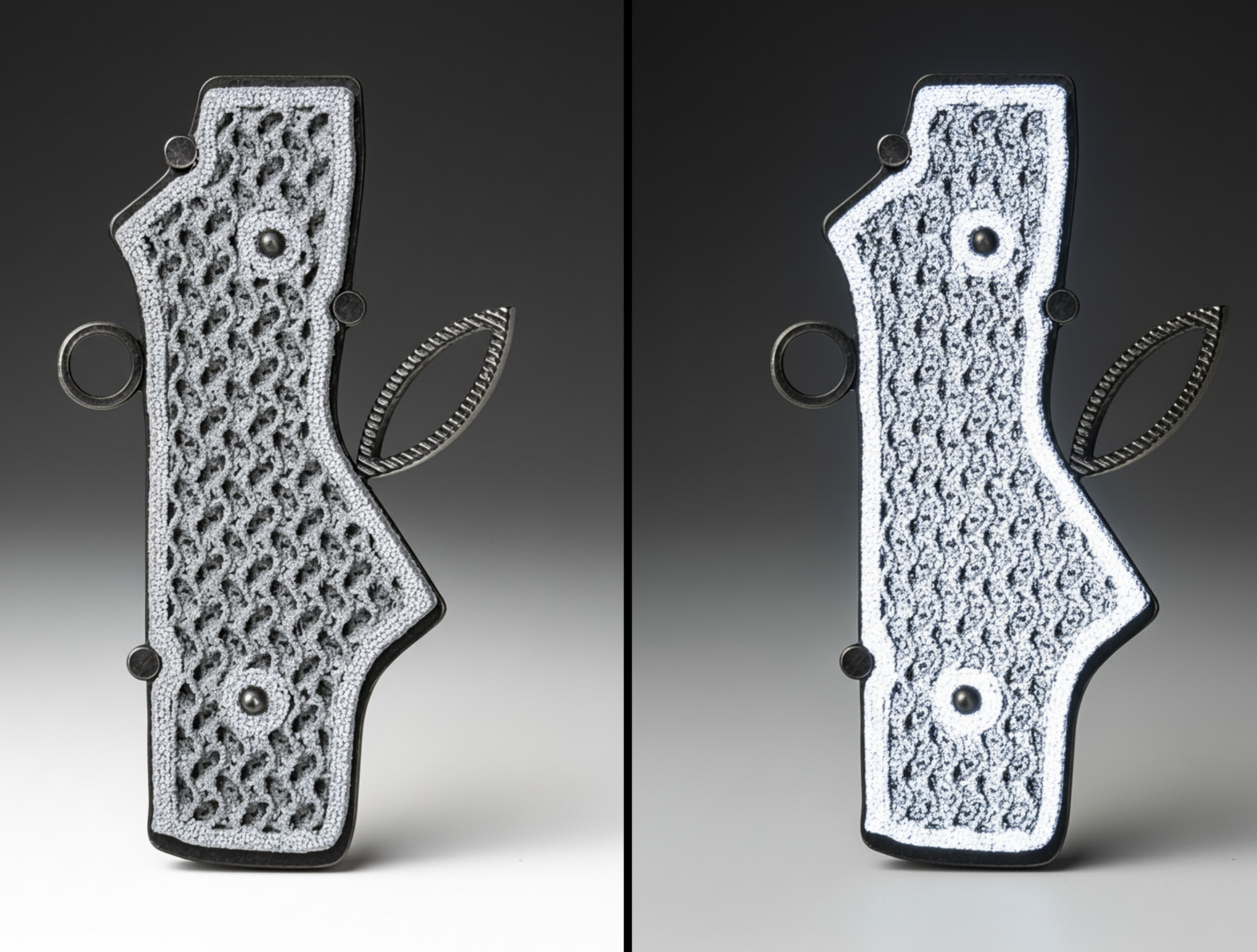
Paul Wm. Leathers, Phototaxis Brooch V.2.0, 2024. Oxidized Sterling silver, nickel silver, with 3D printed retroreflective filament (right image, ADOBE Firefly mod.), 5.7 x 3.4 x 1.0 cm. COURTESY OF THE ARTIST.
S: What wisdom do you want to impart to younger makers?
PWL: What I would offer is not so much a prescription as a framework for navigating a field that will not look the same as it did for me. Learn your materials deeply, but understand that material may now include digital systems. Skill still matters, but its definition is expanding. Develop your voice—visually, materially, and verbally. Being able to articulate your work clearly is important; it’s part of how your work lives in the world. Clarity is not simplification—it’s precision. Be deliberate about time. There is value in slow accumulation, in building a practice that has weight and continuity. Recognize that your conditions may demand different rhythms, and don’t mistake speed for relevance. Decide what kind of relationship you want to have with the field. Community matters, but it can take many forms. Understand that the field is shaped by participation, not just by production. And finally, the field will not be the same at the end as at the start of your journey; nor should it. Don’t replicate past models—build a practice that is viable, rigorous, and honest within your own context and moment.
Paul Wm. Leathers
instagram: @paulwleathers
website: www.alluvium.ca
This article was published in the Fall/Winter 2026-2027 issue of Studio Magazine.