

Lexus Award 2026 - Craftsperson of the Year
Craft exists as both a way of working and a way of seeing: beyond the possibilities of material exploration, it furnishes makers with alternative relations to object, land, body, and labour, renewing our vision of the world by offering a different lens. Traversing this terrain daily, craft artists weave through history, mediate the present, and envision new futures, remaining an ever-important connective tissue keeping people in tune with the world.
In pursuit of this mission, this year the Canadian Crafts Federation (CCF/FCMA) introduced a national craft award, sponsored by Lexus Canada: Craftsperson of the Year. This award has in mind craft artists working today whose profound innovations, whatever their medium, are impacting the world beyond the studio, changing or reinvigorating the cultural landscape of craft in Canada. Each nominee was put forth by members of the CCF/FCMA, who announced the shortlists in June 2026. Jennine Krauchi (Manitoba) and Julie Moon (Ontario) are in the running for Craftsperson of the Year; the recipient will receive a $10,000 CAD prize courtesy of Lexus Canada, a contribution that reflects Lexus’ commitment to innovation, artistic excellence, and the present and future of Canadian craft.
The Craftsperson of the Year Award recognizes artists who “have made lasting contributions to Canadian craft through dedication to material exploration, technical excellence, and artistic vision” — in sum, masters of their craft, a title well-applied to these two artists. I spoke with Jennine Krauchi and Julie Moon about their nominations, curious about what they’re working on and what electrifies them about contemporary craft.
Jennine Krauchi photographed by Indspire Awards.
Jennine Krauchi is an internationally recognized Métis artist and designer based in Winnipeg, known for her critical role in the revitalization and advancement of Métis beadwork. In her work, traditional Métis artistic practices — beadwork, quillwork and moccasin/mukluk making — interweave with contemporary, critical, and nuanced questions of identity, preservation, and enduring cultural strength.
Over the span of her 40-year career, Krauchi has left an indelible mark on Canadian craft. Her national accomplishments include commissions from the Canadian Museum of History, the Canadian Museum for Human Rights, the Manitoba Museum, and Parks Canada, among many others. In 2022, she was commissioned by the Royal Canadian Mint to design a commemorative silver coin honouring the Métis Nation.
But for Krauchi, being nominated as Craftsperson of the Year means more than individual recognition. The nomination acknowledges the continuum of Indigenous women and beadworkers who lived and made before her, and who have been perfecting this art form for a long time. "This is not just a nomination for me as a beadworker; it brings beadwork into a realm where it can be seen and acknowledged and taken seriously, as a craft but as an art form as well," she says; a noticeable shift from a dark time in Canadian history when beadwork was something to be hidden, not celebrated. That all has changed. Instead, Krauchi has been invited by major institutions to preserve, restore or replicate Indigenous cultural objects, and has facilitated numerous beading workshops and residencies across Canada and Europe, ensuring that the practice and the beauty of Métis culture will endure. This resonant impact earned her both the Manitoba Arts Council’s Award of Distinction and the Winnipeg Arts Council’s Making a Difference Award in 2024.
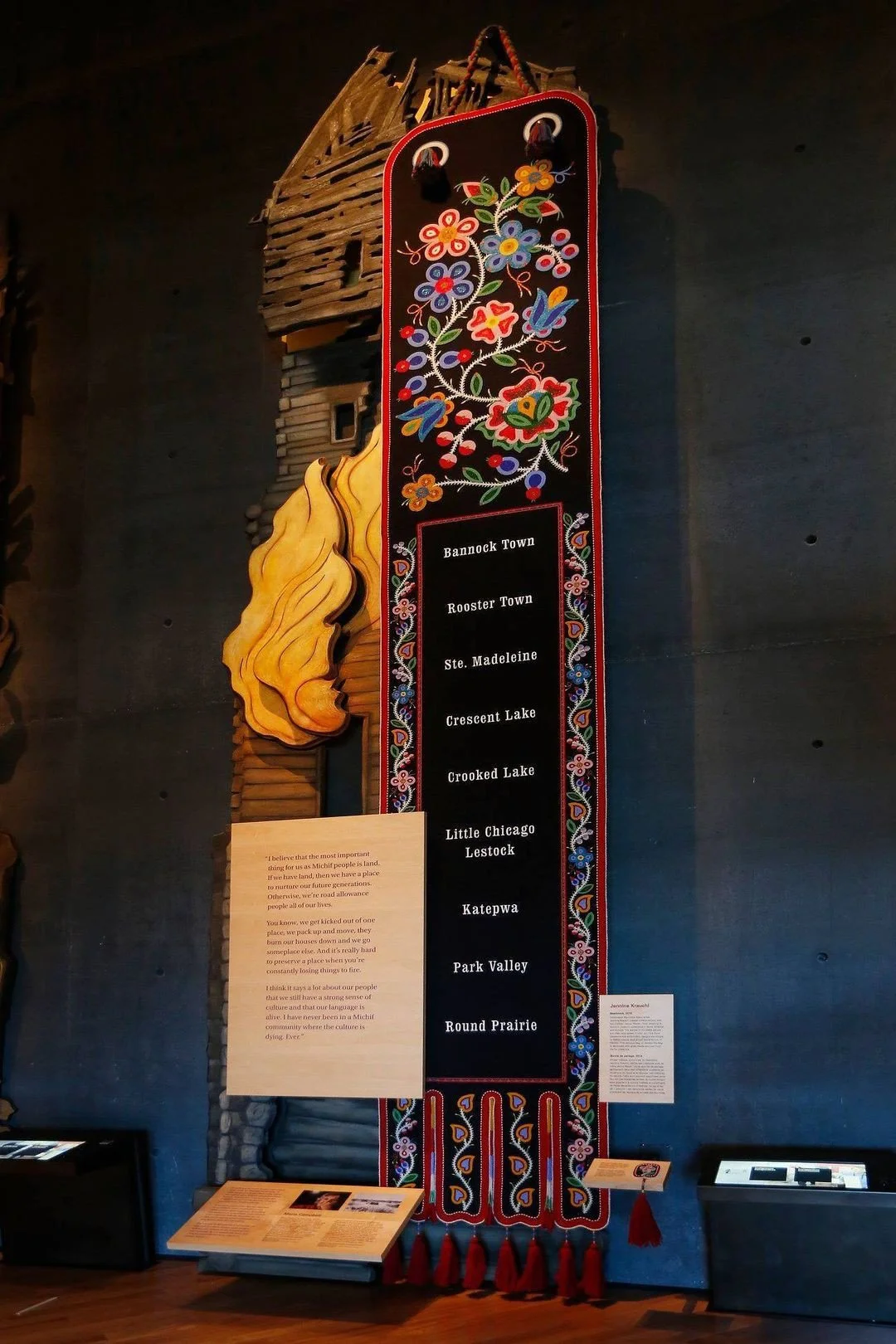
Jennine Krauchi, Octopus Bag, 2013. Beadwork on felt. 700 x 150 cm. Photo courtesy of the Canadian Museum of Human Rights.
Thus, Krauchi sees a radiant future for beadworkers, especially as she witnesses the passion and artistry of the incoming generation. “I think what is really exciting for me right now is seeing the younger generation of beadworkers and artists and craftspersons carrying on our Indigenous culture through their work,” she says. “There is a beadworking resurgence now and our work is being taken very seriously, like it never has before.”
For Krauchi, the genuine acknowledgement of this award – not mere words but a true enthusiasm that carries real material benefits for Indigenous craftspeople – is an assurance that craft is and always will be a necessary force. She thanks everyone who nominated her. “I am very hopeful; not only for my Métis culture, but for others also. This resurgence of craft (and art) is now a part of so many people’s lives, and I think that this is something our collective souls need at the moment.”
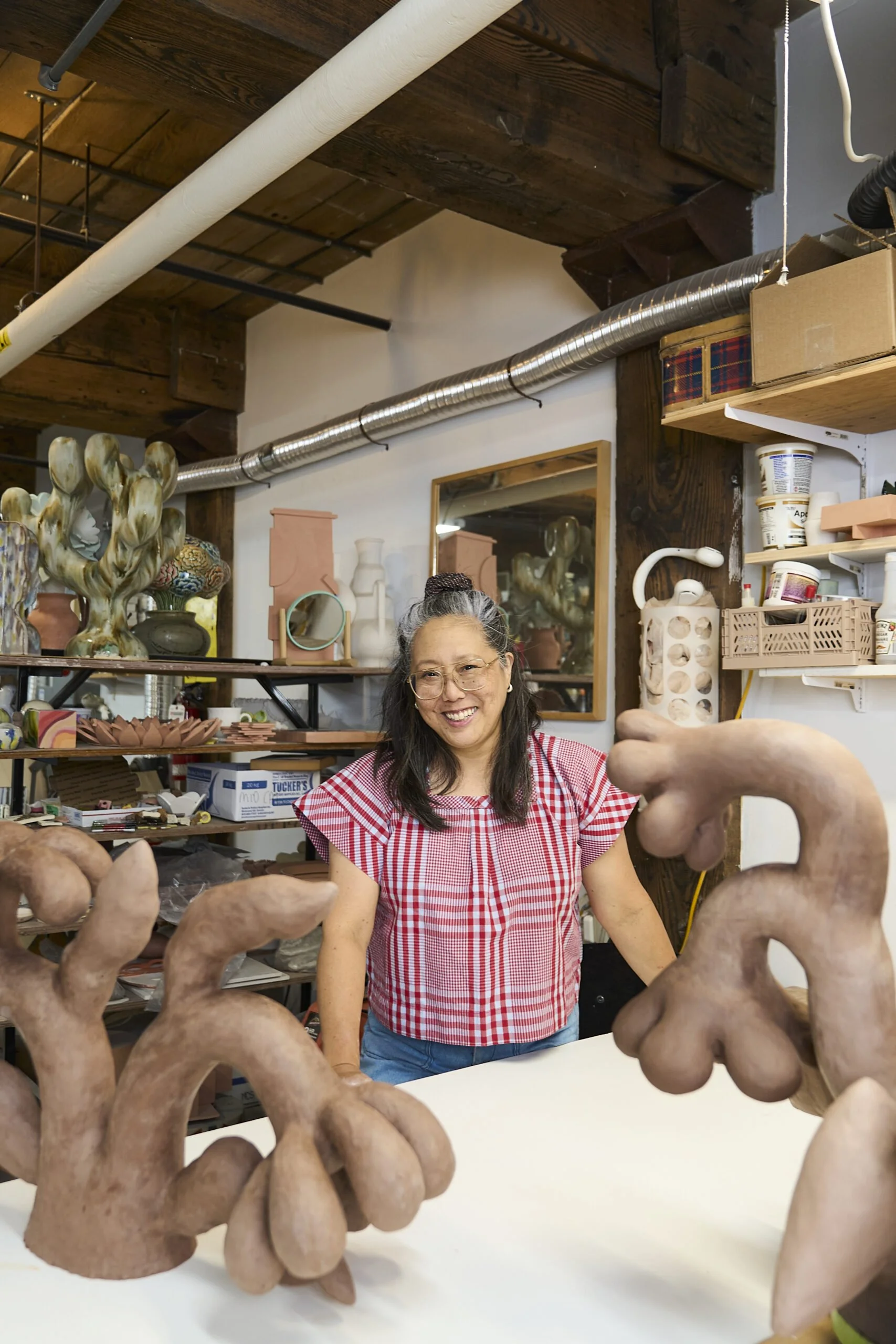
Julie Moon photographed by May Truong.
While Krauchi carries forward the legacy of beadwork, Julie Moon reimagines the world of contemporary ceramics. Based in Toronto, Moon is considered legendary for her innovative approach to clay, developing techniques to create whimsical pieces that bridge nature, dream, and culture, and with great prowess play with form, surface, texture and colour. Formerly a garment worker studying fashion technology, her practice often weaves between ceramics, textiles, sculpture, and design.
For Moon, the nomination came with an unexpected validation. As an artist who began in a variety of other mediums — pottery, accessories, design, as well as teaching and fundraising — she feels that her breadth and willingness to evolve is being seen, that those values "can be their own form of mastery."
Moon’s work has been exhibited widely in Canada and the United States, including at the Gardiner Museum, The Clay Studio Philadelphia, Cooper Cole Gallery, and ART Toronto. She is particularly honoured by being recognized within a Canadian community of makers, institutions, and standards that have shaped her practice. For Moon, it symbolizes how far she’s come and allows her to understand her own practice better – she describes it as affirming her multidisciplinarity and material fluidity as strengths to be supported. "More than anything," she adds, "this nomination is a moment to consider how far the work has travelled from where it started, and to feel that the distance was worthwhile."
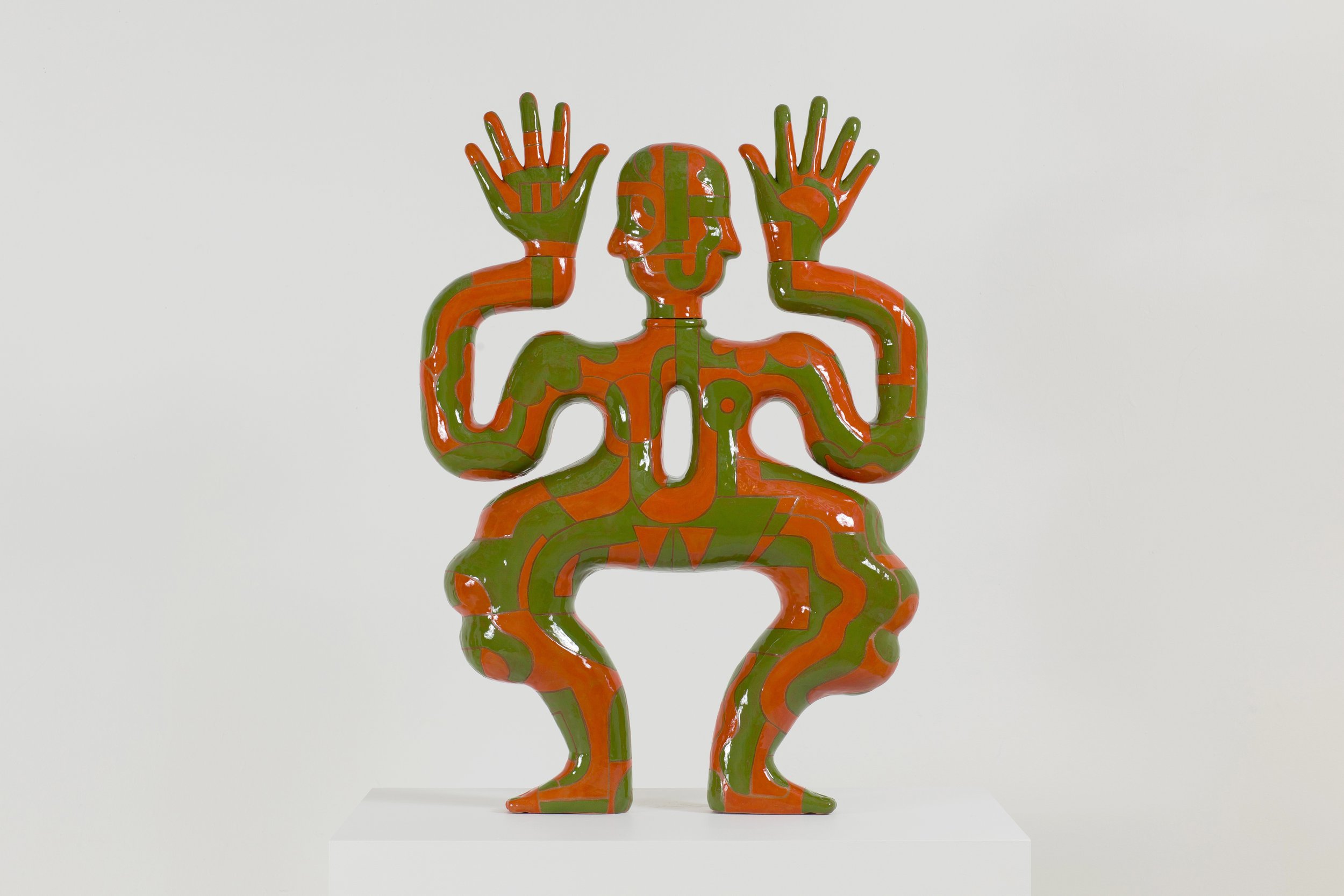
Julie Moon, Universal Human, 2020. Stoneware, glaze. 31”h x 21.5”w x 5.5” Photo: May Truong.
Alongside her exhibition career, Moon is a dedicated educator and mentor and has participated in residencies at the Archie Bray Foundation, Anderson Ranch Art Center, and the Center for Ceramics Berlin; she also has a residency scheduled this summer at MenLo Studio in Jingdezhen, China. She is moved by how much community strengthens and motivates her practice. “Early on, I understood craft as largely solitary — material, maker, object. That understanding has shifted. Canada's craft community is genuinely active, and the students and peers around me have become as central to the work as any technique.” On top of it all, she continues to be a fierce advocate for her students and for improved craft sector infrastructure.
As for the future, Moon is heartened by the public gravitation towards craft in an increasingly technocratic world: a beautiful and hopeful shift. “People are craving real things — real experiences that connect them to material, and to their own bodies,” she observes. “Craft has the ability to make us feel human in ways that are increasingly rare. It connects us to histories that predate the screens we live through, and it makes a quiet but important argument for the utility of beauty and expression — that these aren't luxuries, but necessities.
I sense a broader shift away from valuing only what is practical or efficient, toward a deeper appreciation for what is meaningful, even when it can't be measured or explained in purely functional terms.”
Check out the interviews with the Emerging Craftsperson nominees here.