
Anna Torma: An Intelligent Hand
Anna Torma hand-stitches radical textiles that draw on archetypal forms of women’s work and women’s pleasures: large pictures of monsters, outlandish sexual exploits, rich ripe flowers and foliage, children at play.
The New Brunswick-based artist has dedicated her professional life to an astonishing studio practice that has emerged from an early, deep understanding of embroidery traditions and their place in global, contemporary visual culture. She has established an intensely personal approach to the storytelling capacity of textiles with stitched narratives that connect through technique, materials and imagery to Hungary, her country of birth which she emigrated from in 1988. There, she completed a degree in Textile Art and Design from the Hungarian University of Fine Arts in Budapest in 1979. Upon moving to Canada, she developed an ambitious, steadfast record of increasingly notable participation in art, craft and design systems of juried competitions, arts awards, workshops, residencies, group and solo exhibitions.
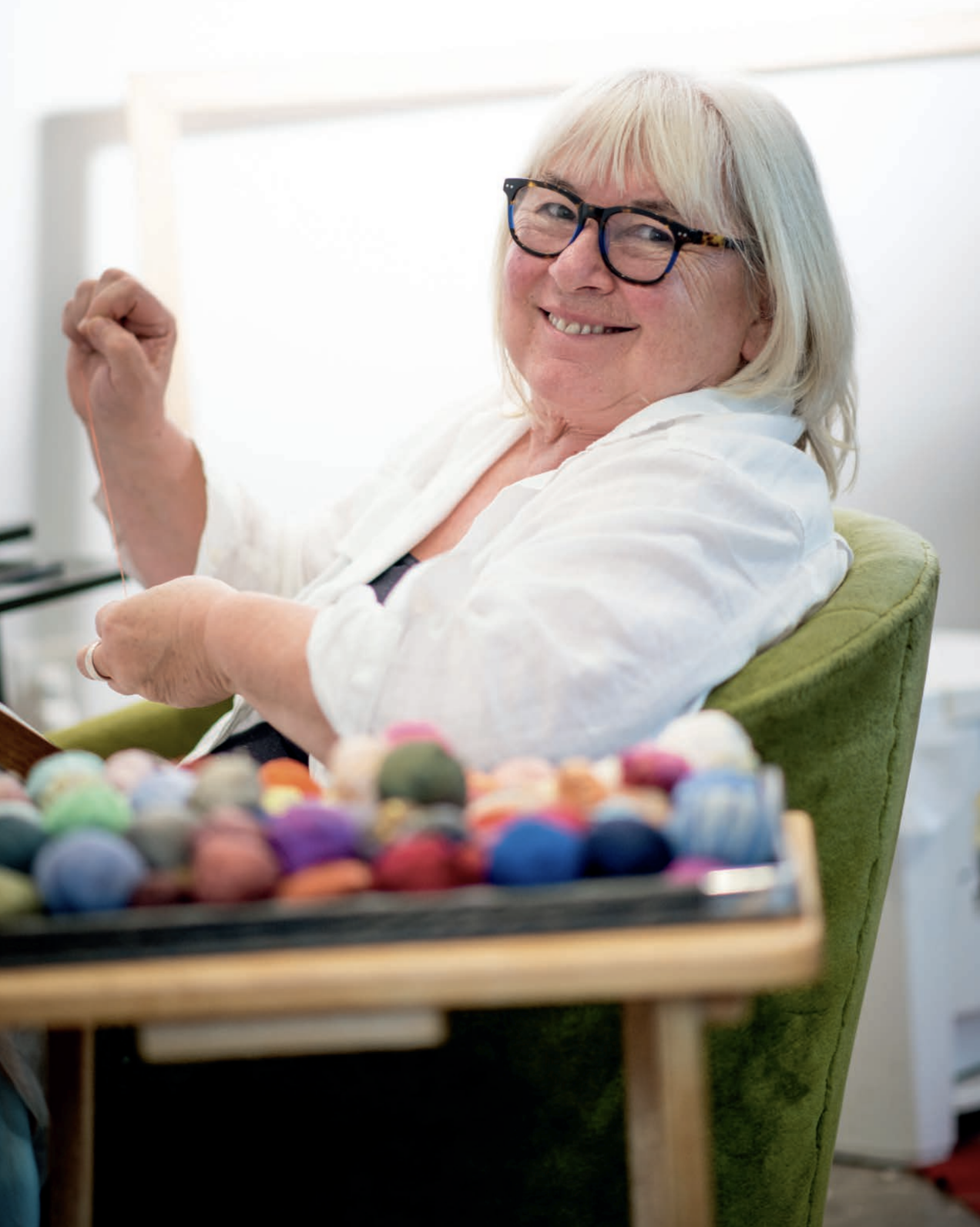
Anna Torma Portrait, 2019. COURTESY OF THE ARTIST.
Torma’s early professional work exudes unmistakable and deliberate stylistic and material references to regional and family embroidery traditions. As a child, she learned needle crafts from her mother and both grandmothers. This has evolved to shape an interest in collecting a wide range of textiles that are metaphorically and physically folded into her explorations of identity and belonging. Many of these treasured fragments have deteriorated beyond repair, yet they continue to exemplify gifts of affection, rites of passage and whimsical tokens in their cycles of decay and renewal.
Over Torma’s 40-year career, new images, colours, patterns, ideas and materials have been pouring out of her studio, toppling over one another to shape compositions that poke into the dark and not-so-dark corners of the human condition. Frenetic is a word that describes the energy of her practice; focus and calm are other truthful attributes: Torma and her artwork are a dizzying blend of both. It takes hours, days, weeks to complete a piece—relentless flurries of activity where concepts are broken and mended, technical solutions formed and reformed—followed eventually by precise cutting, piecing and stitching.
Torma’s work is unabashedly large in scale, an absolute requirement to contain her bold gestural sweeps of stitchery, appliqué and brushed inks and washes. Irregularities in expressive, hand-sewn lines bring out the innate, natural qualities of cloth, celebrating her undulating stitches and uneven edges: these qualities are equivalent to a ceramicist’s controlled yet idiosyncratic glaze, or a metal worker’s process of developing an erratic patina. Torma sources her materials from all over the world: linen, cotton, silk, sewing thread, floss and found materials are selected for their distinct physical qualities as well as cultural references—from pop culture to Hungarian red embroidered aprons and reclaimed thrift shop items. Torma has amassed an archive of material that is her palette, her source of texture, pattern and image.
Torma travels in order to familiarize herself with historic textiles that inform her compositions, techniques and material choices. Some of her fabrics and threads are hand dyed with synthetic or natural colourants, others are dyed commercially. As part of her planning, she makes drawings and notations onto paper patterns, jots into sketchbooks and stitches directly into cloth with needle and thread.
Gemey Kelly, Director Emerita at the Owens Art Gallery in Sackville, New Brunswick offers her insights:
“Anna Torma’s subject matter reflects an interest in human life in all its aspects, evoking themes of connectedness through myth and storytelling, the representation of speech and language, and cultural diversity. Her art truly opens up in joyful ways a dialogue about concepts of community, immigration, aging, loss and difference. Her approach to craftsmanship is significant. She valorizes the controlled irregularity arising from the tension when the cloth and the threaded needle interact with the hand.”
Torma herself notes that "…small imperfections with the edges and lines assure the viewer that the pieces are true for themselves, contemporary, manifested on fabric, sewed by thread, put together with an intelligent hand—the most important things that they must suggest are passion, freshness and a new discovery every time for a viewer.”
Canadian multidisciplinary artist Barbara Klunder has spoken about the impact Torma’s work has had on her own studio practice:
“It’s the scale. Huge pieces of fabric crowded with colourful images, displayed like paintings, but all embroidered. Hung in the air, or on the wall. The originality of that decision alone is what makes Anna Torma an important artist. Add to that the way she chooses to channel her memories, throw in frightening mythical creatures, or stitch sexualized images as well as words, quotes, numbers and typography: this is a totally new frontier.”
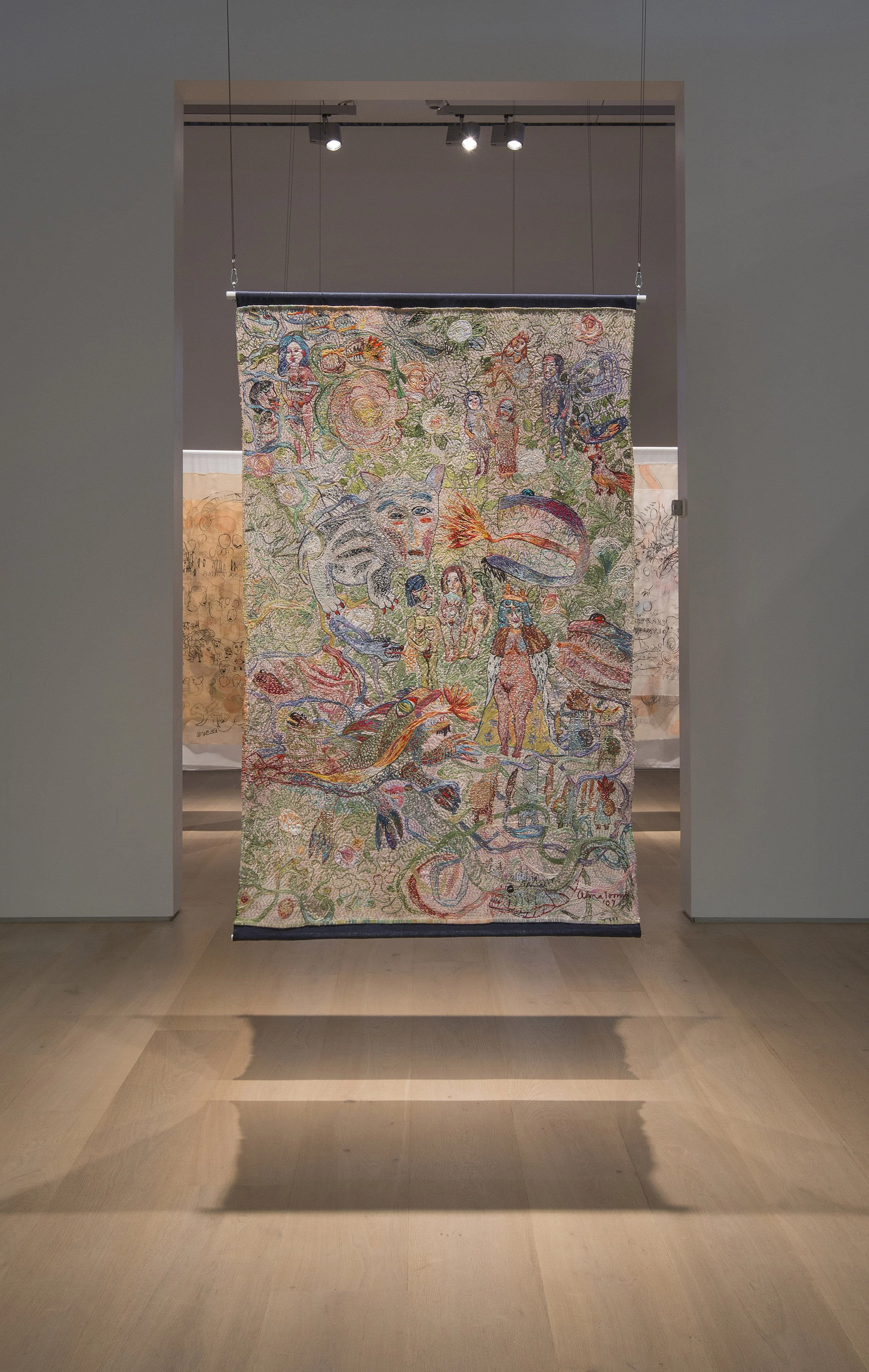
Anna Torma, Permanent Danger (front detail at Esker Foundation), 2018. Hand embroidery and reverse applique on linen, silk thread and double-sided work, 160 x 125 cm. Photo: John Dean. COURTESY OF ESKER FOUNDATION.
An example of Torma’s work that embodies the tension between structure and surface that defines the innate dimensionality of cloth is Permanent Danger (2017), a double-sided embroidery. Masterful stitches penetrate three layers of fabric and the artwork’s suspension in space reinforces the depths of the surfaces and the cloth's sculptural attributes. In it, life’s perils abound. Torma’s deep need to protect others from unspeakable threats from the natural world, political discord and humankind’s underbelly is palpable. Here, she reveals her anxieties about an unknown hostile presence, articulated from a point of view that values handcrafted textiles as integral to a family’s ecology of mutual care.
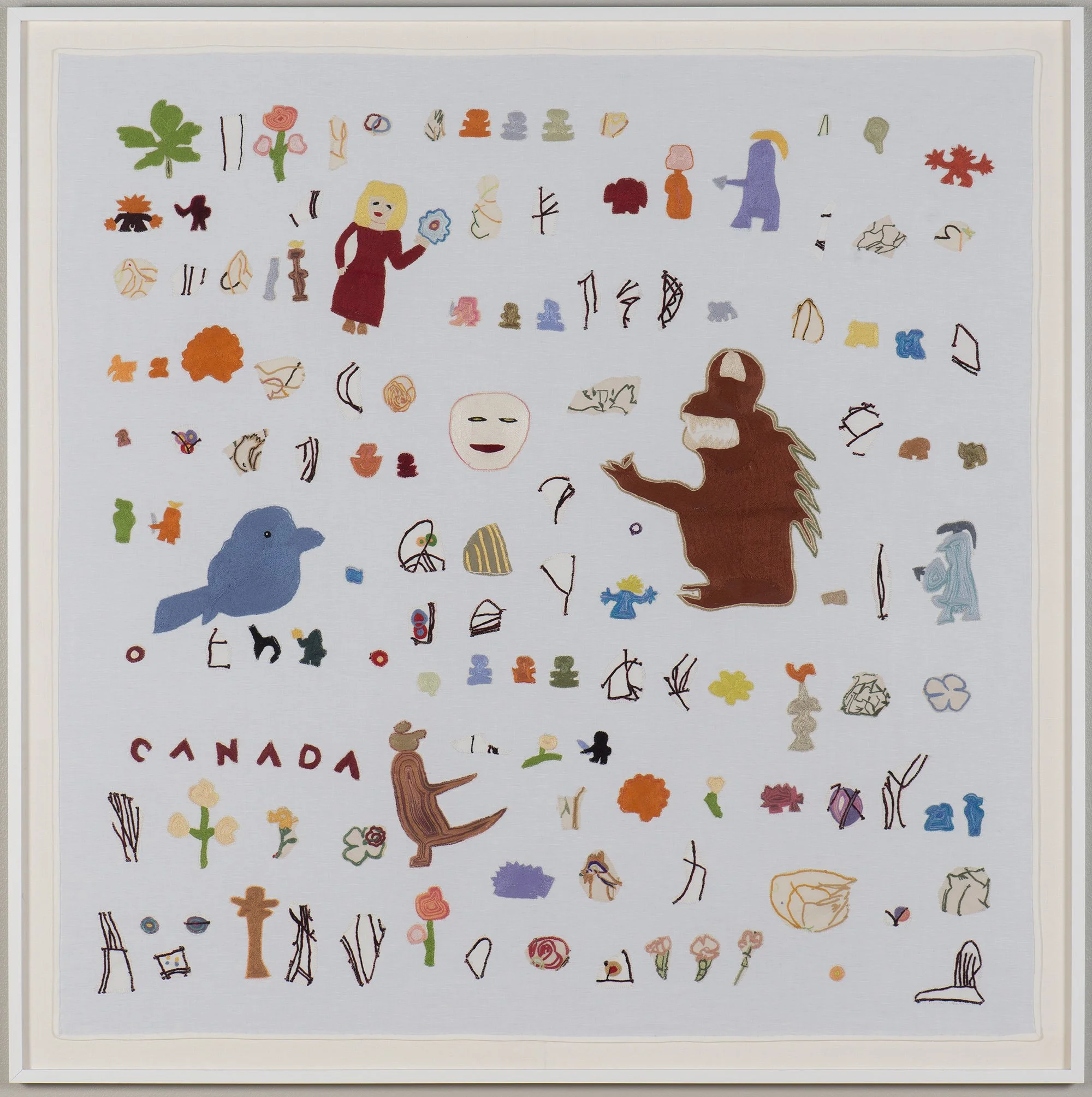
Anna Torma, Abandoned Details 3, 2018. Hand embroidery and collage on linen and silk thread, 143 x 143 cm. COURTESY OF ANNA TORMA
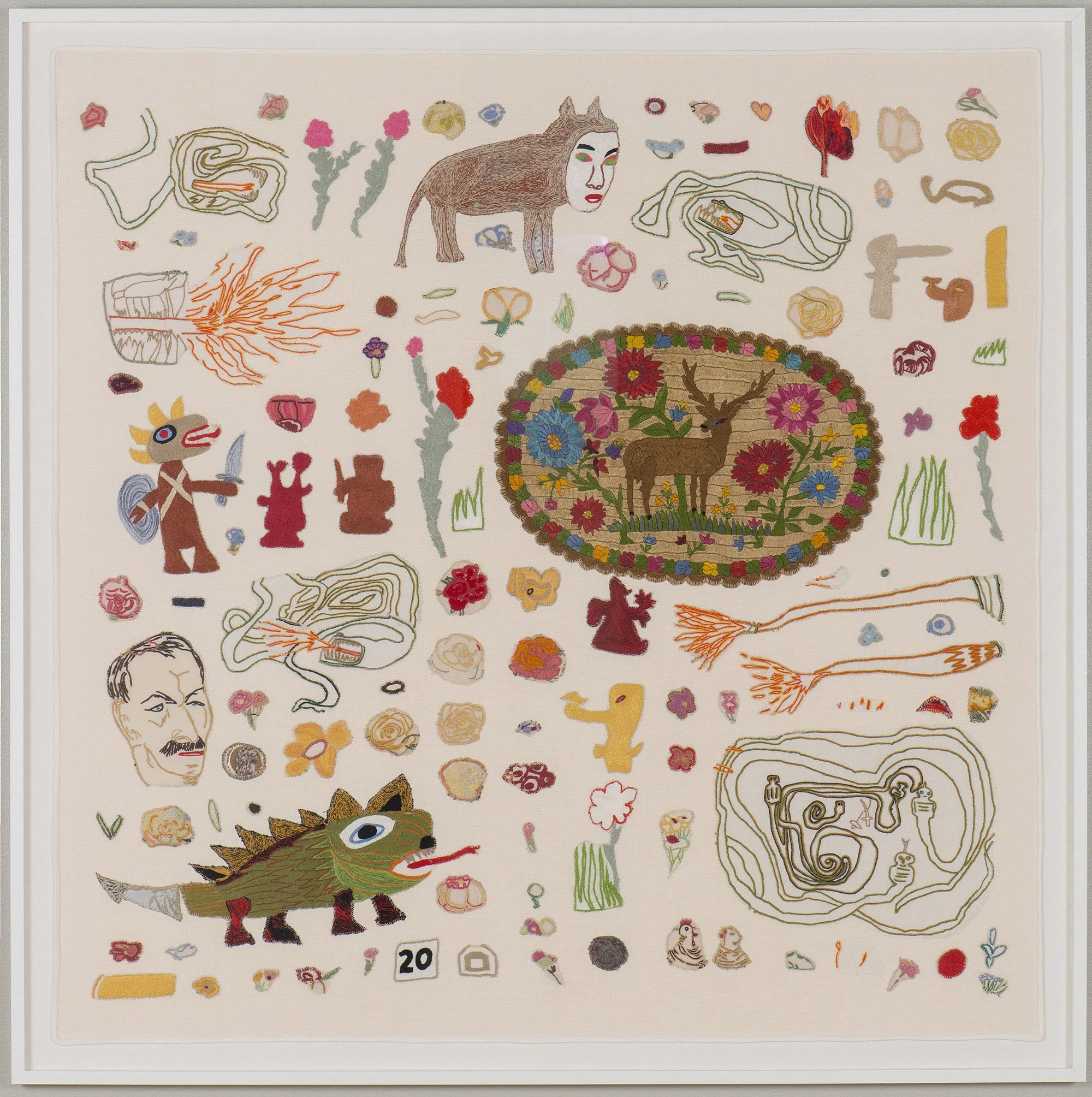
Anna Torma, Abandoned Details 1, 2018. Hand embroidery and collage on linen and silk thread, 143 x 143 cm. COURTESY OF ANNA TORMA
Shauna Thompson, Curator at the Esker Foundation in Calgary, curated Anna Torma’s 2018 exhibition, titled Book of Abandoned Details. She speaks to the artist’s work in the context of her long career:
“Anna Torma’s extraordinary work is part of a vibrant contemporary practice that is both connected to a deep Hungarian textile tradition and the radical feminist avant-garde movements of the 1960s and 70s, which reclaimed craft and fibre-based work as urgent and political fine art practices.”
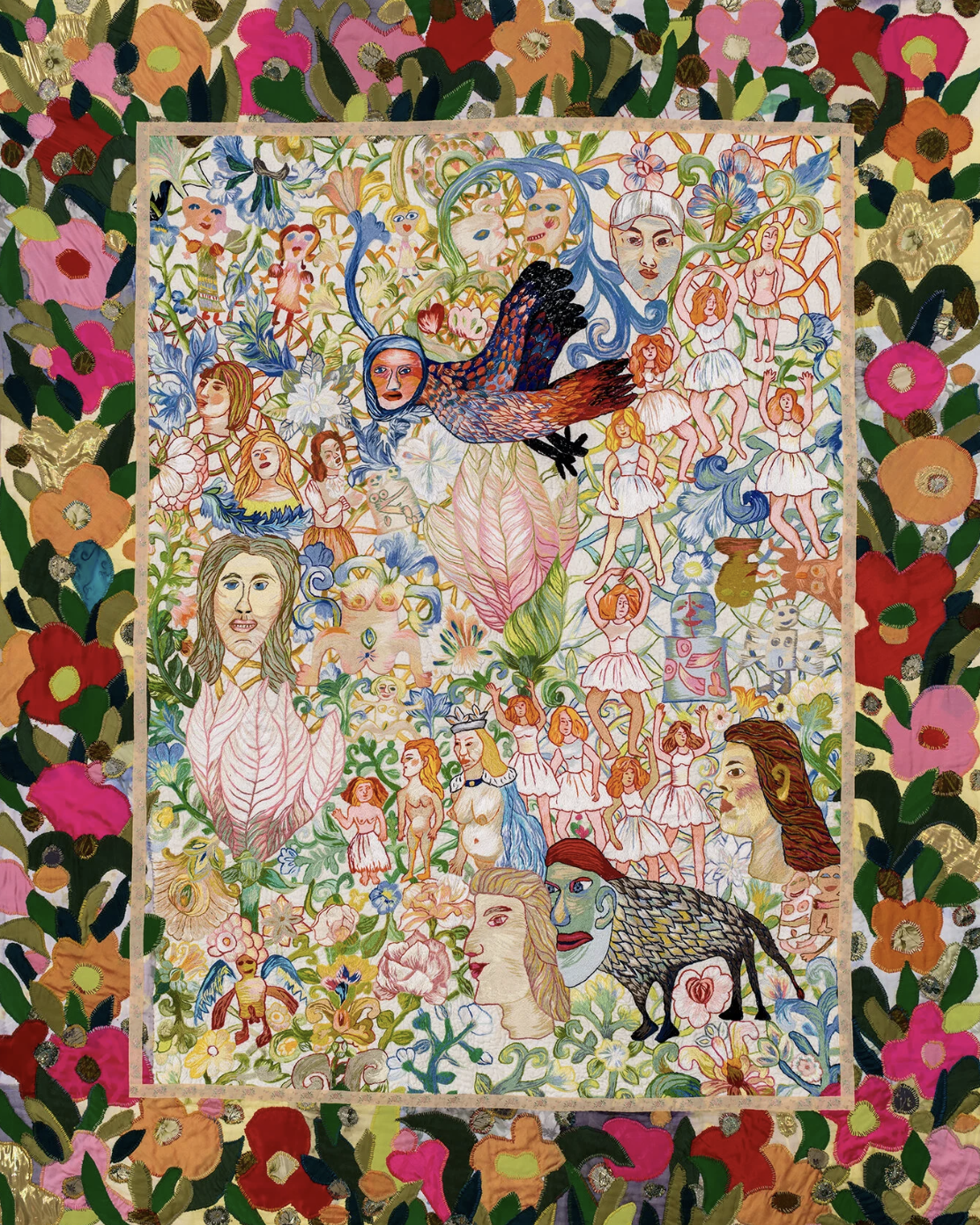
Anna Torma, Party with Dionysos, 2016. Hand embroidered collage on linen fabric, cotton thread, silk collage border, 185 x 150cm, Collection of Patrick Cady / Musée d’Art Contemporain Singulier, Photo: Guy L’Heureux
Party with Dionysos (2011) is titled after the ancient Greco-Roman god Dionysos, who is associated with lust for joy and ecstatic behaviour. Torma often extrapolates from long-standing myths and teachings, and in this piece, her flirtatious relationship with materiality and excess supports a bawdy chorus of animal, human and plant life. The scene is set: Torma upends cloth’s role as a veil of idealized modesty and feminine decorum to destabilize fixed ideas of conventional feminine behaviour.
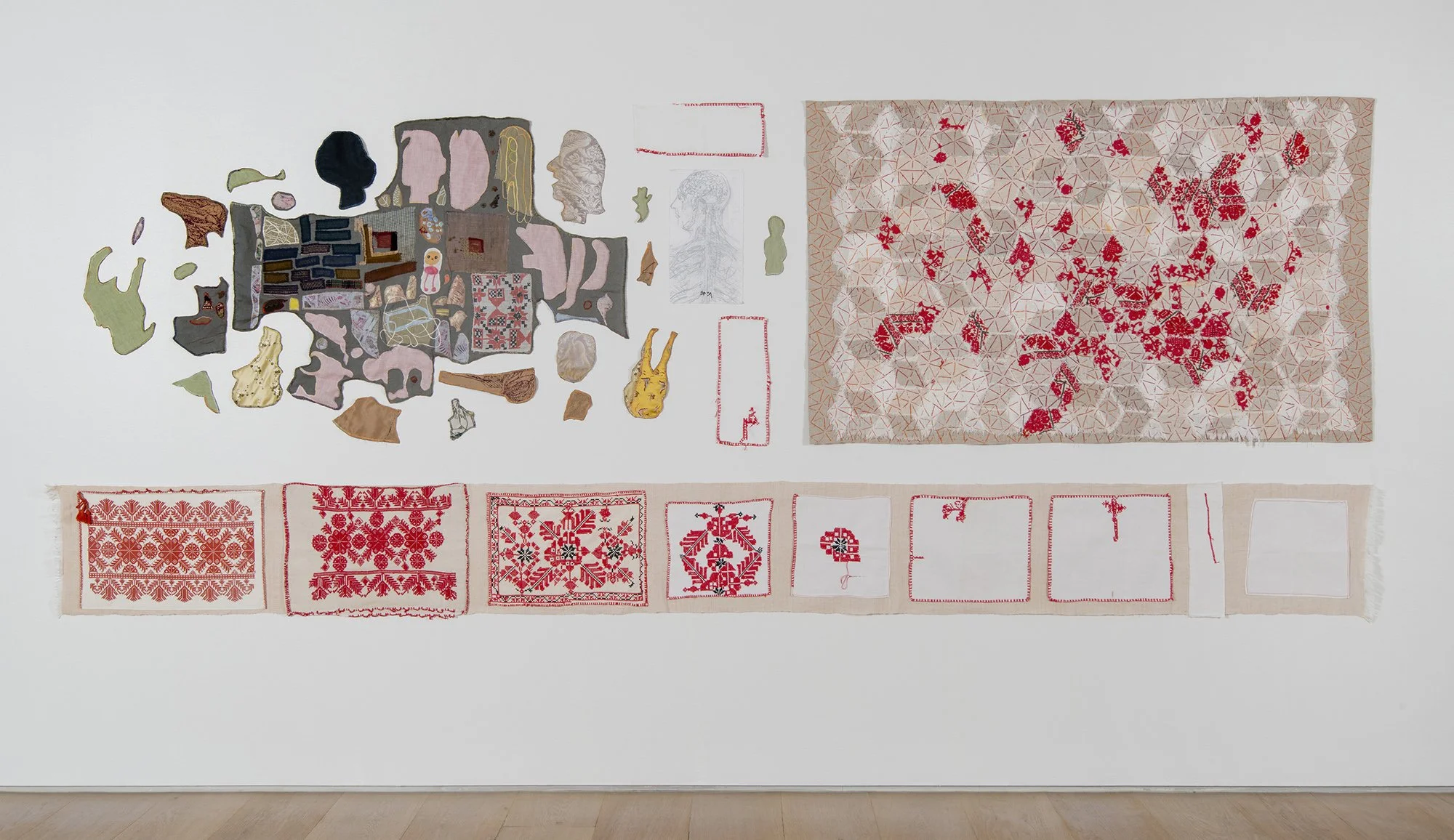
Anna Torma, Red Fragments, 2017. Assemblage of found folk art, own hand embroidered and quilted works in installation form, 210 x 500 cm. Photo: John Dean. COURTESY OF ESKER FOUNDATION.
Red Fragments (2017) is an example of Torma’s nimble approach to artmaking, both conceptually and materially. A portrait of sorts, it documents her relationship with her mother-in-law, who had a stroke that deprived her of the capacity to create her embroideries. The series of increasingly diminished traditional redwork embroideries is a sweeping installation that integrates excerpted sections of Torma’s own textiles made upon her arrival in Canada in the late 1980s. In an act of empathy and compassion, Torma shares this personal experience that connects the power of cultural identity to that of personal identity.
Torma draws upon life-changing experiences of emigration and conflicting responses to concepts of national identity, alongside a passion for documenting family and domestic life as an act of humility, love and humour. In her newest body of work, she includes a reference to the legendary Bayeux Tapestry, an 11th-century embroidery that commemorates William of Normandy’s conquest of England in 1066. The tapestry, both a work of art and an historical document, depicts violent and destructive events of war alongside traces of private lives – themes Torma explores with increasing regularity. Her congested surfaces are studies of the human body, erotic energy and fantastic creatures; they are places of memory and of imagination. And they are expressions of the joyous act of making by hand and coming to terms with the world through art.
This article was published in the Spring/Summer 2020 issue of Studio Magazine.